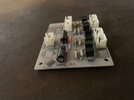
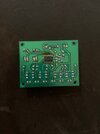
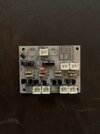
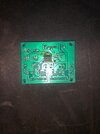
Circuit from "Watch Winder" doesn't turn on the motors.

KetchupSeedHD

Apr 25, 2023
11
Joined
Apr 25, 2023
Messages
11
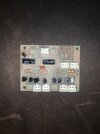
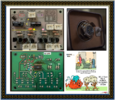
I have a small circuit that should turn on four 3V motors. I was given it to troubleshoot but using the tools I have I could not figure out what is wrong with it. I could not find anything online to help either. I put power to the board (3V-9V) and the output (where the motor should be connected) only receives some mV.
I tested the transistors on the board they all seem to be good with the basic test (Diode test on multimeter) (0.7V drop).
The traces look fine to the naked eye.
The resistors are all reading fine and none look burnt/discolored.
It has 2 47uF capacitors, I tried testing those but didn't get the 47uF and I am assuming it's because it's in the circuit.
The transistors on it are (S8550 and S8050).
The motors work when connected straight to power adapter I have.

I got the board the way it looks in the photos.
 

Attachments

  • WhatsApp Image 2023-04-25 at 1.21.00 PM (1).jpeg
    WhatsApp Image 2023-04-25 at 1.21.00 PM (1).jpeg
    176.5 KB · Views: 17
  • WhatsApp Image 2023-04-25 at 1.21.00 PM.jpeg
    WhatsApp Image 2023-04-25 at 1.21.00 PM.jpeg
    231.1 KB · Views: 15
  • WhatsApp Image 2023-04-25 at 1.20.59 PM (1).jpeg
    WhatsApp Image 2023-04-25 at 1.20.59 PM (1).jpeg
    214.2 KB · Views: 15
  • WhatsApp Image 2023-04-25 at 1.20.59 PM.jpeg
    WhatsApp Image 2023-04-25 at 1.20.59 PM.jpeg
    369.7 KB · Views: 15
  • WhatsApp Image 2023-04-25 at 1.20.58 PM.jpeg
    WhatsApp Image 2023-04-25 at 1.20.58 PM.jpeg
    447.2 KB · Views: 13

charly2choo

Apr 25, 2023
5
Joined
Apr 25, 2023
Messages
5
Hi! Have you tested the transistors in-circuit? I mean while you've tested the transistors with a diode test on a multimeter, it might be worth checking them in-circuit to see if they are functioning properly. Transistors can sometimes fail when under load, so testing them in-circuit could give you a more accurate result)
 

kellys_eye

Jun 25, 2010
6,512
Joined
Jun 25, 2010
Messages
6,512
What type is the integrated circuit? PIC perhaps? There is no onboard voltage regulation so that chip had better have a wide power acceptance range.....

Do you have the schematic? It woould be unusual for ALL the transitors to fail so the driver chip MUST be the issue.
 

Bluejets

Oct 5, 2014
7,374
Joined
Oct 5, 2014
Messages
7,374
I put power to the board (3V-9V) and the output (where the motor should be connected) only receives some mV.
Sounds awfully like the transistors are open collector........possibly motors require their own supply with common ground.
 

KetchupSeedHD

Apr 25, 2023
11
Joined
Apr 25, 2023
Messages
11
What type is the integrated circuit? PIC perhaps? There is no onboard voltage regulation so that chip had better have a wide power acceptance range.....

Do you have the schematic? It woould be unusual for ALL the transitors to fail so the driver chip MUST be the issue.
No markings are on the IC so I don't know what chip it is. I don't have a schematic I would have to make one from what I can see.
 

KetchupSeedHD

Apr 25, 2023
11
Joined
Apr 25, 2023
Messages
11
Hi! Have you tested the transistors in-circuit? I mean while you've tested the transistors with a diode test on a multimeter, it might be worth checking them in-circuit to see if they are functioning properly. Transistors can sometimes fail when under load, so testing them in-circuit could give you a more accurate result)
Ok I will try testing them in circuit when I wake and I will post the results.
 

Alec_t

Jul 7, 2015
3,817
Joined
Jul 7, 2015
Messages
3,817
Looks to me as though the board needs both a 3V supply and a 9V supply. If it's possible to plug those into the wrong board sockets and the IC got 9V instead of an expected 3V then that could explain the failure.
 

kellys_eye

Jun 25, 2010
6,512
Joined
Jun 25, 2010
Messages
6,512
Looks to me as though the board needs both a 3V supply and a 9V supply.
You might have a point! Looks to me as if there should be a regulator fitted on the board (78L05 and the diode D1) to provide a 5V supply to the IC.
 

KetchupSeedHD

Apr 25, 2023
11
Joined
Apr 25, 2023
Messages
11
You might have a point! Looks to me as if there should be a regulator fitted on the board (78L05 and the diode D1) to provide a 5V supply to the IC.
The person that asked me to look at it for them told me the board worked before and no one else touched it.
 

KetchupSeedHD

Apr 25, 2023
11
Joined
Apr 25, 2023
Messages
11
Looks to me as though the board needs both a 3V supply and a 9V supply. If it's possible to plug those into the wrong board sockets and the IC got 9V instead of an expected 3V then that could explain the failure.
I have a video the owner just shared with me, but I can't share it directly here.
The video basically shows him connecting the motor directly to the power supply and saying it doesn't turn on at 5V but rather 12V(11.9V).
 

Alec_t

Jul 7, 2015
3,817
Joined
Jul 7, 2015
Messages
3,817
Well, if the 12V got through to the board, which is rated for 3V/9V, then no surprise that it no longer works. If the IC type is a mystery and can't be deduced by reverse-engineering, there's virtually zero chance of repairing the board.
 

KetchupSeedHD

Apr 25, 2023
11
Joined
Apr 25, 2023
Messages
11
Well, if the 12V got through to the board, which is rated for 3V/9V, then no surprise that it no longer works. If the IC type is a mystery and can't be deduced by reverse-engineering, there's virtually zero chance of repairing the board.
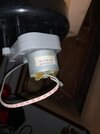
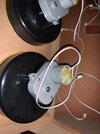
No he connected 12V straight to the motor and it turned. As for the IC type it really is a mystery along with why some components aren't soldered to the board at all. These are the motors in question.
 

Attachments

  • WhatsApp Image 2023-04-26 at 12.12.39 PM.jpeg
    WhatsApp Image 2023-04-26 at 12.12.39 PM.jpeg
    117.8 KB · Views: 6
  • WhatsApp Image 2023-04-26 at 12.12.38 PM.jpeg
    WhatsApp Image 2023-04-26 at 12.12.38 PM.jpeg
    158.7 KB · Views: 6

kellys_eye

Jun 25, 2010
6,512
Joined
Jun 25, 2010
Messages
6,512
The video basically shows him connecting the motor directly to the power supply and saying it doesn't turn on at 5V but rather 12V(11.9V).
That's suspect in the first place - the motor is clearly labelled for 3V operation and might have been damaged by the application of 12V.

What, precisely, does that board do then? (or what is it meant to do?). <edit> I quickly figured this out, see below.

If the motors 'work' when 12V is applied to them then why do you need the board? Why not just connect the motors to a 12V supply?

The circuit itself is a dual h-bridge which allows the motor(s) to be spun clockwise/anticlockwise by applying the supply voltage in one direction or the other, controlled by the IC which is probably 'modulating' this to run the motor at a given (or varying) speed.

Applying a DC voltage to one end of a 'pair' of bridge drive transistors (NPN/PNP pair) will turn it one way, doing the same to the other pair turn it the 'other' way. As mentioned, you can either apply a direct voltage to spin the motors at their full-rated speed or use a PWM signal instead of a steady-DC to run them at a lower speed.

You say you measure 'mV' at the motor connection terminals - this could actually be correct as, if the signal is PWM to a large enough degree then you wouldn't measure 'much' on an ordinary test meter. You really need to 'scope the terminals to see what you're getting.

Given it's a 'watch-winder' it will drive a rotating unit containing a typical 'auto-wind' watch mechanism (my Rolex has this facility) to stop the watch spring 'running out' when you aren't wearing the watch on a daily basis. The rotating mechanism will have to go left-right in order to do the winding hence the h-bridge control of the motor direction.

The motors are 'geared' so at their normal operating speed they could (may) only rotate the output shaft at (say) 1 rev per hour (minute?) but can be a LOT slower. Powering the motors at 12V will over-run them potentially burning them out but as a VERY temporary connection it will allow you to visibly see motion. Do NOT do this for longer than it takes to 'see' what's happening.

Given the motors speed/direction are controlled by the IC then if, literally, nothing is happening then the IC is dud. It's not a circuit that can't be replicated using even non-digital components (a 555 timer would probably do it) then fixing it is 'easy' but you have to know what the motors are MEANT to be doing before going further.
 
Last edited:

KetchupSeedHD

Apr 25, 2023
11
Joined
Apr 25, 2023
Messages
11
That's suspect in the first place - the motor is clearly labelled for 3V operation and might have been damaged by the application of 12V.

What, precisely, does that board do then? (or what is it meant to do?). <edit> I quickly figured this out, see below.

If the motors 'work' when 12V is applied to them then why do you need the board? Why not just connect the motors to a 12V supply?

The circuit itself is a dual h-bridge which allows the motor(s) to be spun clockwise/anticlockwise by applying the supply voltage in one direction or the other, controlled by the IC which is probably 'modulating' this to run the motor at a given (or varying) speed.

Applying a DC voltage to one end of a 'pair' of bridge drive transistors (NPN/PNP pair) will turn it one way, doing the same to the other pair turn it the 'other' way. As mentioned, you can either apply a direct voltage to spin the motors at their full-rated speed or use a PWM signal instead of a steady-DC to run them at a lower speed.

You say you measure 'mV' at the motor connection terminals - this could actually be correct as, if the signal is PWM to a large enough degree then you wouldn't measure 'much' on an ordinary test meter. You really need to 'scope the terminals to see what you're getting.

Given it's a 'watch-winder' it will drive a rotating unit containing a typical 'auto-wind' watch mechanism (my Rolex has this facility) to stop the watch spring 'running out' when you aren't wearing the watch on a daily basis. The rotating mechanism will have to go left-right in order to do the winding hence the h-bridge control of the motor direction.

The motors are 'geared' so at their normal operating speed they could (may) only rotate the output shaft at (say) 1 rev per hour (minute?) but can be a LOT slower. Powering the motors at 12V will over-run them potentially burning them out but as a VERY temporary connection it will allow you to visibly see motion. Do NOT do this for longer than it takes to 'see' what's happening.

Given the motors speed/direction are controlled by the IC then if, literally, nothing is happening then the IC is dud. It's not a circuit that can't be replicated using even non-digital components (a 555 timer would probably do it) then fixing it is 'easy' but you have to know what the motors are MEANT to be doing before going further.
Thanks for the much needed insight. I will ask the owner if the motors were switching directions like the typical watch winder circuit.

If the motors are supposed to be going in the two directions after each revolution what is the easiest fix(circuit) to accomplish this?
 

Bluejets

Oct 5, 2014
7,374
Joined
Oct 5, 2014
Messages
7,374
What is the device the board comes from....link...?...details.....?.....model...make...?
 

kellys_eye

Jun 25, 2010
6,512
Joined
Jun 25, 2010
Messages
6,512
If the motors are supposed to be going in the two directions after each revolution what is the easiest fix(circuit) to accomplish this?
An astable running at a low frequency based on the 555 device would suffice BUT this depends on the motor speed. If the motor speed UNREGULATED is too fast then you'll have to include another circuit to deliver the necessary pulses to slow them down. Another 555 astable at a couple kHz applied to a gate WITH the low speed astable signal will do it.
 

73's de Edd

Aug 21, 2015
3,730
Joined
Aug 21, 2015
Messages
3,730
Sir KetchupSeed . . . . . . . . . . . . .(In actuality . . . . .' mater seed . . . . .since you can't grow "ketchups" and harvest their seeds. . . . . . UNLESS you gazed upon the table top and done went and " seed " a bottle of ketchup . . . . . . a sittin' thar. )


Here are my observations . . . . . you correct . . . . .or fill me in . . . if finer details from your photos, fails me..
I now "read" the boards foils for you . . . . . follow me . . . .

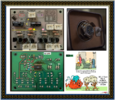
PICTORIAL REFERENCING . . . . ALL marked up . . . . .
(Moved to VERY bottom )


THE SITUATION . . . . .
Look at the top left corners J4 connector . . .being non existent . . . but looking to the foil side, looking one pic down, it has a finer line foil joining its two lands into a constant ON position . . . we're thru with that factoid.
Back to the top pic to examine the J1 power connector . . . . . 2 pins used on it. Look down to the foil pic see my assignment of a BLACK diamond to the wall warts negative power supply in and an ORANGE diamond to its positive power supply input. The negative drops down that octapuss-ified-icated black line and travels ALL OVER that board. . . . and I do mean ALL over it !
Now due to that "CLUX FLUTTER" , you will have to confirm for me if that ORANGE diamond and its power path down the RED line and has NO connection into that pad to its right that connects to a never/ now non existent battery back up at the VIOLET oval. I am expecting no connection.
NOW . . . lets track that power flow . . .after you first read the wall warts specs to see what the DC output of it is being and current capability and feed that info back to us . . .sort of expecting 9-12 VDC @ ? milliamperes.
If that IC is powered by +5 VDC expect the RED line power flow to pass down to the very bottom where that voltage level is supplied to the
YELLOW boxed driver transistors for one watch motor and the branch off of the same voltage for the other watches circuitry at the PINK supply lines path.
A logic HIGH from that IC1 , traveling down to either YELLOW triangles should have THAT watch running for that HIGH's duration in either a CW direction of the watches turntable , or a CCW direction . . . respective to the triangle that was selected..
Same is true of the other watch turntable, with it using the PINK colored mark ups.
Now is where I need your eyes and an ohmmeter set ito lowest ohms to confirm direct connections.
Confirm for me if the PINK branching path upwards , just below where I have the WHITE oval is correct.
I see 5 connections . . . .
1 . . .The top solder joint connection is a 3 direction ground plane connection
2 . . .Just below it is the Z marked connection that would feed 5 VDC into the IC if 5 VDC supply, if such voltage is used.
3 . . . Looks like that pad also ties into the Y-Z common junction foil but is its wire one of those leads of the round orange ceramic disc capacitor . . . .with that caps other lead going to the left sides ground plane ?
4 . . . . There seems to be an open spacing and then a solder pad with a wire lead enclosed and then a very short minor width foil trace that ties into a
5 . . . . Foil land that just appears to be an unpopulated solder blob.
BUT . . . . does that blob connect into that PINK supply line as is shown ?
And lastly, look at the BROWN O foil area, at its top right corner, it looks as if its sneaking a trace from its top right corner under the IC bottom.
Conform that, and then pass back what its bottom left corner ties into, in respect to those earlier reviewed 5 pads.

Looking at the bottom photos foils, looks like its populated in the D1 and 78L05 areas.
Looking at the top photo . . .who cannibalized those parts at YELLOW X's ??

EXPECTED MAIN POWER FLOW . . . .

If its Wall wart is connected and powered up, expect its full voltage to be present at the ORANGE diamond and pass down to the anode of the D1 (1N4007) diode ( RED flag area ) and goes into its anode and out its cathode (BLACK band on the left) and pass thru jumpered J4 and then down the RED power buss .
Now if you were to have just YELLOW mark up area of motor driver circuitry connected up to that watch turntables motor , have the wall wart plugged in and confirm its DC output at that RED buss , as is being referenced to the ground plane.
A test of that turntable could be made by using a 1K resistor with one lead extended with a wire to be able to stretch connections between the wire end at the RED power buss line and the other end of the resistor touched to either of the YELLOW triangle mark ups.

5V POWER SUPPLY . . . . . .
If that is the case, then the RED buss comes into the X input of the small TO-92 encased low power 5 V linear regulator I.C. as being a 78L05 as
ROBINS EGG BLUE . . . . MARK UP RECTANGLE.
There, that buss gets some additional filtering by the BLACK JEC axial E-capacitor . . . . tell us its voltage rating.
78L05 mid pin goes to the ground plane and the regulated 5VDC comes out the Y output to get some more filtering by the companion other JEC E-cap at Z connection . . .what is its voltage rating ?
The regulated 5 VDC supply then passes into the underneath area of the IC1 at the RED star. . . . . to go to its ? power pin

K1 and K2 . . . . . plugs
Are those connected into, as there two connections relate to modifying an input parameter to the IC1.

I.C.1 . . . . . . ? ? ?
If only that were a 16 pin unit . . . . . alas, its being only 14 . ., the use a MC4060 oscillator and its divider chain could be used to selectively tap off sub division outputs to get the ~ 800 rotations needed of the turntable throughout a 24 hr timing period of windee-windee..
Check out that chips top to see if it has had a flat black over coating to hide its markings try . . . .acetone . . . lacquer thinner . . .MEK . . . . Toluene . . .Xylene . . . . . methyl methacrylate . . . . . tiger piss ?
I can't see an indexing dot on top . . . . but think that I feebly see a small indexing gap at its left side. If that is true, its pins 2 and 3 would be the YELLOW turntables motor driver activation outputs . . . . the PINK turntables inputs foil paths.are hidden under the IC


COME YE FORTH . . . . . . . and talk towards me . . . .

Thaaaaaaaaaaaaaaaasssit . . . . .

73's de Edd . . . . .

A closed mouth gathers no feet.

Watch Winder Modi-Operandi.png
 

Attachments

  • Watch Winder Modi-Operandi.png
    Watch Winder Modi-Operandi.png
    2.2 MB · Views: 14
Last edited:
Top