Electronic Stethoscope

audioguru2

Apr 6, 2004
12,026
Joined
Apr 6, 2004
Messages
12,026
Alun said:
No audioguru, this isn't true
Hi Alun,
What isn't true?
Many articles in Google say that a voltage charge is placed in an electret material in the diaphragm, back plate or front plate. You can't measure the voltage charge because your meter will drain it away.
I have also looked inside them and used the tiny FET transistor in other circuits. ;D
 
A

Alun

Jan 1, 1970
0
Don't you mean that the foil is polarised? This is totally differant, when you were talking about a high voltage charge I thought you were meant a miniture inverter inside the mic. ;D


audioguru2

Apr 6, 2004
12,026
Joined
Apr 6, 2004
Messages
12,026
The electret material has long molecules that are made as a metalized diaphragm, back-plate or front-plate of the electret microphone. The electret material is heated and 50V is applied to it. When it cools, the 50V charge remains on it . Manufacturers say the charge lasts 10 to 25 years. 

 
A

Alun

Jan 1, 1970
0
Yes that's polarization, the molecules line up so the negitive poles  and positive all point in the same direction, this is quite similar to the aluminium oxide molacules on an electrolytic capacitor.


xoy

Mar 3, 2005
45
Joined
Mar 3, 2005
Messages
45
HI AUDIOGURU!!!

SORRY FOR LATE REPLY..

WELL ABOUT THE BACK-UP SUPPLY.. I HAVE MADE HERE ONE.. CAN YOU FIGURE IT OUT IF ITS OK TO APPLY.... THANKS!!!!!

View attachment 37813


audioguru2

Apr 6, 2004
12,026
Joined
Apr 6, 2004
Messages
12,026
Hi Xoy,
Sorry, but your circuit won't work.
It has only a 9V positive supply. The project also needs a 9V negative supply. Its opamps won't work with their negative supply pin shorted to ground.

Why do you need an AC adapter?
If the circuit doesn't have the 741 and LEDs, the TL072's negative supply current is only 2.8mA. A little 9V alkaline battery will power it continuously for more than 900 hours, which is 37.5 days.

View attachment 37816

 
A

Alun

Jan 1, 1970
0
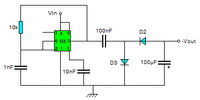
Or you could build yourself a negitive power supply with a 555 timer.

You could use a 7555 of TS555 if you're worried about battery life.

-supply.GIF


audioguru2

Apr 6, 2004
12,026
Joined
Apr 6, 2004
Messages
12,026
Hi Alun,
I was also going to mention using a Cmos charge-pump IC to make -9V from +9V but then the single 9V battery would have half its life so the project might as well use two 9V batteries. ;D


xoy

Mar 3, 2005
45
Joined
Mar 3, 2005
Messages
45
thanks Alun and Audioguru!!!!!

i have here a very small mic from ericsson cellphone, which is about 3/4 cenitimeter in diameter... i dont know to which unit it belongs.. but it has a long lead and a short one,, which one of them is positive?

thanks...


---xoy----


audioguru2

Apr 6, 2004
12,026
Joined
Apr 6, 2004
Messages
12,026
Hi Xoy,
If it is an electret microphone then one of its pins is connected to its metal case and is ground and should be connected to your cable's shield. The other pin is positive and its output which should be connected to the inner wire of your shielded audio cable. ;D


dukedevil

Sep 25, 2005
6
Joined
Sep 25, 2005
Messages
6
Hi again,
  I was just curious what the sensitivity and signal to noise ratio of your microphone was.  I have the circuit built, but I'm having a hard time distinguising between possible heart beats and random noise.  Is there anything I might do to help with this?  I was also wondering if the gains of the circuit are enough to magnify the signal enough to be audible.  From my calculations given a microphone with a sensitivity of -35 dB, I find that heart sounds would only produce outputs at the microphone of around 10 microvolts.  To magnify this to the audible range, it seems like a total gain of 1000 or more would be necessary.  Thanks for any help you can give me.


audioguru2

Apr 6, 2004
12,026
Joined
Apr 6, 2004
Messages
12,026
Hi Duke,
I heard my heartbeat loud and clear, too loud. See your doc because maybe you have a weak heart. ;D

Did you build the 2nd project? Did you substitute any parts?
Please describe the random noise you hear. I heard movement of the mic and my dog barking and a phone ringing in the next room with a flimsy plastic jar lid as the mic's holder. I used a rubber grommet so my hand moving on the holder wasn't too loud. It would be much better with a solid cast metal holder which docs call a "head".

Maybe your mic or headphones have poor very low frequency response. Use headphones that surround your ears. Mine picks-up the rumbling of jetplanes at an airport about 20km away. 


dukedevil

Sep 25, 2005
6
Joined
Sep 25, 2005
Messages
6
I did build project 2 and I didn't substitute any parts.  Do you know what the specifications are for your microphone?


dukedevil

Sep 25, 2005
6
Joined
Sep 25, 2005
Messages
6
I was also wondering if you might be able to post a picture of the mic and it's holder.  Where is the rubber grommet placed?  The noise I hear is a small intermittant bursts of static.  It's difficult for me to tell whether I'm hearing a heart beat or whether all I'm hearing is noise.  Is the gain of your entire circuit about 10*20 or 200? Thanks.


audioguru2

Apr 6, 2004
12,026
Joined
Apr 6, 2004
Messages
12,026
Hi Duke,
The total gain of my project is 272. U1a has 8.5 which is more than I thought because the impedance of the mic is a little lower than I thought. U1b has 1.6 and U5 has 20.

I don't know where your bursts of static noise is coming from. On other circuits you could separate the stages but it would be awkward on this one because it is DC coupled. If you hear the noise with the volume control turned down then the noise comes from U5.

Maybe your mic or circuit doesn't work. You should hear your voice loudly if you speak with a normal voice level towards the mic's front with it held at arm's length away. It will sound muffled due to the lowpass filter. Keep the mic away from your headphones to avoid feedback.

My mic came from a cell phone and isn't supposed to have its very good very low frequencies response but it does. I think all ordinary electret mics are the same.

My mic and its rubber jacket are mounted in the center of a plastic jar lid and look exactly like my sketch on the schematic. The rim on the lid makes a space so that the mic isn't blocked by skin.


audioguru2

Apr 6, 2004
12,026
Joined
Apr 6, 2004
Messages
12,026
Oh yeah, I forgot to say that I used the headphones that came with my pretty good Kenwood portable CD player. Their bass is awesome. ;D


UH3455

Oct 15, 2005
7
Joined
Oct 15, 2005
Messages
7
Hey, Audioguru,

I have some questions regarding the original electronic stethoscope design
http://www.aaroncake.net/circuits/steth.htm
and the second one that you improved it to
http://www.electronics-lab.com/projects/science/019/

Why do you change the 741 op-amps to the LM386 op-amp and to the TL072 dual op-amp?  The circuit would still work with 741s, correct?  Please explain the need for the dual op-amp, could you, as opposed to 2 741s?

Thanks.


UH3455

Oct 15, 2005
7
Joined
Oct 15, 2005
Messages
7
I'd like to understand the reasons for the changes made between the two circuits.

Thanks.

 
Last edited by a moderator:
A

Alun

Jan 1, 1970
0
The 741 is a pretty outdated slow opamp so audioguru decided to replace it with the more modern TL072 but this isn't needed since the bandwidth of this circuit is very low. ;D The idea behind using a dual amplifier is to both save money and space, I bet you could use the LM1458 which is a dual 741 and it wouldn't sound that bad.

Edit:
I do agree about the LM386 though, the old 741 could barely output enough power to drive normal headphones while the LM386 is specifically designed for the job.

Yes, do go for the TL072 or even the TL082 or old obsolete LF315 or LF451 rather than the 741 but it's ok to use it if you're totall stuck at it still will work.

 
Last edited:

audioguru2

Apr 6, 2004
12,026
Joined
Apr 6, 2004
Messages
12,026
Hi UH,
The original project had errors that I corrected:
1) The original circuit shows a 741 for U5. A 741 is designed to drive a load of 2k ohms or more. Headphones are 8 ohms to 600 ohms. Two 8 ohm headphone "ears" in parallel are a load of only 4 ohms.
The original U5 is shown with its inputs grounded, and without any negative feedback, but a 741 opamp cannot work like that in this application.

The LM386 IC is not an opamp, it is a power amp designed to drive 8 ohm speakers to 1/2W or less. It is designed to have its inputs grounded and has negative feedback built-in. It is perfect for U5.

2) The original schematic is missing a junction at pin6 of U2 with C3 and R7.

3) I replaced the two noisy single 741 opamps with a low-noise dual TL072 opamp that is much better and costs less for the dual than for a single 741.

4) I increased the value of C2 which was about 100 times too small to pass low frequency heartbeat sounds.

5) I added very important supply bypass capacitors so the project can operate properly with its batteries.


Hi Alun,
I wouldn't use a dual MC1458 nor LM358 dual opamp as the low level microphone preamp in this project. They are much too noisy.

 
Top