I need a really good inline connector

poormystic

Jul 23, 2023
187
Joined
Jul 23, 2023
Messages
187
Hi People

I’ve had a project going for the last couple of years that will soon require me to wire up some piezoelectric crystals… ThorLabs PK4FA3H2P2’s to be exact.

These devices come with 75mm wires already soldered onto the chip, so my machine will have these wires sprouting out of it.

The stainless steel tube is 14mm diameter (od)
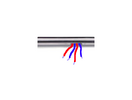
pic for ep.png
I don’t like wires to sprout – I think they should be led to a nice safe connector, which I can anchor to the body of the machine and so keep my expensive components from getting their wires yanked.

The maximum voltage is 50V, and the maximum current 500mA.

I want advice on the best connector to use, please :)
 

Sunnysky

Jul 15, 2016
573
Joined
Jul 15, 2016
Messages
573
This seems to need a "wire-to wire" connector pairs which exist in many sizes rated for your load and wire size. That is the easy part.
The greater challenge is the mechanical interface. How to secure the connector, prevent insulation damage, make it repairable for sensors, and rugged enough for the mechanical environment (TBD) and suitable for appearance. Buying a couple pre-made cables then cutting them to connect the pigtails precludes crimping or soldering issues and then you just heatshink the soldered pigtails. If you have more experience, it can be more elegant.

I would use silicone for the hole with a taped wire or heat shrink then attach the connector to the shaft with tie-wraps such that it enables access. A 5 pin header with 1 pin blocked as a key or any other rugged attachment.

As Mr Kapps says, pick from JST or even use spare 4 pin HDD connector pairs from an old PC with 0.1" spacing.
It all depends on the purpose of this component design.
 

poormystic

Jul 23, 2023
187
Joined
Jul 23, 2023
Messages
187
Thanks @Sunnysky
Generally yes, there is a great need to mechanically secure those tender sprouts and keep them tidy. I'm a bit scared of silicone in this context though - as it goes off it releases acid, which might damage the piezoelectric components.
Perhaps the worst of the problem is that the connection must be secured to a tube. Round things just ain't so easy.

I'd quite like the little machine I'm building to be up to or above the standard I would expect from an industrial supplier. My machine must be tidy, and well made in every respect!
I might lead my wires down in a separate tube alongside, and make the connection on a tiny, covered pcb.

I'm not ready to say just what I hope my little machine will do just yet, because it might not work at all and then I'm left with egg on my face. I've already discovered that some of my notions just don't work in the real world.
Please cross your fingers for me you good guys. There'll be a few months of work yet before I get results... finding ways to work with micron movements presents me with great challenges.

Mark
 

ivak245

Jun 11, 2021
143
Joined
Jun 11, 2021
Messages
143
You can use neutral cure silicon, it has no acetic acid. I have used it many times in commercial equipment.
 

Sunnysky

Jul 15, 2016
573
Joined
Jul 15, 2016
Messages
573
For a strong adhesive I use a polyurethane sub-floor adhesive from any hardware store in large tubes as my go-to product.


There is also a small clear gorilla glue for the hole in a clear thick paste that is like a soft silicone but not very strong and can peel off for ease of repair.
 
Top