Simple help with transistors!!

Um...Me123

Aug 6, 2005
174
Joined
Aug 6, 2005
Messages
174
So is an IR reciever like a transistor?  You supply its specified voltage/current on the positive side and when it recieves ir light it outputs that voltage on its neg side?


audioguru2

Apr 6, 2004
12,026
Joined
Apr 6, 2004
Messages
12,026
Your music player probably has a modern IR receiver IC. It doesn't even have a phototransistor. Where are you going to connect another phototransistor to it?

View attachment 39105


allvol

Nov 30, 2005
101
Joined
Nov 30, 2005
Messages
101
ummm... Um

I don't really think IR is the way you want to go.


Um...Me123

Aug 6, 2005
174
Joined
Aug 6, 2005
Messages
174
It's that time of year again.  Back to the electronic firework firing box project.
Was making some improvements to my older model and have a little transistor question.
I have a wire that will go positive with around 12V under certain conditions (when a que is being tested)  I have a 12V LED assembly (before i knew how to use resistors) and a 12V buzzer that are suppose to light up/sound.  In series the buzzer doesnt work well due to the resistor in the LED.
Parallel won't work will it?

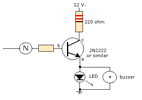
Ok so if I connect a transistor to it like this, will it work?:
the negative side of the led to the base
A 12V supply (not within this circuit) to the collector and
the positive of the buzzer to the emitter

To me this would work but no one has really yet told me if I have the correct understanding--just everything wrong with making an IR signal go around a corner!! (should not be that hard!!)

thnx


audioguru2

Apr 6, 2004
12,026
Joined
Apr 6, 2004
Messages
12,026
If you connect the 12V LED to a 12V battery then it lights.
If you connect a 12V buzzer to a 12V battery then it buzzes.
If you connect the LED and the buzzer to the battery then they are in parallel aren't they?

Why connect an LED to the base of a transistor? The LED doesn't turn itself on and off unless it is a flashing LED.

Where is the anode of the LED connected?

Where is the negative of the 12V connected?

Is the transistor an NPN or a PNP?

Make a sketch of your circuit design in MS Paint or something so you can see all the things in it that aren't connected to anything.


Um...Me123

Aug 6, 2005
174
Joined
Aug 6, 2005
Messages
174
Um...you may have a good point in the first 3 lines.

I always get stuck on the idea that electricity chooses it's path...sort of.
Like say you have a 12V supply and you hook the leds and buzzer and the led is 3V and buzzer is 12V- You obviousely have a resistor for the led (in the assembly) so the electricity will go almost completely through the buzzer because it's "the path of less resistance".  This always hangs me up and if there is a short way to explain it feel free but if its long and complicated don't waste your time.  I'll either spend a looonnnnggggg time sifting through all the articles out there for one simple enough for me or just wait untill my properties of electricity class.  Again, I don't want to waiste your time if its a long explanaition.  My question was pretty much answered in your first 3 lines.  If that for some reason doesn't work then I'll post a schematic.
Thanks

 
Last edited by a moderator:

allvol

Nov 30, 2005
101
Joined
Nov 30, 2005
Messages
101
While you are waiting on Audioguru's answer, you might want to look at the attachment, which shows a transistor driving both a LED and a buzzer.

LED_driver.GIF


audioguru2

Apr 6, 2004
12,026
Joined
Apr 6, 2004
Messages
12,026
You don't want the transistor switch as an emitter follower. It switches better when it is a common emitter stage.
My transistor switches the LED with its resistor and the buzzer to the 12V battery. They are in parallel.

View attachment 39126

 
Last edited by a moderator:

indulis

Nov 21, 2005
488
Joined
Nov 21, 2005
Messages
488
Funny thing about current in a parallel circuit.  It divides equally among its branches, like a stream flowing around an island.  Its the same amount of water (current) but each stream path carries its share of the water (current).

This is ONLY true if the impedances are the same.
 

Um...Me123

Aug 6, 2005
174
Joined
Aug 6, 2005
Messages
174
Thinking back to my car/fuse/relay question I came up with this little circuit that probably won't work or has an unnecessary transistor in it but what the heck!
Basically I want the relay to come on when the PANEL (spelled wrong everywhere but here) lights come on.

View attachment 39166


audioguru2

Apr 6, 2004
12,026
Joined
Apr 6, 2004
Messages
12,026
Hi Um...Me,
Q1 doesn't have a base current-limiting resistor so it will fry. Q1 is not needed.
The LED also doesn't have a current-limiting resistor so it will also fry.

The relay coil makes a very high voltage when it is turned off because it is an inductor. The high voltage will destroy Q2 unless you add a reversed biased diode across the coil.

The 2 supplies must have their grounds connected together.


Um...Me123

Aug 6, 2005
174
Joined
Aug 6, 2005
Messages
174
The LED is an unknown sourse of light

maybe its a led
maybe its some sort of electroluminence (sp?)

I just threw in an led to show that (resistor is there then)


Yes I forgot the reverse diode.

You always need a resistor on the base side of a transistor?


Another question:
in the case of the transistor or a led and the supply voltage is equal to the spec. voltage what sort of resistor so you use?  1 ohm?


audioguru2

Apr 6, 2004
12,026
Joined
Apr 6, 2004
Messages
12,026
Actually, your transistors are connected as emitter-followers and don't need a base resistor. If the emitter is grounded and the load is between the collector and positive supply then the base would need a series resistor to limit its current.
With a 12V supply, a 1 ohm resistor would limit the base current to 12V - 0.7V= 11.3V/1= 11.3A. Transistors have current gain so a little 2N3904 can have a 200mA load at its collector and only 1mA to 10mA at its base will turn it on.


Um...Me123

Aug 6, 2005
174
Joined
Aug 6, 2005
Messages
174
Working on another project dealing with the electricity choosing the path of less resistance thing.
In the circuit a car deck has an auto antenna wire that goes 12V pos when the deck is turn on.  This in turn connects to a spot on the amp that signals it to turn on.  I have a (LED) lighted DPDT that I want to use to switch it.  Conditions for the switch being lighted are when the deck is on (because the supply is from the amp signal wire) and when the switch is on.  Here's the circuit but once its all wired up will the LED even light?
Thanks-fast responce would be very helpful.

View attachment 39171


Um...Me123

Aug 6, 2005
174
Joined
Aug 6, 2005
Messages
174
OK-------Back to the car thing...
I got my lighted switches yesterday and just installed into the dash (was a little scary to think my new car could have a big hole in it if the switch didn't fit.

The switch is a NKK pushbutton (on-off) that SPDT with isolated led leads/pins whatever you call 'em.

The fog light button is in the same panel I removed and I tested the wires

View attachment 39227

 
Last edited by a moderator:
Top