Simple mesh or junction method

KostasGreco

Jan 24, 2017
14
Joined
Jan 24, 2017
Messages
14
Hi,
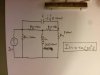
I need help with this problem. I am to solve it using either simple mesh method or junction method. Now my problem is that the impendance and reactance are given. BUT ! I know from theory that Xc and Xl can be calculated using the methods Xc=1/2πF and XL=2πfL only when current and voltage are in phase. In this case they are not. So do i have to make a phasor diagram first to calculate the real impedance and reactance or i am completly wrong?
 

Attachments

  • 16409676_1409723539069823_2065689397_o.jpg
    16409676_1409723539069823_2065689397_o.jpg
    116.6 KB · Views: 96

CDRIVE

Hauling 10' pipe on a Trek Shift3
May 8, 2012
4,960
Joined
May 8, 2012
Messages
4,960
Hi,
BUT ! I know from theory that Xc and Xl can be calculated using the methods Xc=1/2πF and XL=2πfL only when current and voltage are in phase.
In perfect inductors the current lags the voltage by 90°. In a perfect capacitor the current leads the voltage by 90°. So the formulas for Xc & Xl don't rely on the current and voltage being in phase because that's not going to happen. If it did it wouldn't be a capacitor or inductor.

Chris
 

Ratch

Mar 10, 2013
1,102
Joined
Mar 10, 2013
Messages
1,102
Hi,
I need help with this problem. I am to solve it using either simple mesh method or junction method. Now my problem is that the impendance and reactance are given. BUT ! I know from theory that Xc and Xl can be calculated using the methods Xc=1/2πF and XL=2πfL only when current and voltage are in phase. In this case they are not. So do i have to make a phasor diagram first to calculate the real impedance and reactance or i am completly wrong?

Yes, you are completely wrong. All the values of impedance are given for each component, so you don't have to calculate them. You never did indicate what you are trying to calculate, by the way. I don't understand what you mean when you slay that the voltages and currents have to be phase to calculate the impedances. A phasor diagram in unnecessary and undefined as to where it is needed. What does the underlined "o" by the capacitor and inductor mean?

Ratch
 

KostasGreco

Jan 24, 2017
14
Joined
Jan 24, 2017
Messages
14
Yes, you are completely wrong. All the values of impedance are given for each component, so you don't have to calculate them. You never did indicate what you are trying to calculate, by the way. I don't understand what you mean when you slay that the voltages and currents have to be phase to calculate the impedances. A phasor diagram in unnecessary and undefined as to where it is needed. What does the underlined "o" by the capacitor and inductor mean?

Ratch
Underlinde O is the greek letter omega and the one of the sumbols for Ohms.I found out where i was wrong later on. I got jetlaged by the amount of the info i had resieved in one day. In the end I mananged to solve my confusion and double check with your responses so thanks anyway :)
 

KostasGreco

Jan 24, 2017
14
Joined
Jan 24, 2017
Messages
14
In perfect inductors the current lags the voltage by 90°. In a perfect capacitor the current leads the voltage by 90°. So the formulas for Xc & Xl don't rely on the current and voltage being in phase because that's not going to happen. If it did it wouldn't be a capacitor or inductor.

Chris
Yeah i was a bit comfused by tha phase that the current scource had. I thought i had to calculate again the Xc and XL using the given ones, which i though were only for phase=0.
 
Top