What does the 33uH coil in this circuit?

samy555

May 11, 2010
63
Joined
May 11, 2010
Messages
63
What is the function of the 33uH inductor in this circuit from the link:
http://www.talkingelectronics.com/projects/27MHz Transmitters/27MHzLinks-1.html
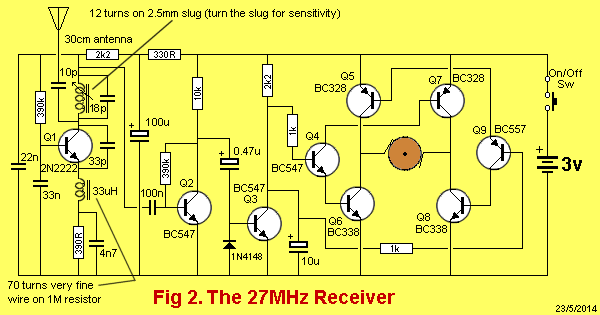
Fig2.gif
 

Harald Kapp

Moderator
Moderator
Nov 17, 2011
14,271
Joined
Nov 17, 2011
Messages
14,271
It says on the website:

However the end result is the emitter is pushed down to turn the transistor ON more and pulled up to turn it off. The 70t inductor on the emitter simply keeps it away from the 0v rail so that the pulses on the 39p can have an effect on pushing and pulling the emitter.

The inductor is a very high impedance for high frequencies, it effectively blocks them. Bit for setting the DC operation point the inductor has a low impedance so the operating point can be set by the emitter resistor.

Harald
 

samy555

May 11, 2010
63
Joined
May 11, 2010
Messages
63
I didn't understand this: "the emitter is pushed down to turn the transistor ON more and pulled up to turn it off"
Is it meant by "pushed down" that making VE lower and by "pulled up " making VE higher???
If my word is true, what will happen to the base voltage when the emitter voltage change?
thank you Harald for your response
 

Rleo6965

Jan 22, 2012
585
Joined
Jan 22, 2012
Messages
585
Let's say the base voltage was 3V and the emitter was 2V there will be 1 volt bias on transistor that transistor conduct will small current.
But if you "pushed down" or lower the emitter voltage to 1V. There will be 2V bias between base and emitter. this therefore cause more current to flow on the collector of transistor or more turn on.
 

samy555

May 11, 2010
63
Joined
May 11, 2010
Messages
63
Let's say the base voltage was 3V and the emitter was 2V there will be 1 volt bias on transistor that transistor conduct will small current.
But if you "pushed down" or lower the emitter voltage to 1V. There will be 2V bias between base and emitter. this therefore cause more current to flow on the collector of transistor or more turn on.

First: Thank you very much for this answer that I felt from which you are trying to simplify the image in order to make me understand

But I know that if the voltage at the base = 3 volts, the voltage on the emitter = approximately 2.3 volts. Am I wrong?

thanks alot
 

duke37

Jan 9, 2011
5,364
Joined
Jan 9, 2011
Messages
5,364
You are correct on average, however Q1 is an oscillator with the emitter fed by the 33pF capacitor. The emitter voltage will rise and fall, switching the transistor on and off.

The 33uH inductor is there to allow this high frequency voltage to occur without loss.

The base voltage is held constant at high frequency with the 33nF capacitor.
 

duke37

Jan 9, 2011
5,364
Joined
Jan 9, 2011
Messages
5,364
Yes. I normally measure voltages relative to ground. You may want to measure voltages across components in other circumstances.
 
Top