Missing parallel resistors

Mr Musabe

Oct 10, 2015
9
Joined
Oct 10, 2015
Messages
9
Morning All

I am trying to complete a task sheet on parallel resistors. I have a table and I have to fill in the blanks

All I am given is a value for the first resistor and the total resistance. The question is to find the value of the other two resistors. How do I do this without know knowing the voltage or current?

Example.

Resistor 1 = 120 ohms
Total resistance = 48 ohms.

find resistor values for resistor 2 and resistor 3.

How is this done? I have uploaded a picture of the table that requires completion.
 

Attachments

  • Capture.JPG
    Capture.JPG
    30.5 KB · Views: 103
Last edited:

Harald Kapp

Moderator
Moderator
Nov 17, 2011
14,271
Joined
Nov 17, 2011
Messages
14,271
As you describe the task, it is not solvable in a defined form. Multiple solutions (in fact infinitely many) exist.

The resistance of two resistors in parallel is Rtotal = (R1*R2)/(R1+R2).
Knowing Rtotal and R1 you can solve for R2. That's the easy part.

But if resistor R2 is made from two parallel resistors R2a and R2b (that would be resistor 2 and 3 in your post), there are infinitely many combinations to create R20(R2a*R2b)/(R2a+R2b).
Perhaps you are missing some point in the task description?
 

Mr Musabe

Oct 10, 2015
9
Joined
Oct 10, 2015
Messages
9
As you describe the task, it is not solvable in a defined form. Multiple solutions (in fact infinitely many) exist.

The resistance of two resistors in parallel is Rtotal = (R1*R2)/(R1+R2).
Knowing Rtotal and R1 you can solve for R2. That's the easy part.

But if resistor R2 is made from two parallel resistors R2a and R2b (that would be resistor 2 and 3 in your post), there are infinitely many combinations to create R20(R2a*R2b)/(R2a+R2b).
Perhaps you are missing some point in the task description?


Thanks for the reply.
~I thought that the question was unanswerable. I am pretty sure I haven't misread the question. I have copied it below for you to see,

regards
 

Attachments

  • Capture.JPG
    Capture.JPG
    30.5 KB · Views: 117

GPG

Sep 18, 2015
452
Joined
Sep 18, 2015
Messages
452
Perhaps you are meant to solve if R3 in rows a, b, c.(They are marked) are missing. d, e, are solvable.
 

Harald Kapp

Moderator
Moderator
Nov 17, 2011
14,271
Joined
Nov 17, 2011
Messages
14,271
Perhaps you are meant to solve if R3 in rows a, b, c.(They are marked) are missing. d, e, are solvable.
I agree with this interpretation:
  • Rows a, b and c have only two resistors in parallel -> solvable.
  • Rows d, e and f have 3 resistors in parallel, 2 of which are given -> solvable.
 

davenn

Moderator
Sep 5, 2009
14,470
Joined
Sep 5, 2009
Messages
14,470
But if resistor R2 is made from two parallel resistors R2a and R2b (that would be resistor 2 and 3 in your post), there are infinitely many combinations to create R20(R2a*R2b)/(R2a+R2b).
Perhaps you are missing some point in the task description?

Harald, you are assuming something that isn't needed and making the answering more difficult

just use the table as stated DONT consider any other unlisted variations


Dave
 

davenn

Moderator
Sep 5, 2009
14,470
Joined
Sep 5, 2009
Messages
14,470
Thanks for the reply.
~I thought that the question was unanswerable. I am pretty sure I haven't misread the question. I have copied it below for you to see,

no it's not unsolvable
you are looking for a single value in each example line
as a result there can only be one value that will give you the stated answer in the right hand column


Dave
 

davenn

Moderator
Sep 5, 2009
14,470
Joined
Sep 5, 2009
Messages
14,470
Perhaps you are meant to solve if R3 in rows a, b, c

again NO

the first 3 examples are only 2 parallel resistors and you are given one of those values and the total

the bottom 2 examples are 3 resistors in parallel with which you are given 2 of the values and the Rt


its VERY plainly set out
 

hevans1944

Hop - AC8NS
Jun 21, 2012
4,968
Joined
Jun 21, 2012
Messages
4,968
I agree with @davenn. The dashes under R3 in rows a, b, and c imply that no value is assigned there, that R3 is not part of the problem. The remaining blank spaces in rows a, b, c, d, and e are easily solvable as Dave pointed out.
 

GPG

Sep 18, 2015
452
Joined
Sep 18, 2015
Messages
452
GPG said:
Perhaps you are meant to solve if R3 in rows a, b, c
again NO
I f you read the whole reply #4 I concluded that for a b c R3 is void
 

davenn

Moderator
Sep 5, 2009
14,470
Joined
Sep 5, 2009
Messages
14,470
GPG said:
Perhaps you are meant to solve if R3 in rows a, b, c
again NO
I f you read the whole reply #4 I concluded that for a b c R3 is void


that's not what you said
you inferred that a, b, and c were unsolvable and only d and e were solvable you assumption and interpretation is incorrect

ALL are solvable ..... there is only ONE resistor to find for each example

find resistor value for

a - R2
b - R1
c - R1
d - R2
e - R2

nothing more, nothing less ... end of story

Dave
 

hevans1944

Hop - AC8NS
Jun 21, 2012
4,968
Joined
Jun 21, 2012
Messages
4,968
Well, @Mr Musabe have you figured out how to "fill in the blanks" or do you want us to do that for you too? Since this is homework, that ain't gonna happen... at least not by me. If you post your results however, someone here will check them for you, and possibly point you in the right direction if you get it wrong.
 

Harald Kapp

Moderator
Moderator
Nov 17, 2011
14,271
Joined
Nov 17, 2011
Messages
14,271
Harald, you are assuming something that isn't needed and making the answering more difficult
Dave, in the original post there was no table attached, see the history of the post. Therefore my answer was, I believe, completely o.k.
The table which was added only later clarifies everything, see my post #5.
 

GPG

Sep 18, 2015
452
Joined
Sep 18, 2015
Messages
452
you inferred that a, b, and c were unsolvable and only d and e were solvable you assumption and interpretation is incorrect
It is not my interpretation that is incorrect.
 
Last edited:

dorke

Jun 20, 2015
2,342
Joined
Jun 20, 2015
Messages
2,342
I believe the easiest way to solve these kind of question is using the equation for parallel resistors directly:
1/Rt= 1/R1 + 1/R2 +1/R3+ ...+1/Rn
In our case here we have n=3.

In general:
Given only Rt ,It is always solvable even in the case none of the Rn's are given!!!
The solution will not be unique.
The only limitation is that all Rn's should be larger than Rt.


On the practical side one may ask ,
what is this "drill" good for?

Here is an example:
Lets take "line a from the table"
R1=120 ohm
Rt=48 ohm

solving for a single R2 we get R2=80 ohm.
That 80 ohm value is not a standard value,
furthermore ,even if it were ,we may not have it "on-hand"(rings a bell anyone?:().
So,do we wait till we can get it from Ebay?
What if we need to build that circuit immediately,
no time to wait?

Here is what we should do:

Assuming,we do have other values "on-hand",
we can make that physical circuit with them.
How?
Use 2 or more other resistors to create that 80 ohms.
Now remember,
any resistors we use should be greater than Rt=48 ohm.(actually, now greater than 80 ohm)

I'm choosing "almost" arbitrarily the value R2=120ohm (standard value and "on hand".
we just used it for R1 didn't we ...;)).
Now, solving for R3 we get R3=240ohm(with a bit of luck it is a standard value and I have it "on-hand")

Now we are a bunch of happy campers,
correct me if I'm wrong...:cool:
 

hevans1944

Hop - AC8NS
Jun 21, 2012
4,968
Joined
Jun 21, 2012
Messages
4,968
... Now we are a bunch of happy campers,
correct me if I'm wrong...:cool:
You aren't wrong, but I don't usually bother to calculate what I need to put in series or in parallel with a given resistor to obtain a specific value. I just use my ohmmeter and plug away with whatever values I happen to have in my "junque box" of FOUPs (Fine Old Used Parts).:D

This only works for resistor values less than about 20 kΩ or so because I bridge the candidate resistors by hand and my somewhat calloused but slightly conductive fingers contribute to the total resistance. Of course I could tack-solder the potential candidates together to eliminate my body contribution, and this is indeed sometimes necessary if the resistance adjustment is being made to tweek an active high-impedance circuit. However, with relatively low-impedance semiconductor circuits, my body impedance rarely makes any difference. And I do have a lot of fun in my attempts to get something that "works gud enuf".

I don't know how I managed years ago, when I did such things with vacuum tube circuits. It was fairly late in my career when solderless breadboards became widely available at reasonable cost. Those things actually encourage "live" substitution of parts, and I do usually get away with that. Not really recommended though, especially for beginners. It's a bad habit. Always remove power and safely discharge energy-storing capacitors before making component changes in a circuit. Make sure you use an anti-static mat on your work bench, use a grounding wrist strap with a one megohm series resistor to make sure your body has not accumulated a static charge. Be safe. Have fun. Live long and prosper.

Thanks @dorke for reminding me of how we used to get things done... it's still applicable today, and even easier with electronic hand calculators.
 

dorke

Jun 20, 2015
2,342
Joined
Jun 20, 2015
Messages
2,342
Thanks @dorke for reminding me of how we used to get things done... it's still applicable today, and even easier with electronic hand calculators.

Your welcome.:)

"...how we used to(?) get things done..."
I just did that recently while fixing a vintage 70's Yamaha receiver.

"electronic hand calculators (?)"
good thing you didn't say "slide-rule" o_O
We must be from the few here we still know what that was...;)

"Be safe. Have fun. Live long and prosper."
Absolutely!
and let me add be healthy...

P.S
Hevans,
From the day I joined here,
I'm impressed by your knowledge and verity of fields involved.
Wondered what was your carrier life...:)
 

davenn

Moderator
Sep 5, 2009
14,470
Joined
Sep 5, 2009
Messages
14,470
P.S
Hevans,
From the day I joined here,
I'm impressed by your knowledge and verity of fields involved.
Wondered what was your carrier life...:)

ahhh yes, Hop is a great guy and a bundle of knowledge
who's contributions to the forum are really appreciated !!


Dave
 

hevans1944

Hop - AC8NS
Jun 21, 2012
4,968
Joined
Jun 21, 2012
Messages
4,968
... "electronic hand calculators (?)"
good thing you didn't say "slide-rule" o_O
We must be from the few here we still know what that was...;)
My first introduction to a slide rule was something my father used as a navigator/bombardier during WWII. I never did figure out how to use all its features, but it was circular, about six inches diameter, and therefore equivalent to about an 18-inch linear slide rule. See a picture of it here (front and back sides) and also below:

upload_2015-11-6_18-36-37.jpeg

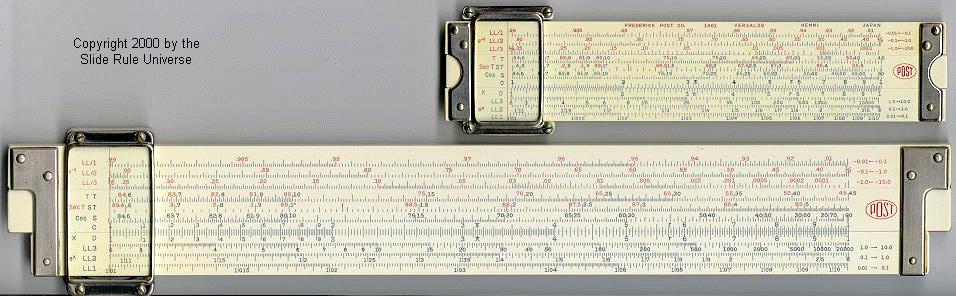
Much later, as a teenager, I purchased a metal linear slide-rule mail-order from Lafayette Electronics in the 1950s. And much later than that (while attending college) I was able to afford a very nice bamboo slide-rule manufactured by Post, their 1460 Versalog, which competed with the K&E Log-Log Duplex Decitrig but sold for less. I still have this slide rule and take it out of its case to admire it once in awhile. Below is a picture of my Post slide rule, the one on the bottom:

183-post-partypak-2.jpg


I never could justify purchasing the smaller "pocket size" slide rule shown in the above picture, but admired the engineers I knew who owned one.

As it turned out, I also carried around the eleventh edition of "Mathematical Tables from the Handbook of Chemistry and Physics" published by Chemical Rubber Publishing Company. This fine little (almost pocket sized) text had five decimal-place tables of logarithms and logarithms of trigonometric functions, as well as several other function tables with somewhat less precision. When the first "four banger" calculator with tiny red LED displays from Texas Instrument appeared I bought one, because the major disadvantage of using a slide rule was it didn't add or subtract numbers. That calculator, when used with the mathematical tables, allowed me to solve just about any engineering problem. The slide rule pretty much languished after that, and was replaced permanently when the first "scientific" calculators appeared. Again, I chose Texas Instruments for my first scientific calculator, but I toyed off and on with Hewlett-Packard RPN calculators, and once owned an HP 35 and later an HP 65, complete with magnetic card reader/writer. Eventually both HP calculators were stolen, so I dropped back to inexpensive Casio calculators and very expensive personal computers for my mathematical calculations.

And that's where things have remained, computation-wise, as I skated into the 21st Century.

Just thought I would get that off my chest... maybe I am getting old(er).

Hop
 

dorke

Jun 20, 2015
2,342
Joined
Jun 20, 2015
Messages
2,342
Hop,
Your are full of surprises...

RPN, as in Reverse Polish Notation...
another Joke the Poles played on us.:p

That "joke" became quit a nightmare when I had to write recursive functions using RPN in C and Assembly back in the 80's.
I almost got stuck on a stack with it,for many hours... :(

Thanks for reminding me of those calculators.
In the early 80's I had and used the TI-59 calculator with the EE solid state module.
It should be laying around somewhere,
hope the battery didn't cause total destruction... :rolleyes:
 
Top