I meant this test. Make sure the Pot's at mid range. It insures that this test can't pop anything because the opposite fixed un-shorted terminal will always see some resistance between it and the wiper.
Chris
I'll try it during my lunch break today
I meant this test. Make sure the Pot's at mid range. It insures that this test can't pop anything because the opposite fixed un-shorted terminal will always see some resistance between it and the wiper.
Chris
Make sure the Pot's at mid range. It insures that this test can't pop anything because the opposite fixed un-shorted terminal will always see some resistance between it and the wiper.

Your results are somewhat as expected but not 100%. I expected no arc at all.
You know I'm thinking maybe that tiny bit of current is how the welder senses a stuck electrode. When I was testing and got that spark, the buzzer would go off and the welder would act like it had a stuck electrode. Maybe the only way to get rid of that spark would be to somehow disable the stuck electrode sensing circuit.I expected no arc at all.
Are you thinking that there will always be a tiny spark even though there's no current coming through the pot?
You know I'm thinking maybe that tiny bit of current is how the welder senses a stuck electrode. When I was testing and got that spark, the buzzer would go off and the welder would act like it had a stuck electrode. Maybe the only way to get rid of that spark would be to somehow disable the stuck electrode sensing circuit.
Energize the overload relay coil and kill the output entirely.
turn the Pot to minimum but not OFF and test the arc.
Is the stuck electrode feature something different than the overload feature? Or are you saying that when overload occurs it also sounds the Piezo until the electrode is unstuck? If that's the case it kinda puts the relay option in the undesirable category.I'm wondering if triggering the overload relay is a guarantee that that stuck electrode sensing feature will be deactivated.
You know I'm thinking maybe that tiny bit of current is how the welder senses a stuck electrode. When I was testing and got that spark, the buzzer would go off and the welder would act like it had a stuck electrode. Maybe the only way to get rid of that spark would be to somehow disable the stuck electrode sensing circuit.
The control pot has a small amount of CCW rotation in the on/off switch click zone that can't be observed because the unit is powered down once the pot is rotated into that far left 3-5 degrees.
I guess if I want to observe the true effect the pot has when turned all the way down, I should jump the power switch pins so the unit remains powered up while the pot is rotated all the way CCW.
Is the stuck electrode feature something different than the overload feature?
It says 12VDC .40 ampsHere's another thought. Take a look at the data plate on the cooling fan and post the voltage and freq if it's AC.
Make sure the Pot's at mid range. It insures that this test can't pop anything because the opposite fixed un-shorted terminal will always see some resistance between it and the wiper.
could be detrimental to the overload & stuck electrode functions. I don't want to be responsible for frying your welder
More relevant would be the current delivered between the electrode and the work but you could fry your DMM measuring it.By the way, I checked that little sensing spark's voltage with my DMM -it was 3VAC *and* 54VDC -I don't know if that means dual voltage or my DMM is messed up...


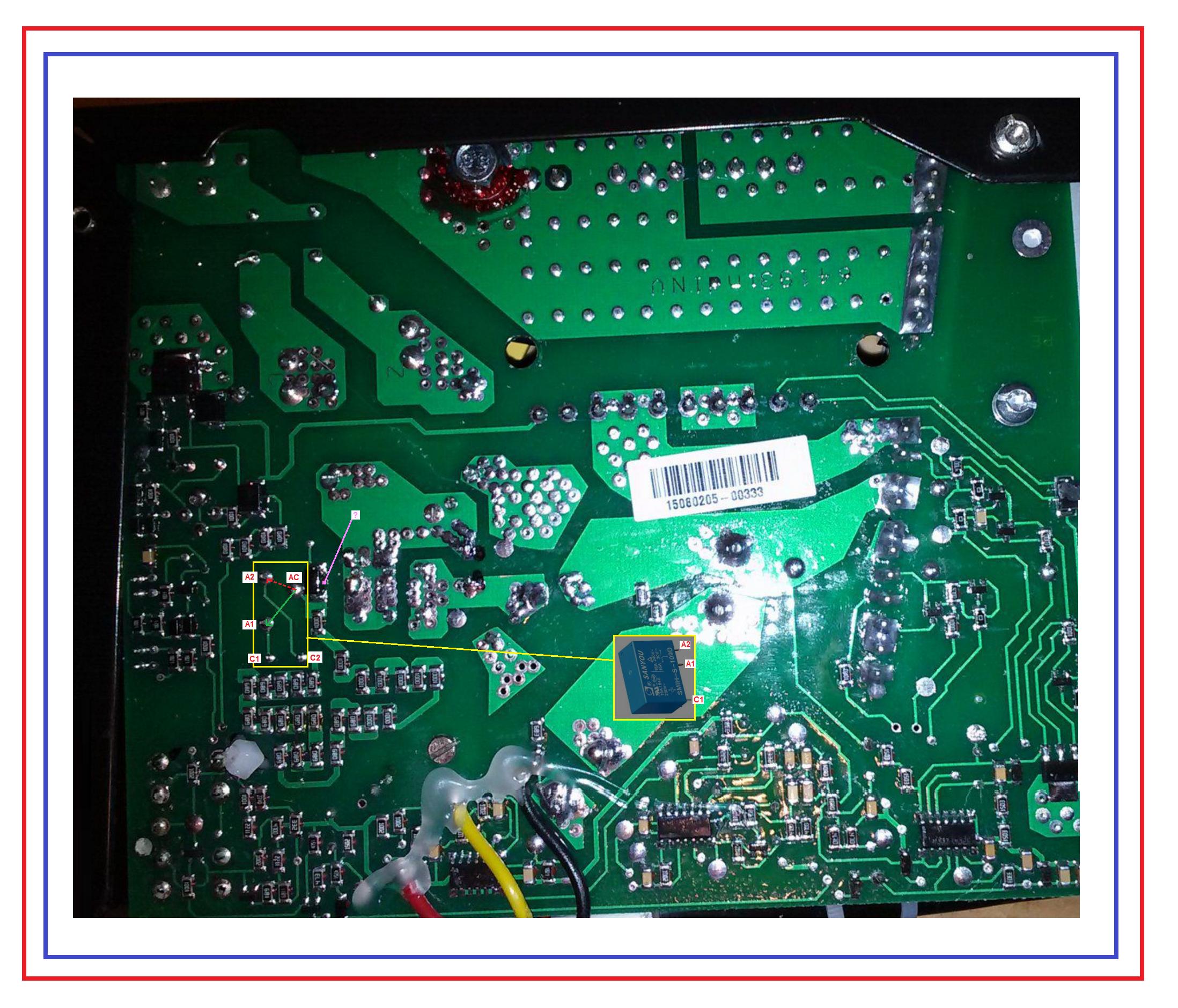
Ed, reading this was like a Maxwell Smart moment. You know those little exchanges between him and the Chief. When the Chief says " Did ya get that Max? " and Max would say " Not quite Chief ". You know how the rest of the dialog goes...
Sir Clambake . . . . . . .
Functionally :
When you bring your "stick" in to your grounded work, the couple of KV's of high voltage initiate a small inter sparking, which creates an initial ionized path.
The 54 volts or so, at MULTI amp POWER capacity then sees that it NOW has a conductive path and it PUSHES in and . . .
ZZZZZZZZZapppppp . . . .
its ARC city ! . . . .with that initial sparking evolving into HOT plasma, until you pull the "stick" away.
Thassit . . . .
73's de Edd
.
You had not made any response in checking out the BLUE relays coil voltage.
and either "stick" a rod or do some heavy work to get the unit into "overload" condition


