555 output to transformer failure

TheMaster

Jul 20, 2016
47
Joined
Jul 20, 2016
Messages
47
I'm a beginner attempting to build a circuit and I'm starting to run out of ideas...
I need to get a somewhat high voltage and low current (above 2ma) through a 100k load with a small device.
I thought I could maybe use these small 1:4 and 1:10 transformers/coupled inductor to do the job:
1:10 Transformer
1:4 Coupled Inductor
With the circuit looking like:
40Ω Resistor is internal resistance
push_pull.png

I get somewhat decent results.
Problem is when I enter the inductance as listed in the datasheet (not leakage inductance) as seen below, everything fails
push_pull.png

Voltage and current on load drop drastically. All other parameters of the transformers don't cause problems.

Is there anyway to do this correctly? Or some other way to obtain the desired results? I'm not getting it...
push_pull.png
 

Alec_t

Jul 7, 2015
3,817
Joined
Jul 7, 2015
Messages
3,817
You are trying to step the voltage up by a factor of 4 x 10 = 400. For 2mA output, that reflects to a 800mA primary current. No way can a tiddly 9V battery with a 40 Ohm internal resistance provide 800mA :(.
 

duke37

Jan 9, 2011
5,364
Joined
Jan 9, 2011
Messages
5,364
You will need a square wave from the 555, i.e. equal low and high times. I do not think that the circuit as shown will do this.

What frequency are you generating, 90kHz?

You could wind your own 1:40 transformer or use a buck convertor which can put much more voltage input than 9V, Limited by the transistor permissible voltage.
 

TheMaster

Jul 20, 2016
47
Joined
Jul 20, 2016
Messages
47
You are trying to step the voltage up by a factor of 4 x 10 = 400. For 2mA output, that reflects to a 800mA primary current. No way can a tiddly 9V battery with a 40 Ohm internal resistance provide 800mA :(.
I thought 4 x 10 = 40
3.3uH is way too small.

Bob
Bob, what do you mean it is to small? Am I entering the data in correctly?
I'm essentially asking if there is a way to do this with these small transformers or not...
Because if I'm entering they're data correctly then I can't find any way to use them efficiently.
 
Last edited:

BobK

Jan 5, 2010
7,682
Joined
Jan 5, 2010
Messages
7,682
A transformer with that kind low an inductance is for use in the Megahertz region.

Bob
 

(*steve*)

¡sǝpodᴉʇuɐ ǝɥʇ ɹɐǝɥd
Moderator
Jan 21, 2010
25,510
Joined
Jan 21, 2010
Messages
25,510
Try placing a capacitor between the junction of the two transistors and the first transformer.

Reverse biased diodes across the transistors may also help.

Choose a capacitor so that the resonant frequency of it and the transformer are equal to the operating frequency of the 555.

Alternatively (and possibly more simply) design a boost converter possibly with the 555 as the signal source. You may be able to get away with operating this open loop.
 

BobK

Jan 5, 2010
7,682
Joined
Jan 5, 2010
Messages
7,682
Can you link to a datasheet of the inductor?

Bob
 

TheMaster

Jul 20, 2016
47
Joined
Jul 20, 2016
Messages
47
Can you link to a datasheet of the inductor?

Bob
http://www.coilcraft.com/pdfs/na5880.pdf
http://www.mouser.com/ds/2/400/e6813_atb3225-22041.pdf

Steve, when I raise the frequency to 1Mhz and put a capacitor as you said the performance improves when I use one transformer, when I put two in a series it falls drastically. Perhaps this isn't a good way to go about it?

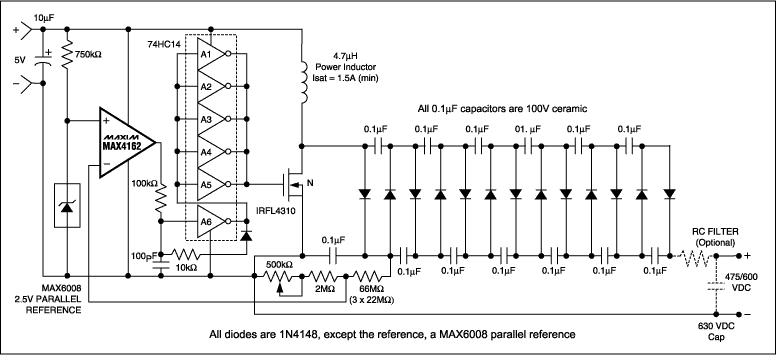
Do you think a boost converter such as this could possibly work? (I have all the necessary components)
3757Fig01.gif

Taken from Here.

Or is the current too low... Perhaps it can be slightly modified.
If not, can you point me to a better idea?
 

(*steve*)

¡sǝpodᴉʇuɐ ǝɥʇ ɹɐǝɥd
Moderator
Jan 21, 2010
25,510
Joined
Jan 21, 2010
Messages
25,510
That's one option, but if you google for a dc-dc switch mode boost converter you'll find better circuits.
 

BobK

Jan 5, 2010
7,682
Joined
Jan 5, 2010
Messages
7,682
In your OP, you state that the 40Ω resistor is internal resistance. Internal resistance of what? The battery? The inductor? In either case it is too high.

Also, it is not clear if your results are coming from a real circuit or from simulation, which is it?

I simulated a simplified version of your circuit, and with the 40Ω resistor is behaves very poorly, without it it is much better.

Bob
 

TheMaster

Jul 20, 2016
47
Joined
Jul 20, 2016
Messages
47
In your OP, you state that the 40Ω resistor is internal resistance. Internal resistance of what? The battery? The inductor? In either case it is too high.

Also, it is not clear if your results are coming from a real circuit or from simulation, which is it?

I simulated a simplified version of your circuit, and with the 40Ω resistor is behaves very poorly, without it it is much better.

Bob
40Ω is the resistance of the batteries. It is inevitable and cannot be changed given the button cells which must be used in this application. The results are from a simulation alone.
I've given up on using two transformers, as I found a 1:50 which is the same size.
I obtain decent results when using a higher frequency and a capacitor in resonance as suggested earlier.

As for a different method as suggested, I don't quite know what constitutes a "good" converter design. A point to a specific circuit would be very helpful.
 

BobK

Jan 5, 2010
7,682
Joined
Jan 5, 2010
Messages
7,682
What battery are you using that has an internal resistance of 40Ω?

The typical resistance of a rectangular 9V alkaline is 1 to 2Ω.


Bob
 
Last edited:

TheMaster

Jul 20, 2016
47
Joined
Jul 20, 2016
Messages
47
What battery are you using that has an internal resistance of 40Ω?

The typical resistance of a rectangular 9V alkaline is 1 to 2Ω.


Bob
I said coin cells. 3 2032 in series one in parallel ~ 9V 40Ω I believe
 

BobK

Jan 5, 2010
7,682
Joined
Jan 5, 2010
Messages
7,682
Then I think your project is doomed.

Actually it is not, doomed, I think you could just make it by using a different inductor.

Here is my reasoning. First, let's look at the current situation. Inductor is 3.3uH. At 90KHz, its inductive reactance is 1.9Ω. So you are driving it with a voltage divider with 40Ω and 1.9Ω. With a perfect half bridge, the most you can get out is then 9V * 1.9 (40 + 1.9) = 0.34V. The RMS voltage is half this for a singled sided square wave, so 0.17V. This is why I said the indcuctor is to small.

Now let's look at power. The current through the inductor will be at max 9V / 41.9Ω = 0.21A. And power is that multipltied by the voltage or 0.21 * 0.17 = 0.036W.

Compare to the output you want, 200V at 2mA = 0.4W.

So it is low by an order of magnitude.

You will get the largest transfer of power when the inductive reactance is 40Ω to match the series resistance. Let's see how that works out.

Voltage across the inductor is 4.5V. Current is 9 / 80 = 0.112A. Power is .250W. Still low by nearly a factor of two.

This is where a full bridge come in. You can get twice the voltage by using a full bridge. And now you can get the power transfer you need! But just barely. The circuit will need to be designed to be as efficient as possible.

The calculations would be different for a boost converter. I suggest you try that out as well to see if it is feasible and what kind of inductor you need.

Let's also compare your circuit to a transistor radio from the 60's. The little rectangular ones that used a 9V battery. They put out, I think, about 100mW of power into the speaker, using a rectangular 9V battery, which is about twice the capacity of your 3 CR2032 cells. So, again, you are right on the edge of being able to do this just from analyzing the power needed.

Bob
 
Top