I want to know all of the maths concerning this scissor mechanism!

Delta Prime

Jul 29, 2020
2,987
Joined
Jul 29, 2020
Messages
2,987
I just googled difference between trousers and pants... Weird is good I'm not judging.
still don't know what the scissor has to do with windmills
That's good! That was a psyc- test
You're not supposed to find a correlation between windmills and scissors.
But if you decide to charge it in full armor
Riding horseback you would tell us right? :oops:
 

Maglatron

Jul 12, 2023
2,025
Joined
Jul 12, 2023
Messages
2,025
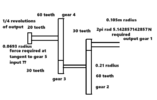
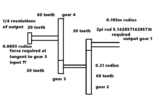
trying to work out the force at gear 5 (input) can't get an answer from chatgpt, it's giving a different answer every time1722196215213.png
 
Last edited:

bertus

Moderator
Nov 8, 2019
3,837
Joined
Nov 8, 2019
Messages
3,837
Hello,

Here are some pages about gearing forces:

I hope you can get the wanted info from that pages.

Bertus
 

Maglatron

Jul 12, 2023
2,025
Joined
Jul 12, 2023
Messages
2,025
thanks Mr Bertus! that info is good but was kind of asking for the simplistic answer or formula to work out tangential force on the input fifth gear if the out put on gear 1 is 5.142857143 with this coumpound gear train the gear 5 turns 1/4 of the output!
1722245674828.png
 
Last edited:

Maglatron

Jul 12, 2023
2,025
Joined
Jul 12, 2023
Messages
2,025
can anyone have a crack? I'd prefer a formula though because I want to experiment with different sizes of gear 5! thanks
 
Last edited:

Alec_t

Jul 7, 2015
3,817
Joined
Jul 7, 2015
Messages
3,817
You have 4:1 gearing, so the torque at gear 4 shaft = 4 x the torque at gear 1 shaft. The tangential force on the 20-tooth gear is the gear 4 shaft torque divided by the radius of the 20-tooth gear.
 

Maglatron

Jul 12, 2023
2,025
Joined
Jul 12, 2023
Messages
2,025
so whatever I do the energy to move the 10.8km^2 inertia flywheel at 0.05rad/s^2 that weights approx 40kg in the ring format the energy is 3.392920066J but if I have (1 newton then that weighs approx 102grams) J/N = meter (high) then the height it needs to lift up is 3.392920066m and the lever arm is s = r theta 3.392920066/0.3490658504 equals 9.72m lever arm the flywheel moves at 2pi rad/s initially the wheel is about 392 times the mass and it's moving I think the problem is starting me in the face but common sence says that I should be able to use the mass of the moving wheel to shoot the 102gram wheight up easily
 
Last edited:

Maglatron

Jul 12, 2023
2,025
Joined
Jul 12, 2023
Messages
2,025
if the force downawrd is 0.25N (25gram 0.02549290532kg) it needs to lift 13.57168026 meters It just makes sence that the moving mass of 40kg 10.8kgm^2 can lift the 25 gram weight 13.57168026m easily given the right mechanism what do you guys think if it hits with impact to "shoot" it up and not lose 3.392920066J in doing it, I think it's about power which is J/sec so if I move it up slower than it falls eg 1 sec to fall equals 3.392920066watts but if it lifts up in 2 seconds then it will use 1.69460033watts to lift
 
Last edited:

Maglatron

Jul 12, 2023
2,025
Joined
Jul 12, 2023
Messages
2,025
weather the distance of the arc of the lever is lifted 1.319468915m and 2.571428573N downwards or arc of 13.57168026m and 0.25N the energy is = to 3.392920066J fo acceleration of 0.05rad/s^2 and inertia of 10.8kgm^2
 

Maglatron

Jul 12, 2023
2,025
Joined
Jul 12, 2023
Messages
2,025
sorry
so whatever I do, the energy to move the 10.8km^2 inertia flywheel at 0.05rad/s^2, that weights approx 40kg - in the ring format, the energy is 3.3929J. But if I have (1 newton then that weighs approx 102grams) then J/N = 3.3929J / 1N =meter (in this case the distance moves up, high) then the height it needs to lift up is 3.3929m, and the lever arm is r, and s = r theta 3.3929/0.34906 equals 9.72m = lever arm, the flywheel moves at 2pi rad/s initially, the wheel is about 392 times the mass, and it's moving. I think the problem is starting me in the face, but common sence says that I should be able to use the mass of the moving wheel to shoot the 102gram wheight up easily

if the force downawrd is 0.25N (25gram 0.02549kg), it needs to lift 13.5716 meters, upward. It just makes sence that the moving mass of 40kg 10.8kgm^2; can lift the 25 gram weight 13.5716m easily - given the right mechanism, what do you guys think? if it hits with impact to "shoot" it up - and not lose 3.3929J in doing it, I think it's about power which is J/sec, so if I move it up slower than it falls eg 1 sec to fall equals 3.39292watts, but if it lifts up in 2 seconds then it will use 1.6946watts to lift

weather the distance of the arc of the lever is lifted 1.3194m and 2.5714N downwards, or arc of 13.5716m and 0.25N, the energy is = to 3.3929J for acceleration of 0.05rad/s^2 and inertia of 10.8kgm^2
now I'm going the other way heavier weight, less height, so less stage of scissor and for a cam profile of 5% slope!!
hope that you can read it now!!
 
Last edited:

Maglatron

Jul 12, 2023
2,025
Joined
Jul 12, 2023
Messages
2,025
so now I'm thinking 3.3929J / 0.3m (height) = 11.3097N approx 1.1528kg, and have a cam that varies with 1 lobe 10cm drop off (need to design the cam so that the slope is 5%) and have the scissor have only 3 levels, this way Fv will be 3*f and then so Fv = 3 * 11.3097 = 33.9292, and the Hf will be = 5% of Fv, 33.9292 * 0.05 = Hf = 1.6964N
From energy considerations, for a n-stage scissor mechanism the vertical force Fv the cam needs to provide will be n x the vertical force fv needed to accelerate the load at the top. But if the cam has a s% slope then the horizontal force Fh on the cam follower will be s% of Fv,
If n=10 and s=10% (which I think is the arrangement you presently have) then Fh will just happen to equal the force f.
It is Fh which determines the cam torque needed.
need to design a cam that varies over it's slope 10cm and must be 5% any ideas people, 1 lobe! max radius min radius or a formula - must tick 5% slope box and 10cm from max to min box?? ideas, thanks does not need to be 10 cm the important part is it needs to be 5% slope, thanks but would be good if the solution ticked both boxes for the design of the cam
 
Last edited:

Maglatron

Jul 12, 2023
2,025
Joined
Jul 12, 2023
Messages
2,025
slope = Rmax - Rmin / 2pi * Ravg
can I rearrange this formula for 5% slope??
average radius Ravg half way between the minimum and maximum radii Rmin, Rmax.
the smaller the lower radius the better because lower radius = lowers required torque!
 
Last edited:

Harald Kapp

Moderator
Moderator
Nov 17, 2011
14,272
Joined
Nov 17, 2011
Messages
14,272
can I rearrange this formula for 5% slope??
Obviously you can't, why else would you ask ;)
average radius Ravg half way between the minimum and maximum radii Rmin, Rmax.
makes for Ravg = 1/2 × (Rmax+Rmin).
Insert into
slope = (Rmax - Rmin) / (2×Pi × 1/2×(Rmax+Rmin)) = (Rmax - Rmin) / (Pi × (Rmax+Rmin)) = 0.05.
You now have an equation with two variables: Rmax and Rmin. You need to define one of the two, e.g. Rmin, then solve the equation for Rmax. Or vice versa.
 
Top