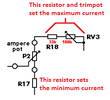
The output current is not shutoff when the current exceeds the current setting. Instead the current is regulated to drop to and stay at the setting:
Yes, I understand this.
Responding to your numbered points:
1) Agreed.
2) "Voltage is set to 20.0V and current is set to 1.0A. A load of 10 ohms is applied. The output voltage must drop to 10 ohms x 1A= 10V and the output of U3 drops to about +3.13V. The input of U2 is about +3.73V."
I think we agree here, too. The input of U2 has to be just low enough that the positive output is 10v, measured relative to the negative output terminal. Measured relative to ground, we add the 1A times the resistance of the R7 current sense resistor, or 10.47 volts. To get nominal 10v output, the input of U2 is down by the gain of the U2 amp stage set by the feedback resistors R12, R11, RV2. It should be around 3+ volts and the output of U3, setting the CL will be 0.6 lower, so those numbers look right.
3)" Voltage is set to 20.0V and current is set to 1.0A. The output is shorted. The output voltage must be 0V and the current must be 1A. The output of U3 drops to about -0.04V and the input of U2 is about +0.56V. The output of U3 will never go below -0.04V which does not harm it since its negative supply is -1.3V."
This looks right, too.
"The gain of the voltage amplifier is 30V/11.2V= 2.68 and the output of U2 never goes below about +1.2V due to the driver and output transistors Vbe voltage drops. The non-inverting input of U2 is always at least +1.2V/2.68= +0.45V when the voltage and current settings are zero and there is no load. Many ordinary opamps have inputs that do not work when they are a few volts from the negative supply pin, but the inputs of the TLE2141 work all the way down to the negative supply pin voltage."
OK, put that way, assuming that both transistors are always forward biased base to emitter, I understand. But is that assumption warranted? Are there no conditions under which the input of U2 might be low enough to drive the output low enough to cut off the transistors? I can see that assuming that they aren't in cutoff requires an input that is safe, but I don't understand where that assumption comes from (not disagreeing, just haven't worked through it yet, and it was the only way to explain my simulation problem I could come up with.)
"Isn't the idling current simply the 3.4mA to 4.4mA current of U2? You are correct, U2 gets hot but not too hot."
The rev 7 design has the idling current of U2 going direct to ground, so the current limiting circuit doesnt see it. It's the idling current of U1 that goes through R7, so there is 3.4 to 4.4 mA for the TLE 2141. Also, there is another 5.6mA idling through zener D8 and R4. The rest comes from gain resistors on both U1 and U2 and pot P1, but its minor. Most of that is eliminated by removing U1.
"The driver and output transistors need huge non-enclosed heatsinks or a fan."
Yes. I even considered adding another 2n3055. (4 instead of 3). The present heatsink is roughly 7"x8".
Also, my transformer has two additional 10 vac rms windings, each rated for 5A, I intend to connect them in series and provide a 20v second supply in the same housing that I will use for lower voltage high current conditions. I might even use a relay with the windings to autoswitch so that they are in series only when needed and at the lowest voltages, high current conditions, only a single 10vac rms winding is in use. That way the main supply will seldom run at low voltage high current, except when accidentally shorted

Thanks for taking the time to reply. I really appreciate it.