RMS and Average Value Difference

Electric1

Nov 29, 2025
50
Joined
Nov 29, 2025
Messages
50
1769316989728.png
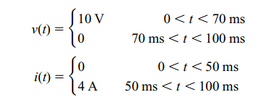
For the above waveform i can calculate the Average value and the RMS value as below
Avg Voltage = 1/0.1*(10*0.07 + 0 * 0.03)=0.7/0.1 = 7 V
Avg Current = 1/0.1*(0*0.05 + 4 * 0.05) = 2 A

Rms Voltage = 10*Sqrt(D) = 10*Sqrt(0.7) = 8.3V
RMS Current = 4*Sqrt(0.5) = 2.82A

Now my main question is when to use the average value and when to use rms value for example in power calculations etc. I was always of the impression that RMS values are only calculated for singnals whose Average value is 0 for example periodic sine signals etc. Is my understanding correct?
 

Electric1

Nov 29, 2025
50
Joined
Nov 29, 2025
Messages
50
The power is calcualted as time average of V * I
1/0.1*(10*4*0.02) = 8Watts. ->1

Power using average voltage and current
7V * 2A = 14Watts ->2

Power using the RMS voltage and current
8.3V * 2.82A = 23.4 Watts. ->3

So both 2 and 3 do not match 1, probably i cannot use 2 and 3 for power calculations.

Now if i consider V = Asin(wt), I = Bsin(wt);
Avg V = 0
Avg I = 0;
P = Time integral of Voltage and current;
P = ABsin^2(wt) -> P = AB/2 -> P = A/sqrt(2) * B/sqrt(2) -> Vrms * I rms;

So the power calculation is dependent on the input waveform, am i correct?
 

crutschow

May 7, 2021
986
Joined
May 7, 2021
Messages
986
The average value of a waveform does not show the true power.

The RMS calculation gives you the true power delivered by the waveform.
You do the calculation for the waveform shape, and it does not depend upon the waveform having an average value of zero.
For example, if the waveform has a DC offset, it just adds to the RMS calculated value.

To do a discrete RMS power measurement, you can take a large number of simultaneous voltage and current measurements during one cycle of the waveform, multiply each voltage and current value to get the power at that measurement point, and then take the average (the mean from RMS) of those power measurements over the cycle.
That will give a true power value, even for waveforms with a voltage/current phase-shift from a reactive power load, a distorted wave, and/or any arbitrary wave-shape.
This is often done with fast A/D converters and a digital processor to do the math.
 
Last edited:

Delta Prime

Jul 29, 2020
2,989
Joined
Jul 29, 2020
Messages
2,989
IMG_0794.jpeg
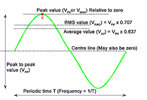
Six of the most important characteristics of a sine wave are;
PEAK TO PEAK value.
INSTANTANEOUS value.
AMPLITUDE.
PEAK value.
PERIODIC TIME.
AVERAGE value.
RMS value.
The link below will answer all your next questions that you will naturally have..
 

Electric1

Nov 29, 2025
50
Joined
Nov 29, 2025
Messages
50
But as you can see in post2 the power calculations are not matching, why?
 

Electric1

Nov 29, 2025
50
Joined
Nov 29, 2025
Messages
50
View attachment 69810
Six of the most important characteristics of a sine wave are;
PEAK TO PEAK value.
INSTANTANEOUS value.
AMPLITUDE.
PEAK value.
PERIODIC TIME.
AVERAGE value.
RMS value.
The link below will answer all your next questions that you will naturally have..
The average value of the above waveform should be 0 as it has equal areas on the positive and negative side. What am i missing here?
 

Delta Prime

Jul 29, 2020
2,989
Joined
Jul 29, 2020
Messages
2,989
Unfortunately, this homework help I cannot give you the answer I could be banned for doing so… :(
 

Electric1

Nov 29, 2025
50
Joined
Nov 29, 2025
Messages
50
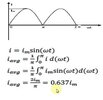
Vavg = [math]\frac{\int_0^\pi V\sin(wt) w dt}{\pi} = V*2/\pi =V* 0.637[/math]
Only positive cycle is considered above, it is confusing each book is following different methodologies.
 

Harald Kapp

Moderator
Moderator
Nov 17, 2011
14,281
Joined
Nov 17, 2011
Messages
14,281
So the power calculation is dependent on the input waveform, am i correct?
Yes to this.

But there's more to it. With sinusoidal waveforms you also have to take into account the pase shift between voltage and current. For example you may have:
[math] V_{rms} = V_0 \cdot sin(wt) [/math][math] I_{rms} = I_0 \cdot sin(wt+ \phi) [/math]Where φ is the phase shift between voltage and current.

For any complex periodic waveforms you have:
[math]P_{rms} = \sqrt{\frac{1}{T}\int_0^T{(v(t)\cdot i(t)) dt}}[/math]
Only positive cycle is considered above,
That's because the sinusoidal waveform is symmetric. So
[math]\sqrt{\frac{1}{T}\int_0^T{(v(t)\cdot i(t)) dt}} = \sqrt{\frac{1}{(\frac{T}{2})}\int_0^\frac{T}{2}{(v(t)\cdot i(t)) dt}}[/math]
 

Alizayy

Dec 31, 2025
5
Joined
Dec 31, 2025
Messages
5
The RMS value represents the "DC equivalent" heating power of a waveform, and you must calculate the average of the instantaneous power (the product of [imath]v(t) \cdot i(t)[/imath]) rather than multiplying independent average or RMS values to find true power in non-sinusoidal or phase-shifted systems.
 

Delta Prime

Jul 29, 2020
2,989
Joined
Jul 29, 2020
Messages
2,989
Average values are mostly used when you want to know the net or mean value of a waveform over time, like the average current flowing in a half-wave rectifier, or when designing certain DC circuits.
Thank you for your contributions AI.
"Average" is the broader, general term for central tendency, while "mean" is the specific statistical calculation.
 
Top