12V - 300V with Royer Oscillator

abuhafss

Aug 3, 2010
348
Joined
Aug 3, 2010
Messages
348
Hi

Please see the schematic below:
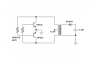
Screenshot 2014-09-22 19.20.46.png
The transformer is a small ferrite EE core
Primary 12+12 turns of 0.38mm (inductance 19-20μH each)
Secondary 3570 turns of 0.25mm (inductance 12.77mH)

I got about 550VDC at the cathode of UF4007 however, only transistor gets hot. Within few seconds, it could not be touched. The other remained at ambient temperature.

Is it normal? If not, what could be the reason?
 

KrisBlueNZ

Sadly passed away in 2015
Nov 28, 2011
8,393
Joined
Nov 28, 2011
Messages
8,393
The Royer oscillator is a full wave forward converter. You should use a bridge rectifier at the output. That will change something - either both transistors will get hot, or both will run cool!

I don't think the Royer oscillator is very suitable as a CDI driver. It works best working into a constant load, not a load that is constantly being discharged. Also you need a much higher turns ratio. But I could be wrong.
 

abuhafss

Aug 3, 2010
348
Joined
Aug 3, 2010
Messages
348
I don't think the Royer oscillator is very suitable as a CDI driver. It works best working into a constant load, not a load that is constantly being discharged. Also you need a much higher turns ratio. But I could be wrong.

See post #43 here.
Wherein, debe is informing that it has been used in CDI's for many years.
 

Arouse1973

Adam
Dec 18, 2013
5,178
Joined
Dec 18, 2013
Messages
5,178
I believe this is a form of a saturable core oscillator and the problem you maybe having is the use of a core material which does not saturate easily and does not have a rectangular hysteresis loop. The core needs to saturate so the magnetic field collapses quickly and a rectangular hysteresis loop ensures fast transition between on and off because of low core retention. If you don't have the correct core the transistors could spend time in the partly on off region and generate excessive heat which could damage the transistor. Some designs also put a capacitor across the primary winding to limit high voltage spikes that can also damage the transistors.
Adam
 

abuhafss

Aug 3, 2010
348
Joined
Aug 3, 2010
Messages
348
I believe this is a form of a saturable core oscillator and the problem you maybe having is the use of a core material which does not saturate easily and does not have a rectangular hysteresis loop. The core needs to saturate so the magnetic field collapses quickly and a rectangular hysteresis loop ensures fast transition between on and off because of low core retention. If you don't have the correct core the transistors could spend time in the partly on off region and generate excessive heat which could damage the transistor. Some designs also put a capacitor across the primary winding to limit high voltage spikes that can also damage the transistors.
Adam

You might be correct but, how only one transistor would dissipate enormous amount of heat while the other stays cool :confused:?
 

Arouse1973

Adam
Dec 18, 2013
5,178
Joined
Dec 18, 2013
Messages
5,178
I don't know to be honest maybe a slight difference in the core?
Adam
 

KrisBlueNZ

Sadly passed away in 2015
Nov 28, 2011
8,393
Joined
Nov 28, 2011
Messages
8,393
You might be correct but, how only one transistor would dissipate enormous amount of heat while the other stays cool :confused:?
I answered that.
The Royer oscillator is a full wave forward converter. You should use a bridge rectifier at the output. That will change something - either both transistors will get hot, or both will run cool!
You are going about this the wrong way. You do not just find some core that you have laying around and try to make it work. You design the inductor for the requirements you need - which includes saturation characteristics, then you buy the core you want.

This is especially important with blocking and Royer oscillators because saturation of the core is the critical factor that makes the oscillator work properly... or not.

Because you don't know the characteristics of your core, you are wasting both your time and ours.
 
Top