Arduino & DFPlayer mini noise.

Martaine2005

May 12, 2015
5,276
Joined
May 12, 2015
Messages
5,276
Hello forum,
As the title suggests, I’m having issues with noise.
One wire in particular on the breadboard which connects both sides Negatives together acts as an antenna.
The other noise issues are (I believe) low frequency oscillations from the DFPlayer while playing.
The Arduino has a higher frequency oscillation and when the neopixels flash, there’s a distinct clicking at the same time.
I’m powering the Arduino with my bench PSU with 8V. I put an LM7805 on the breadboards power lines for the DFPlayer and neopixels (one strip of 8).
I’ve added a 1000uF and 100nF to the power lines.
I’ve also added 100nF as close as possible to the DFPlayer VCC and GND.
I’ve tried several bench PSUs too with same results.
I realise that breadboards can be noisy but I’m hoping that someone will have had similar results and have a solution.
Google results say adding a series 1K resistor on the DFPlayer TX to Arduino RX fixes it . It doesn’t.
Others say a resistor divider (470 & 1K) works. It doesn’t.
Where else can I filter?

Thanks Martin
 

danadak

Feb 19, 2021
1,063
Joined
Feb 19, 2021
Messages
1,063
Picture of the breadboard and circuit connections layout. Possibly a
schematic of interconnect between player and Arduino.

Do you have a scope so you can look at signal lines/grounds/power
distribution ?
 

Martaine2005

May 12, 2015
5,276
Joined
May 12, 2015
Messages
5,276
Thanks @danadak ,
I knew those questions would be asked:) and I should have been better prepared.
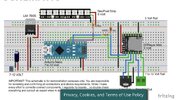
I’ll sort the schematic and pictures as soon as I can.
After work tonight, I’m going to solder it all to perf board first to eliminate my breadboard and jumper wires.
 

Martaine2005

May 12, 2015
5,276
Joined
May 12, 2015
Messages
5,276
This is the breadboard layout exactly how I copied it.
One minor difference is that I put the 7805 on the bottom power strip with the output going to the top power strip.
The black wire connecting top and bottom negative/GND together is quite bad as an antenna. Touching it sounds like running your finger over a record deck stylus.
Other than that, it’s very tidy like the picture.
 

Attachments

  • IMG_6234.jpeg
    IMG_6234.jpeg
    210.6 KB · Views: 4

Martaine2005

May 12, 2015
5,276
Joined
May 12, 2015
Messages
5,276
They are there. In fact, I went overboard!.
But I may have sorted it now. I put a 1000uF on the 7805 output and the noise almost disappeared. I followed up with a 470uF and it’s almost perfect. I had decoupling everywhere. I systematically removed one by one and listened to the difference. No difference at all.
So now I have a 100uF and 0.1uF on the input and 1000uF + 470uF + 0.1uF on the output. It sounds great now.
 

Martaine2005

May 12, 2015
5,276
Joined
May 12, 2015
Messages
5,276
I’m completely new to Arduino and coding. The device I’m copying is a random thunder and lightning unit for a friend’s Halloween party. The code was also copied and works great.
I have other questions about adding to the unit, like mosfets or relays trigger at the same time as the lightning. Should I open another thread or continue here? (Moderators?)
Thanks. Martin
 

Delta Prime

Jul 29, 2020
2,987
Joined
Jul 29, 2020
Messages
2,987
I systematically removed one by one and listened to the difference. No difference at all.
So now I have a 100uF and 0.1uF on the input and 1000uF + 470uF + 0.1uF on the output. It sounds great now.
Paralleling capacitors with different values capacitance spreads the load caused by current spikes at different frequencies, it also distributes heat dissipation so no individual cap gets self heated over its design threshold.
You’re a “Natural” my friend.:)
 
Last edited:

ahsrabrifat

Jan 18, 2025
76
Joined
Jan 18, 2025
Messages
76
Hello forum,
As the title suggests, I’m having issues with noise.
One wire in particular on the breadboard which connects both sides Negatives together acts as an antenna.
The other noise issues are (I believe) low frequency oscillations from the DFPlayer while playing.
The Arduino has a higher frequency oscillation and when the neopixels flash, there’s a distinct clicking at the same time.
I’m powering the Arduino with my bench PSU with 8V. I put an LM7805 on the breadboards power lines for the DFPlayer and neopixels (one strip of 8).
I’ve added a 1000uF and 100nF to the power lines.
I’ve also added 100nF as close as possible to the DFPlayer VCC and GND.
I’ve tried several bench PSUs too with same results.
I realise that breadboards can be noisy but I’m hoping that someone will have had similar results and have a solution.
Google results say adding a series 1K resistor on the DFPlayer TX to Arduino RX fixes it . It doesn’t.
Others say a resistor divider (470 & 1K) works. It doesn’t.
Where else can I filter?

Thanks Martin
Breadboards create noise. Long wires act like antennas. NeoPixels add sharp current spikes. These spikes disturb the DFPlayer power line. The result is clicks and hiss. A stable layout helps a lot. A small example is here: https://www.pcbway.com/project/sponsor/Arduino_With_Neopixel.html.

Give the NeoPixels their own 5V rail. Join all grounds at one point. Keep wires short. Add a 1000 µF cap at the strip input. Add 100 nF caps near each module. Use a buck converter instead of a 7805. Add a 220 Ω resistor on the NeoPixel data line.

Place a 100 nF and a 10–47 µF cap on the DFPlayer pins. Shorten speaker wires. Add a ferrite if needed. Reduce brightness to test load. If noise drops, the supply is weak. A simple proto-board layout often fixes the rest.
 
Top