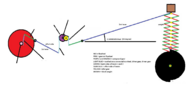
I want to know all of the maths concerning this scissor mechanism!

Maglatron

Jul 12, 2023
2,025
Joined
Jul 12, 2023
Messages
2,025
ok i'll learn about spreadsheets! thanks

any ideas of what to put in the rows and columns, very new to spreadsheets? thanks

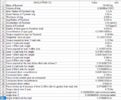
so the only things I might be changing now is the rotaion speed of the cam and the speed of the flywheel, I will be experimenting with different numbers for the best results but the weight of the block will be staying the same, 0.2622kg, the height it needs to be lifted to will stay the same, 1.32m, the size of the cam will remain the same the potential energy in the block to start with stays the same 3.392920066J
 

Maglatron

Jul 12, 2023
2,025
Joined
Jul 12, 2023
Messages
2,025
ok so I've enerted the digits I'll try and use formulas next time round so that if I alter somthing then the precceding values will change automatically
1721309093577.png
 
Last edited:

Alec_t

Jul 7, 2015
3,817
Joined
Jul 7, 2015
Messages
3,817
The number of decimal places can be set in LibreOffice. A maximum of 3 would make your maths easier to follow.
 

Maglatron

Jul 12, 2023
2,025
Joined
Jul 12, 2023
Messages
2,025
thanks am using openoffice calc, how do I set to 3sdp please
ok found round function is there any way to round all to 3sdp's at once or do I go through one by one?
went through one by one 1721317033654.png
 
Last edited:

Alec_t

Jul 7, 2015
3,817
Joined
Jul 7, 2015
Messages
3,817
Much tidier. :)
You can 'click and drag' to select a group of cells, then apply a chosen number format. By default the number of decimal places displayed is 2, but any calculations are actually done to many more places.
This link, first hit, shows one way to customise the number of places.
 

Maglatron

Jul 12, 2023
2,025
Joined
Jul 12, 2023
Messages
2,025
thank you
so do you get what is going on in the thing I'm building, can you visulize what it looks like yellow is an idler gear just to switch direction! and the units for the density are kg/m^3
 

Attachments

  • unlabelled.png
    unlabelled.png
    298.7 KB · Views: 1
Last edited:

Maglatron

Jul 12, 2023
2,025
Joined
Jul 12, 2023
Messages
2,025
Force = mass x acceleration (not forgetting g-force). Acceleration is controlled by cam profile and cam rotation rate.
In view of all the changes you keep making, why not put all the formulae you need into a spreadsheet so that changes to parameters result in any dependent parameters being updated automatically?

so I know that you explained that F = ma , and that I need to add in gravity but as I understand it that has to be the force at the top of the scissor. what do you think the force needs to be at the cam ? also I think that the larger the cam the shallower the slope (ie profile of the cam), the less force, and the longer time that it takes to move the scissor with the weight on top - the less force will be needed, what are your thoughts how fast sould the cam be turning and how much force do you think I will need at the cam? but instead of solving the problem perhaps you could provide all of the formulas this information will be worth it's weight in gold - to me!! or you could use digits as a template in the formulas
 
Last edited:

Alec_t

Jul 7, 2015
3,817
Joined
Jul 7, 2015
Messages
3,817
From energy considerations, for a n-stage scissor mechanism the vertical force Fv the cam needs to provide will be n x the vertical force fv needed to accelerate the load at the top. But if the cam has a s% slope then the horizontal force Fh on the cam follower will be s% of Fv,
If n=10 and s=10% (which I think is the arrangement you presently have) then Fh will just happen to equal the force f.
It is Fh which determines the cam torque needed.
 

Maglatron

Jul 12, 2023
2,025
Joined
Jul 12, 2023
Messages
2,025
hmm so n is 10 because of the 10 stages of scissor, Fv is the vertical force the cam needs to provide, and that will be n * fv with a little f to differentiate from the capitalized Fv which denotes the vertical force at the cam, and n * fv is needed to accelerate the load at the top of the scissor. I'm confused about the slope s and its percentage. the horizontal force on the cam, Fh, on the cam follower will be the slope percentage s% of Fv I get that part but then I get lost!!! thanks can you relate the Fh value to the torque why does s = 10%? still a little confused but I can feel progress! which direction is the f that is equal to Fh? is it fv? i GET WHY IT'S 10% is because it's equal to 0.109!! getting there
ok so Fv is n * fv
n = 10
Fh = s% of Fv
s = 10% of 10 is 1
1 * fv is just fv
correct?
 
Last edited:

Maglatron

Jul 12, 2023
2,025
Joined
Jul 12, 2023
Messages
2,025
also how fast does the cam need to be going at and how do I relate it to Fh to the speed? I think there's a bit more maths involved! thanks
do I still need to accelerate to the final velocity of the block in the first 10% of time?
 
Last edited:

Alec_t

Jul 7, 2015
3,817
Joined
Jul 7, 2015
Messages
3,817
do I still need to accelerate to the final velocity of the block in the first 10% of time?
It's your choice as to the duration of that initial acceleration. I used 10% as an example.
You have already specified the cam speed as 4 sec per revolution.
 

Maglatron

Jul 12, 2023
2,025
Joined
Jul 12, 2023
Messages
2,025
From energy considerations, for a n-stage scissor mechanism the vertical force Fv the cam needs to provide will be n x the vertical force fv needed to accelerate the load at the top. But if the cam has a s% slope then the horizontal force Fh on the cam follower will be s% of Fv,
If n=10 and s=10% (which I think is the arrangement you presently have) then Fh will just happen to equal the force f.
It is Fh which determines the cam torque needed.
this is very clever! as I understand it there will be two main forces involved, the force required to accelerate to the final velocity and then the force that will only be overcoming the weight and the acceleration due to gravity (2.5713N) that keeps it as that same velocity how do I use that information for the two forces in your example I don't know which force you described in that equation!! thanks

It's your choice as to the duration of that initial acceleration. I used 10% as an example.
You have already specified the cam speed as 4 sec per revolution.
I would like to keep it at 10% of the 2sec / half revolution, thanks
 

Alec_t

Jul 7, 2015
3,817
Joined
Jul 7, 2015
Messages
3,817
... ..
as I understand it there will be two main forces involved, the force required to accelerate to the final velocity and then the force that will only be overcoming the weight and the acceleration due to gravity (2.5713N) that keeps it as that same velocity
Yes. The cam torque to get that acceleration is accordingly greater than the torque needed to sustain the final velocity. The torque is the horizontal force times the radius at which it acts.
 

Alec_t

Jul 7, 2015
3,817
Joined
Jul 7, 2015
Messages
3,817
In the above post you are quoting old data. But you have since changed the cam speed and the rise height. The rise time is now 2 sec. Height is now 1.32m.
 

Maglatron

Jul 12, 2023
2,025
Joined
Jul 12, 2023
Messages
2,025
yes sorry about that I wasn't thinking about that I was thinking about the formula You want the weight to rise at constant velocity; but when the weight falls to its lowest point it instantly has zero velocity and then has to reverse to have a positive (upward) velocity. Let's assume that for 90% of the 2sec rise time the velocity v is constant. So v=(0.9 x 1.32m)/(0.9 x 2s) m/s = 0.66m/s. That means v has to reached from zero by an acceleration f in the first 10% of the 2sec, so f= v/(0.1 x 2) = 0.66/0.2 = 3.3m/s^2. + 9.80665m/s^2 = 13.10665N. is this the Fh of Fv? gut tells me it's Fv
 
Last edited:

Maglatron

Jul 12, 2023
2,025
Joined
Jul 12, 2023
Messages
2,025
because if it's Fv then Fh will be
s% of Fv = 13.10665N * 0.1 = 1.311N
BUT thats less than the 2.5713N (0.2622kg * 9.80665m/s^2) so
the 13.10665 must be the Fh
Am I missing something?? thanks

Fh = fv = 13.106N for 10% of the time! remaining 90% = 2.571N
 
Last edited:

Maglatron

Jul 12, 2023
2,025
Joined
Jul 12, 2023
Messages
2,025
fv = Fh
since the scissors have 10 levels and the slope remains 10% so no matter the the force required at the top, Fh will be equal to fv!!
correct??
 

Alec_t

Jul 7, 2015
3,817
Joined
Jul 7, 2015
Messages
3,817
I'm afraid I've confused things further by inadvertently using symbol f for force and acceleration.
so f= v/(0.1 x 2) = 0.66/0.2 = 3.3m/s^2.
That's correct where f is the acceleration. The vertical force fv required to accelerate mass m initially against gravity by acting on the mass itself is m x (3.3m/s^2 + 9.81m/s^2).
For the 10-stage scissor the vertical force Fv exerted by the cam will be 10 x fv. If the cam has a s% slope then the horizontal force Fh to move the cam follower is s% x Fv.
 
Top