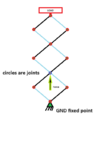
I want to know all of the maths concerning this scissor mechanism!

Maglatron

Jul 12, 2023
2,025
Joined
Jul 12, 2023
Messages
2,025
I'm afraid I've confused things further by inadvertently using symbol f for force and acceleration.

That's correct where f is the acceleration. The vertical force fv required to accelerate mass m initially against gravity by acting on the mass itself is m x (3.3m/s^2 + 9.81m/s^2).
For the 10-stage scissor the vertical force Fv exerted by the cam will be 10 x fv. If the cam has a s% slope then the horizontal force Fh to move the cam follower is s% x Fv.
okay yes I get that a = delta v / t and am glad you included that information
but still if the n are the stages of scissor n = 10 so, (10 * fv = Fv ) and have 10% slope, Fh is 10% of Fv, then Fh must equal to the fv in all cases?!? thanks because the 10 * 10% = 1 so that's 1 *fv or just fv
is this correct
 
Last edited:

Maglatron

Jul 12, 2023
2,025
Joined
Jul 12, 2023
Messages
2,025
No. It only applies for the special case where the slope is 10% and there are 10 scissor stages, so that n x s% = 1.
I meant in all cases that there are 10 stages and 10% slope that = to 1
no matter the force required at the top of the cam follower the Fh will equal fv
 

Maglatron

Jul 12, 2023
2,025
Joined
Jul 12, 2023
Messages
2,025
so f = ma
a = v/(0.1 x 2) = 0.66/0.2 = 3.3m/s^2.
0.2622kg * 3.3m/s^2 = fv = 0.865N and so because slope is 10% and 10 stages of scissor Fh = s% of Fv
Fh = 0.865N!!

this is accounting for the face that 3.3m/s^2 is acceleration and for the force we need to multiply by the mass 0.2622kg
 
Last edited:

Maglatron

Jul 12, 2023
2,025
Joined
Jul 12, 2023
Messages
2,025
I think I am missing something because the force that will only be overcoming the weight and the acceleration due to gravity (2.5713N) that keeps it as that same velocityis MORE than the accelerating force of 0.865N where as it should be less
 

Maglatron

Jul 12, 2023
2,025
Joined
Jul 12, 2023
Messages
2,025
the energy of the block before it drops is3.392920066J
3.392920066J / 1.319568915m = 2.57123N
force needed to keep moving at constant velocity = 2.57123N
2.57123N
/ 9.80665 =mass of 0.2622kg

accelerating force =0.2622kg * 3.3m/s^2 = 0.86526N

But this is counter intuitive because the acceleration force should be a higher value that the force to keep it moving at a constant velocity???
thanks forgotten to add gravity1
that now makes sence (3.3 + 9.80665) * 0.2622 = 3.43656N which is greater than 2.57123N
so now
is the torque simply the forces * radii of the cam ??
thanks
 
Last edited:

Maglatron

Jul 12, 2023
2,025
Joined
Jul 12, 2023
Messages
2,025
Is this still vaid??

you could consider the spiral has an average radius Ravg half way between the minimum and maximum radii Rmin, Rmax. The spiral length would then be 2 x pi x Ravg. Over that length the cam-follower moves a vertical distance Rmax - Rmin. So, the average slope is (Rmax-Rmin)/(2 x pi x Ravg). The rotational force needed, ignoring friction, would be Force x slope acting at a radius of Ravg, which is a torque of Force x slope x Ravg Nm.
 

Maglatron

Jul 12, 2023
2,025
Joined
Jul 12, 2023
Messages
2,025
you could consider the spiral has an average radius Ravg half way between the minimum and maximum radii Rmin, Rmax. The spiral length would then be 2 x pi x Ravg. Over that length the cam-follower moves a vertical distance Rmax - Rmin. So, the average slope is (Rmax-Rmin)/(pi x Ravg). The rotational force needed, ignoring friction, would be Force x slope acting at a radius of Ravg, which is a torque of Force x slope x Ravg Nm.
the numbers work out better with this equation
 

Alec_t

Jul 7, 2015
3,817
Joined
Jul 7, 2015
Messages
3,817
Is this still vaid?
No. That was for a single-lobe cam. For a 2-lobe cam replace 2 x pi by just pi. Also, that torque is for the constant velocity part of travel, so does not apply to the initial 10% of travel where the cam follower has to accelerate.
If you want greater accuracy for the torque value you will need to allow for the force acting at a radius which varies with rotation angle, which complicates the maths somewhat.
 

Maglatron

Jul 12, 2023
2,025
Joined
Jul 12, 2023
Messages
2,025
I realize that the two lobe cam that I replace 2pi by pi I just meant is the formula still valid so you know that Force x slope x Ravg Nm. the horizontal force Fh *' slope??
or
but still if the n are the stages of scissor n = 10 so, (10 * fv = Fv ) and have 10% slope, Fh is 10% of Fv, then Fh must equal to the fv in all cases?!? thanks because the 10 * 10% = 1 so that's 1 *fv or just fv
so what I'm asking is that is the force Force x slope x Ravg Nm
or is the slope already taken care of?
can the
average radius Ravg half way between the minimum and maximum radii Rmin, Rmax. The spiral length would then be pi x Ravg. Over that length the cam-follower moves a vertical distance Rmax - Rmin. So, the average slope is (Rmax-Rmin)/(pi x Ravg). The rotational force needed, ignoring friction, would be Force x slope acting at a radius of Ravg, which is a torque of Force x slope x Ravg Nm.
equation still be applicable?
 
Last edited:

Maglatron

Jul 12, 2023
2,025
Joined
Jul 12, 2023
Messages
2,025
If you want greater accuracy for the torque value you will need to allow for the force acting at a radius which varies with rotation angle, which complicates the maths somewhat.
how so? I hope you understood the previous question about the (Fh = fv) * slope
 
Last edited:

Alec_t

Jul 7, 2015
3,817
Joined
Jul 7, 2015
Messages
3,817
For the frictionless cam, the horizontal (rotational) force is the vertical force Fv x the slope.
So far we have used a constant average slope for simplicity. To maintain constant vertical velocity (for 90% of the travel) the cam profile should be such that the cam radius increases linearly with the rotation angle. This implies that the slope actually would be inversely proportional to the radius; not constant. Accordingly the rotational force actually would reduce as the radius increased, but would act at the increased radius. That means the torque (force times radius) remains constant. So using the average slope as we have been doing seems ok.
 

Maglatron

Jul 12, 2023
2,025
Joined
Jul 12, 2023
Messages
2,025
This implies that the slope actually would be inversely proportional to the radius; not constant. Accordingly the rotational force actually would reduce as the radius increased,
thats exactly what I was thinking about!!
so is this below not right?
For the arrangement in post #34 your input force is applied to the pivot at level 4. If that pivot moves a distance dy vertically, then the corresponding pivots at level 3, 2, and 1 will move vertically by 2*dy, 3*dy and 4*dy respectively. The load platform is a half-level above level 1, so the total distance it moves will be 4.5*dy.
If the platform is stationary and there are no horizontal forces acting on the mechanism, then the vertical upward force at each of those pivots must equal the weight of the (loaded) platform. So, applying just the input force as shown offers no mechanical advantage.
so the slope is 0.109 what is Fv for the if the fv is 2.57N to keep the block moving up at constant speed at the top of the scissor
if the velocity is
v=(0.9 x 1.32m)/(0.9 x 2s) m/s = 0.66m/s
thanks
 

Maglatron

Jul 12, 2023
2,025
Joined
Jul 12, 2023
Messages
2,025
ok cool so then "the vertical upward force at each of those pivots must equal the weight of the (loaded) platform. So, applying just the input force as shown offers no mechanical advantage."
so this is where i'm a little confused!
what is Fv??
is there mechanical advantage with the scissor mechanism when applying the force at this point
 

Attachments

  • scissor yes.png
    scissor yes.png
    20.6 KB · Views: 1
Last edited:

Alec_t

Jul 7, 2015
3,817
Joined
Jul 7, 2015
Messages
3,817
so this is where i'm a little confused!
The quoted bit relates to the static situation. Fv relates to the force applied to move the load.
Because the load moves further than Fv, due to the scissor action, Fv is greater than the load weight.
 
Last edited:
Top