Replace IC 4049

colum

Jul 25, 2013
180
Joined
Jul 25, 2013
Messages
180
Why is you sketch showing the CD4027 connected to the Mosfets without the CD4049 or the complementary transistors? It should work like that but the Mosfets will switch slowly and get very hot.

Then you said the CD4049 has a 5V swing which is way too low!

Then you said the transistor emitters current is nil when they are connected to the Mosfets. The gate of a Mosfet is driven with a voltage, not a current. The gate voltage swing needed for an old IRF510 is 10V. Did you buy the parts from a real electronic parts distibutor or buy fakes from ebay?
To solve these confusions then please post your schematic complete with supply voltages.
Your sketch shows the correct connections to the Mosfets but if you tried the transistors then maybe they were connected wrong.
The 4049 goes to the Transistors with 5V pulsing on each leg that had been 10 V but was divided by the 4027
 

bertus

Moderator
Nov 8, 2019
3,836
Joined
Nov 8, 2019
Messages
3,836
Hello,

You could also use IRL540 mosfets.
Those are logic gate mosfets that are fully open at 5 Volt on the gate.

Bertus
 

bertus

Moderator
Nov 8, 2019
3,836
Joined
Nov 8, 2019
Messages
3,836
Hello,

Decoupling capacitors ate there to have a stable working of oscillarors and logic circuits.
The 555 will need a 10 uF and a 0.1 uF accross the power lines.
Also you need the capacitors on the 12 volts regulator to avoid oscillations from the regulator:
3-pin_low_power_regulators_with_capacitors.png

Bertus
 

colum

Jul 25, 2013
180
Joined
Jul 25, 2013
Messages
180
Hello,

Decoupling capacitors ate there to have a stable working of oscillarors and logic circuits.
The 555 will need a 10 uF and a 0.1 uF accross the power lines.
Also you need the capacitors on the 12 volts regulator to avoid oscillations from the regulator:
View attachment 50511

Bertus
That is how its hooked up except that the 10uf is lower
 

bertus

Moderator
Nov 8, 2019
3,836
Joined
Nov 8, 2019
Messages
3,836
Hello,

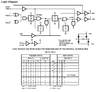
The 4027 will NOT divide the voltage , it will divide the frequency.
The outouts will have the same amplitude as the powersupply.
4027_function.png
When used as a divider the outpouts will alternate at half the frequency.

Bertus
 

colum

Jul 25, 2013
180
Joined
Jul 25, 2013
Messages
180
Thank you for that valuable information. I have decided to go back to square one and find a diagram that will drive a various speed synchronous motor
I think I will beg someone in these forums to send me one
Your advice is much appreciated...colum
 

WHONOES

May 20, 2017
1,242
Joined
May 20, 2017
Messages
1,242
One thing that nobody has mentioned is the very limited source / sink currents available from CMOS logic.
 

bertus

Moderator
Nov 8, 2019
3,836
Joined
Nov 8, 2019
Messages
3,836
Hello,

The PDF in post #18 shows the driving specs of several chips.

Bertus
 

Frankchie

Nov 14, 2017
149
Joined
Nov 14, 2017
Messages
149
I wonder if the 4049 had proper bypass caps directly across its power pins.

About 40 years ago I had a similar perplexing problem that drove me nuts for days. Out of desperation I added a 0.1uf bypass cap and the problem disappeared. As I recall I was using TTL logic chips, but I believe similar bypass caps are recommended for CMOS logic chips.
 

bertus

Moderator
Nov 8, 2019
3,836
Joined
Nov 8, 2019
Messages
3,836
Hello,

@Frankchie , That is why I mentioned the decoupling capacitors in post #21.

Bertus
 

Audioguru

Sep 24, 2016
3,656
Joined
Sep 24, 2016
Messages
3,656
The datasheet for the CD4049 shows that with a 12V supply its typical average output sink current is 25mA and its source current is 12mA per inverter. The circuit has 3 times those currents with the 3 inverters in parallel.
 

Harald Kapp

Moderator
Moderator
Nov 17, 2011
14,271
Joined
Nov 17, 2011
Messages
14,271
I believe similar bypass caps are recommended for CMOS logic chips.
Recommended for any chip. No matter whether analog, digital, bipolar, MOS ...

These bypass capacitors serve to supply an initial surge current when the chip's interbl transistors switch. This surge current canot be supplied very well by the traces of a PCB. Therefore the decoupling capacitors need to be placed near to the supply pins of the chip, ideally right next to the pin and need to be conneced to the supply voltages and ground (0 V) with traces as short as possible.
In very high frequency circuits it is even customary to use different capacitors (e.g. 100 nF, 10 nF and 1 nF) in parallel to optimize the frequency response of the three.
 

colum

Jul 25, 2013
180
Joined
Jul 25, 2013
Messages
180
Thanks Harald I'm going to redo the entire circuit with more capacitors and more test points ...colum
 
Top