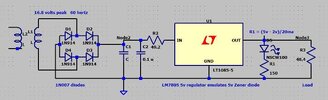
The 12 volt transformer supplies a peak voltage of:
Vpeak = 12 * square root of 2 = 12 * 1.4 = 16.8
With 16.8 volts into the bridge we subtract 0.7 volts for each diode. As the current
passes through 2 diodes for 1.4 volts.
Vdc = 16.8 - 1.4 = 15.4 without a load.
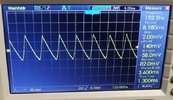
The actual loaded voltage will be more likely around 14 volts as we will see later
with a capacitor and load. I am using 20ma LED here.
For the capacitor:
------------------
ripple voltage Vr:
Vr = (0.0024) * I/C = 100 mv
C = 0.0024 * I / Vr = 0.0024 * (0.120A / 0.10V) = 0.00288 F
0r: C = 2880 micro-farad
from Schertz and Monk "Practial Electronics for Inventors" section 11.6
For a Zener diode
------------------
Lets try the 5.1 volt 1N4733A. As 5.0 volt Zeners are hard to find.
For the 1N4733A Zener diode the value of Vz is 5.1V and Pz is 500 milliWatts
now with a Vdc (dc supply voltage) of 14V the value of R2 will be:
Rs = (Vdc - Vz)/Iz
Rs = (14 - 5.1)/Iz
Iz = Pz/Vz = 500mW / 5.1V = 98mA max.
Thus Rs = (14 - 5.1)/98ma = 90.8 ohms
Rs = 91 ohms (approx) 91 ohms is a standard.
The power/watts into R2 will be:
Pr2 = V^2/Rs = ((14 - 5.1)^2)/Rs = (8.9 * 8.9)/91 = 0.87 watts or 2 watts in practice.
So with a load of 120 ma the voltage drop across Rs:
Vrs = 91 * 0.12 = 10.92 volts ........oops! Looks we only have 14 - 10.92 = 3.08 for
the load and the Zener is out of business!
Lets try a 1 watt Zener and 5.1 volts:
Iz = 1.0 watt / 5.1 volts = 0.196 A or 196 ma.
Rs = (14 - 5.1)/ 0.196A = 45.4 ohms or 47 ohms standard
Voltage drop across Rs at full load: Vrs = 47 * 0.12 = 5.4 volts;
Or 14v - 5.4v = 8.6 volts for the Zener to chew on.
The power/watts into R2 will be:
Pr2 = V^2/Rs = ((14 - 5.1)^2)/Rs = (8.9 * 8.9)/47 = 1.685 watts or 2 watts or better in practice.
Next we can run this through the simulator and see what it looks like. (to be continued).