Crytal Oscillator

Y2KEDDIE

Sep 23, 2012
259
Joined
Sep 23, 2012
Messages
259
I have several crystals (HCU style) ranging from 500KHZ to 10 MHZ and I would to experiment by building an oscillator project to test them.

I found a simple transistor colpitts circuit that is followed by a didode (1N34) detector and transistor amplifier connected to a dc micro- ammmeter.

When fiished I would like to have something a little useful than just a crystal activity meter. I was thinking of tapping off the ocsillator output with a BNC connecter and using this to drive a small transmitter, or use this signal as a band marker/calibartor on a reciever. I would put a toggle switch between the output and detector to select sensitivity of BNC output.

Is this idea feasable?

Im curious, what is the difference when this (colpitts) oscillator is used as oscillator driving a tube or transistor transmitter or when used as a local oscillator in a superhet reciever. Obviously there must be some power output concerns : enough drive to transmitter power circuit , and not too much signal to overload when used in a reciever mixer cicuit.

Eddie
 
Last edited:

davenn

Moderator
Sep 5, 2009
14,470
Joined
Sep 5, 2009
Messages
14,470
Is this idea feasible?

yes :) tho the switch may be a bit lossy ... use a good quality one, more commonly diode switching would be used.
Im curious, what is the difference when this (colpitts) oscillator is used as oscillator driving a tube or transistor transmitter or when used as a local oscillator in a superhet receiver. Obviously there must be some power output concerns : enough drive to transmitter power circuit , and not too much signal to overload when used in a receiver mixer circuit.

none

in a transmitter lineup ...there will be several stages of amplification between the oscillator and the final output

when used as a LO, the oscillator will feed directly to the mixer

Dave
 

davenn

Moderator
Sep 5, 2009
14,470
Joined
Sep 5, 2009
Messages
14,470
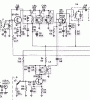
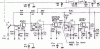
OK here's a couple of examples ( they are just part circuits)
I have left out all the IF and audio stages

The RX and TX circuits are from the same transceiver radio

first the receiver ....

T180 RX1.GIF


now the transmitter ...

T180 TX.GIF


Note the Colpitts oscillator is the same in both circuits

in the receiver circuit, the osc output goes via C11 to one gate of a dual gate MOSFET Q3. The other gate takes the amplified and filtered RX RF from Q1.

in the transmitter circuit, the osc Q21 feeds RF to the driver transistor, Q22 then on to the final transistor Q23

These circuits are from a 26MHz AM CB radio

cheers
Dave
 

Y2KEDDIE

Sep 23, 2012
259
Joined
Sep 23, 2012
Messages
259
yes :) tho the switch may be a bit lossy ... use a good quality one, more commonly diode switching would be used.


none

in a transmitter lineup ...there will be several stages of amplification between the oscillator and the final output

when used as a LO, the oscillator will feed directly to the mixer

Dave


Thank you Dave, now it is clear.

I believe I will leave out the switch and detector, or maybe separate the detector and oscillator out put with two separate BNC connectors with a removable jumper. (then I will have two separate devices in the same box.

Next step construction, wish me luck.
 

Y2KEDDIE

Sep 23, 2012
259
Joined
Sep 23, 2012
Messages
259
I built this circuit, but can't seem to get much output. I feed the output into my 20 MHz scope with a X1 Probe.

Crystal Controlled Oscillator Circuit
This general purpose signal source serves very well in signal-tracing applications. The output level is variable to more than 1 Vrms into a 50Ω load. Almost any crystal in the 1 to 15 MHz range can be used.

2059116218-1.jpg


PARTS LIST R1 10kΩ R2 10kΩ R3 10kΩ R4 10kΩ R5 2.2kΩ R6 470Ω R7 33Ω R8 500Ω Preset C1 0.001µF (102) C2 100pF C3 0.001µF (102) C4 0.01µF (103) C5 0.01µF (103) C6 0.01µF (103) Q1 2N2222 Q2 2N2222 XTAL1 CRYSTAL (1 to 15 MHz)
Q1 forms a Colpitts oscillator with the output taken from the emitter.


I can't get much more than .5 Vp-p , when using a crystal labeled 4.300 Mhz with my scope.

1000 KHz crystal produces no output
1400 Khz crystal produces 0.1V p-p
4300 KHz 0 .5
38.7375 MHz 0..2
38.7375 0..2
38.750 0.15
39.703704 0.2

Any thoughts?
 

Y2KEDDIE

Sep 23, 2012
259
Joined
Sep 23, 2012
Messages
259
The R8 potentiometer is closer to 300 Ohms in the actual circuit I built, maybe this is too much load, but It should still oscillate.
 

davenn

Moderator
Sep 5, 2009
14,470
Joined
Sep 5, 2009
Messages
14,470
The pot (R8) is going to be dreadfully lossy at a few MHz or more

If you really need to vary the output level, then I suggest a variable inductively coupled output
similar to either L5 or L11 in the circuits I showed above

I don't really like where they are taking the drive for Q2 from. I could only imagine its messing up the osc circuit


Dave
 

Y2KEDDIE

Sep 23, 2012
259
Joined
Sep 23, 2012
Messages
259
I believe Q2 is just an emitter follower stage and doesn't seem to have much effect on Q1 oscillating. Higher frequencies and the crystal itself, seem to have a great effect. A 10 Mhz computer crystal yields about 500 mV. Regardless I can't seem to get more than a 1/2 volt output as claimed. I even tried increasing the power supply voltage.

Maybe I just have some poor quality crystals.

I was hoping I could build a circuit that would work from ( as low as) 400 Khz on up.
 

Merlin3189

Aug 4, 2011
250
Joined
Aug 4, 2011
Messages
250
Just having a quick look at your circuit, I'm a bit puzzled as to why you expect much more output? With a 9V supply, can the oscillator stage have more than about 4.5V AC on the emitter?
Then you tap off the output from C2 : C3 junction, which looks like it would be an AC potential divider, Zc2 / (Zc3 + Zc2) = 10% ie about 0.45V AC max
The second stage, as you say, is a follower with no voltage gain, then you tap off about 90% for the output.
Have you tried reducing C3 ? Say 500pF ought to double the output, if I'm right.
 

Y2KEDDIE

Sep 23, 2012
259
Joined
Sep 23, 2012
Messages
259
I agree with you, it is a voltage divider. The circuit is from "wiringelectronicscircuits.com". They state you can get 1 volt RMS out of it into a 50 ohm load. Maybe the 2nd stage (emitter follower is capable of that , but the first stage isn't producing enough signal.

I will try juggling C2 and C3.
 

Y2KEDDIE

Sep 23, 2012
259
Joined
Sep 23, 2012
Messages
259
I have another question: I've seen digital circuits using IC's to generate a square wave output. For testing activity purposes I quess it doesn't matter if the output is square or sine wave. I'm thinking you probably want a clean sine wave if building a transmitter. Maybe using a square wave would not be good as it is high in harmonics. If the output/load is a LC cicuit it would change the square wave into a sine wave?
 

davenn

Moderator
Sep 5, 2009
14,470
Joined
Sep 5, 2009
Messages
14,470
its depends for what you want your osc for ??. If for digital experimenting, then yes a square wave is ok
if for radio based projects then you want a sine wave ... square wave osc's are full of harmonics, something you don't want when experimenting with radio circuits

Yes its really easy to use 2 gates of a 7404 hex inverter to produce an oscillator

Dave
 
Last edited:

Merlin3189

Aug 4, 2011
250
Joined
Aug 4, 2011
Messages
250
Well I'm no great expert, but I think you could do that.
Yes you do want a clean(ish) sinewave output (if it's modulated it's not that clean of course), but transmitters often use very un-sine wave generators and, as you say, use an LC 'tank' circuit to select the frequency required. Then there is further low pass filtering in the output to attenuate harmonic content.

This was used in "Class C" output stages for A1 transmission (CW or morse on/off keying of a single frequency). It wasn't a square wave drive, rather a truncated sine pulses, but the effect was similar.
In VHF (and I presume higher frequency) transmitters it was usual to have a relatively low frequency oscillator and to 'multiply' the frequency up to that required. Each stage used an LC circuit to extract the second or third harmonic. So for eg. my IC215 uses 18MHz crystal oscillator with 3 'doubler' circuits to get 144MHz.

I suspect that even when you try to generate 'pure' sinewaves, especially at any significant power, you are likely to have some impurities, so you would normally filter to minimise these.
 

Merlin3189

Aug 4, 2011
250
Joined
Aug 4, 2011
Messages
250
Looking at Wiringelectronicscircuits you seem to have picked the odd one out. There are several other circuits where the output is taken directly from the emitter, rather than from a low tap. So either try that or use a higher tap ratio.
I see the reviews for that circuit say 50% good, 50% bad, but I can't see any specific comments. If I get some spare time from Xmas preparations, I'll try the cct myself and see what happens.

"... what is the difference when this (colpitts) oscillator is used as oscillator driving a tube or transistor transmitter or when used as a local oscillator in a superhet reciever. Obviously there must be some power output concerns : enough drive to transmitter power circuit , and not too much signal to overload when used in a reciever mixer cicuit."

For a receiver mixer I think it depends on the type of circuit you use. For a diode ring double balanced mixer the local oscillator drive needs to fully switch on pairs of diodes. I think they even use square wave drive.
With unbalanced dual gate or cascode mixers, I believe a lower drive level is used and the drive needs to be a good sine wave.

But mixer design is a bit sophisticated - lots of things to consider and balance out. So whether this oscillator is suitable for any particular use with mixers is beyond me.

For transmitter you can use coarse and beefy drive for simple CW, but for more sophisticated modulation, I think the oscillator requirements are similar to receivers. The modulated signal is generated in low level mixers and then amplified in linear amplifier stages to preserve the sideband frequencies.
 

Y2KEDDIE

Sep 23, 2012
259
Joined
Sep 23, 2012
Messages
259
Thank you all for your input. I looked at a lot of oscillator circuits to build, this one appeared simple Wouldn't I know I would pick an odd circuit to experiment with. but It has served my purpose: to learn.

The fact the authors of this circuit said they got 1 Vrms into 50 ohm output threw me for a loop. My theory background said It wasn't likely. I thought maybe I was missing something. The capacitive voltage divider may be needed to prevent over driving the 2nd transistor. I haven't found any rule of thumb in picking values for C1 and C2/C3 combination. Possibly different values would allow oscillation at lower frequencies.

Next , I plan to try building a digital IC (7404 hex inverter) oscillator. They seem to have fewer components, maybe I can get it to work with the lower freq. crystals as well as the higher.

Eddie
 
Top