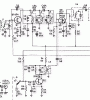
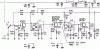
I have several crystals (HCU style) ranging from 500KHZ to 10 MHZ and I would to experiment by building an oscillator project to test them.
I found a simple transistor colpitts circuit that is followed by a didode (1N34) detector and transistor amplifier connected to a dc micro- ammmeter.
When fiished I would like to have something a little useful than just a crystal activity meter. I was thinking of tapping off the ocsillator output with a BNC connecter and using this to drive a small transmitter, or use this signal as a band marker/calibartor on a reciever. I would put a toggle switch between the output and detector to select sensitivity of BNC output.
Is this idea feasable?
Im curious, what is the difference when this (colpitts) oscillator is used as oscillator driving a tube or transistor transmitter or when used as a local oscillator in a superhet reciever. Obviously there must be some power output concerns : enough drive to transmitter power circuit , and not too much signal to overload when used in a reciever mixer cicuit.
Eddie
I found a simple transistor colpitts circuit that is followed by a didode (1N34) detector and transistor amplifier connected to a dc micro- ammmeter.
When fiished I would like to have something a little useful than just a crystal activity meter. I was thinking of tapping off the ocsillator output with a BNC connecter and using this to drive a small transmitter, or use this signal as a band marker/calibartor on a reciever. I would put a toggle switch between the output and detector to select sensitivity of BNC output.
Is this idea feasable?
Im curious, what is the difference when this (colpitts) oscillator is used as oscillator driving a tube or transistor transmitter or when used as a local oscillator in a superhet reciever. Obviously there must be some power output concerns : enough drive to transmitter power circuit , and not too much signal to overload when used in a reciever mixer cicuit.
Eddie
Last edited:

 tho the switch may be a bit lossy ... use a good quality one, more commonly diode switching would be used.