so the plot thickens!!
do you understand it - the spreadsheet and the corrosponding diagram?What number post shows the exact mechanism your spreadsheet refers to?
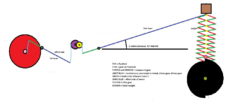
thanks for looking at it though It seems you get the part where the block accelerates the flywheel!I understand the drawing, but it seems to me there's a major problem or two with it. As the weight falls the flywheel will be driven clockwise, but as soon as the cam tries to lift the weight back up again the flywheel would have to instantly reverse direction. That ain't gonna happen, given its huge inertia! Also, that flywheel will take considerable time to get moving when the weight falls, so the weight will fall slowly. In the meantime the cam is still rotating, so the cam follower won't stay in contact with the cam.
.... in which time the cam rotates 1/4 turn and the cam follower is out of contact with the cam..at this rate 2pi rad/s the block takes a second to fall
very good! so do you know what a differential is and how it works? there are three shafts going into the diff one stays constantly turning, picture a remote controlled car when you hold one of the rear wheels still, then the other moves! the motion takes the path of least resistance so if one of the shaft has a brake disk on it, you can control when the cam turns simply by applying the brake, the cam is heavier than a brake disk so when the brake is off, that shaft is the shaft that will turn, applying the brake forces the cam to turn! and if you control the cam to turn when the weight gets to the bottom of its drop then ... watch @ time 4.12 if you wait till the weight has dropped then put on the disk brake on the diff for 2 seconds that solves that problem!! I'm thinking abit further ahead now and will be using arduino to controll the timing of the disk brake but there is even more to this that I want to tell you about because that is not the full design yet after all it's a simple mockup in paintI understand the drawing, but it seems to me there's a major problem or two with it. As the weight falls the flywheel will be driven clockwise, but as soon as the cam tries to lift the weight back up again the flywheel would have to instantly reverse direction. That ain't gonna happen, given its huge inertia! Also, that flywheel will take considerable time to get moving when the weight falls, so the weight will fall slowly. In the meantime the cam is still rotating, so the cam follower won't stay in contact with the cam.
This project is going way beyond considering the maths of the scissor mechanism, as per the thread title, and with no end in sight. I regret I don't really have the time to take this further. But let us know how the final design works out.but there is even more to this that I want to tell you about because that is not the full design yet