0-30V 0-3A Latest Data Discussion

L

liquibyte

Jan 1, 1970
0
Breaking a simple schematic apart into subsections makes it confusing and hard to follow and is basically unnecessary.  For one thing, what is A, B, C, and D?  Where in the grand scheme of things are you inserting this into the PS circuit?

 
E

elboa8

Jan 1, 1970
0
I did not break it apart into sub sections! The switch is a separate entity from the main PSU. It's what I am doing for myself.
I am sharing for anyone who may get something from it.

 
L

liquibyte

Jan 1, 1970
0
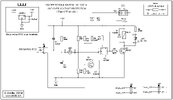
Yeah, but I believe switch in and of itself may be a misnomer.  This is a soft-start circuit using a 555 timer am I correct?  There's a reason that I try and keep all my nets connected is that it's less confusing for a newbie.  Now say that someone that knows very little about electronics comes along and successfully builds the power supply but wants to integrate your circuit into it to fix the startup transient issue.  Does your schematic explain to them in any meaningful way on how to integrate this into their build?  I'm not criticizing the circuit by the way, I have a version of this sitting on a breadboard right now that I put together for the same reasons you did before you posted this, so I understand the impetus behind it.

Switch_Sch.jpg

 
E

elboa8

Jan 1, 1970
0
That's fine. I just feel if you had expressed your concerns and explained how this forum works it would have been more helpful.  I thought I was sharing some thoughts ideas with Redwire et al.  Do I post things like the switch for example, on a new thread?

 
J

Jaxelo

Jan 1, 1970
0
I think what he wanted was a circuit with that switch being a part of the PS, which I want to see also - I'm new and can't really see where that fits in..

 
E

elboa8

Jan 1, 1970
0
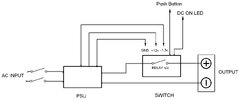
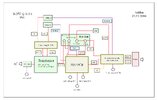
Hi I've attached a very rough block diagram which may help. The three feeds come from the PSU. GND, -1.3v and +12v. The +12v is from a 12v regulator mounted on the PSU heat sink. When you switch ON the PSU at the mains the "switch" is always OFF. You press the push button to toggle the output ON and OFF. If you switch the PSU OFF by the mains the relay on the "switch" disconnects the output very quickly. I really was doing this for my own use. So sorry for lack of information.

Switch_Block.jpg

 
L

liquibyte

Jan 1, 1970
0
Arklite said:
That's fine. I just feel if you had expressed your concerns and explained how this forum works it would have been more helpful.  I thought I was sharing some thoughts ideas with Redwire et al.  Do I post things like the switch for example, on a new thread?
What I said had nothing to do with rules here, I just thought a little clarification would have been nice.  Like I said, I had almost the same idea, just a different implementation.  I knew that you were probably going to be inundated with questions as to how things worked and hooked up and was trying to understand it myself because, to be honest, it wasn't entirely clear because your picture didn't clarify the connections etc.  Not trying to bust your chops, honestly.

The circuit I had was basically a 555 running off a 12V regulator that would latch the power after a delay automatically when the main switch was thrown.
 
E

elboa8

Jan 1, 1970
0
I'm too used to working on my own I guess. Point taken though. I will try to be clearer (I hope) on any other posts.

 
L

liquibyte

Jan 1, 1970
0
I just hope you don't think I was trying to be harsh because, honestly, I wasn't.  I've just learned that when you're on any sort of tech board, the experts will get the intent but the newbies won't.  I program, and while documentation isn't my strong suit I've learned that if you don't and leave the code for a couple of years, when you come back it can seem like someone else wrote it and it makes no sense.  I've started to do this with my schematics lately because when it comes to electronics, I'm a newbie too.  I got made a mod here because I was willing to help keep the spam clear and I understand the code behind the site and offered solutions to help in that regard.  So far I think that part of it is working rather well.  I guess what I'm trying to say in that regard is don't look at my title and think of me and talk to me like you would anyone else.  You could cuss me out if I pissed you off and I wouldn't take it any different than I would on another board.  I only delete spammers posts but I may fix a quote or link here and there but nothing else.  If I can learn something, anything, from someone else, that's always a plus for me.

 
E

elboa8

Jan 1, 1970
0
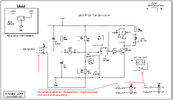
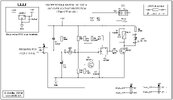
This is just an update on the “stand alone” switch for the PSU. It goes between the output of the PSU and the output terminals. I’ve tested it over a few days now and it’s performing well. I found with the addition of two components, a zener diode and resistor, the switch becomes an over voltage monitor. If the pass transistors fail (the most likely scenario) the output voltage rises to the “rail” value, in my case 33v. If this happens the 27v zener (ZD1) conducts and turns ON Q1 this resets the NE555 which turns OFF Q2 and the relay “drops out” A bonus is the switch is now inoperative, i.e. it will not turn ON the output again until the fault is rectified. The 12v is derived from a 12v regulator mounted on the PSU heat sink. The GND  and the -4v are also from the PSU. The -4v comes from the junction (on the original circuit) of D6 anode,C3 –ve and R3 (220R) .

To sum up…
1) The output is OFF at mains switch ON.
2) If the PSU is switched OFF by the mains the output voltage is turned OFF.
3) If the “pass transistor(s)” fail the output is turned OFF and cannot be turned back ON.
4) It is a “stand alone” circuit. i.e. it is an addition to the PSU not part of it.

I’ve really put this together for my own use. Saying that, if anything is not clear, please let me know.

Switch_Sch.jpg

 
Last edited:
L

liquibyte

Jan 1, 1970
0
That's really clever and some good work.  I think red baron should add this to his and try again with the battery charging to see how well it holds up.

 
E

elboa8

Jan 1, 1970
0
Thanks for that. Red baron, there are some interesting names here!

 
L

liquibyte

Jan 1, 1970
0
You know, I almost started a thread asking where everyone got their names from.  Some of them are easy to work out, some make sense in context, but some like mine or redwire's appear to most people as an enigma.  Now that most of the spam has stopped, this board can move rather slow.  Not that I'm complaining because we don't have enough active mods anymore to really keep up with something that moves as fast or faster than EEVBlog or the AAC forums but it'd be nice to have some active members and not just the one offs that fly by with homework troubles.

Anyway, red baron was having trouble with blowing 3055's while charging a battery.  I'm wondering if this kind of thing might help in that situation and if he's seen this thread.

 
E

elboa8

Jan 1, 1970
0
Hi I looked through the members listings. (I should get out more)! I was surprised how many had not posted anything. Out of interest how many "categories" of  member are there? The vast majority were Newbies. Just curious.

 
L

liquibyte

Jan 1, 1970
0
Newbie (0-49 posts), Jr. Member (50-99 posts), Full Member (100-249 posts), Sr. Member (250-499 posts), Electronics God (500+ posts), Moderator (elected), Global Moderator (elected), and Administrator (owner and elected).  Don't worry, I've done statistics on the member list for mixos before.  Looks like redwire is up for Electronics God soon.  I only have 291 posts so it will be awhile.  Fun fact: the administrator can bump a persons post count in SMF without the user having posted and can leave posts in place but reduce the post count.  I think this is a promotion / demotion feature.  You can also add groups or remove all of them if you wanted to and you can assign custom groups to specific users and really fine tune permissions but it's a major pain in the ass because the back end isn't very intuitive.  I prefer PHPBB myself, I've been coding its base off and on since very early on.

 
E

elboa8

Jan 1, 1970
0
Many thanks for the info. A lot (as always) going on behind the curtain!

 
E

elboa8

Jan 1, 1970
0
PSU

OK, I’m happy with the PSU performance now, and I’m ready to put it into a case.
Again this is my take on a popular project. I’ll try to outline some changes I’ve made, and why.

First a few general specs:
1: 0 – 25 V  0.04 – 3 A. (10 mV and 1 mA meter resolution).
2: Regulation @ 3 A <0.01%.
3: Stability @ 1 A after 1 hr <0.01%.
4: Ripple @ 3 A <  100 mV.
5: Push ON /OFF toggle switch that defaults to OFF, with over volts cut-off.

References are from the original circuit.

The voltage and current range were dictated by the transformer I had (24 V  @ 6 A ). This gives a NO LOAD voltage of  33 V. Adding the -1.3 V to this gives a voltage range of 34.3 V. As the IC’s are rated at  44 V  I could dispense with the zener diode D13.
Reading through the various posts it’s apparent that a lot of problems are caused by trying to use a transformer with different specifications! Unless you are prepared and able to make circuit changes, stick as close as possible to the original specified transformer.
The heart of a good PSU is the voltage reference performance. After doing a number of tests of voltage and temperature stability on the original, built around D8 and U1, I changed it to a constant current FET circuit. The component count is slightly less and the performance is better. As the reference is 6 V not 11 V the gain of the OP Amp U2 was increased from 3 to 4 (approx).
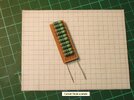
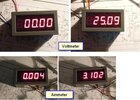
I changed the current sense resistor from 0.47 R to 0.1 R @ 1%. The gain of  U3 was also increased to account for this. I made the resistor from 10 x 1 R 0.6 W 1% in parallel. This gives a 0.1 R 6 W 1% resistor. The advantages of this is reduced voltage drop and reduced heat dissipation. (0.1R @  3A =  300 mV -  900 mW,  0.47R @  3A =  1.41 V –  4.23 W ). It also neatly drops 100 mV per 1 Amp of current. i.e. 300 mV at the 3 A max. As I used a 4 ½ digit 200 mV LED display (19999 max) I put a 10:1  3 resistor divider on the input of the meter and set the decimal point to 19.999 this gives a me a 1 mA to 3 A reading with a meter resolution of 1 mA  ( 0.001  - 3.000 A ). I’m not pretending the precision is as good as the resolution, but it’s within a few mV. To further improve performance I separated the sense outputs and joined them directly to the output terminals, I could have brought them out to the front panel but it meets my requirements as it stands. I also used a 4 ½ digit 200 V LED display (19999 max) for the voltage display. This time the decimal point is placed at 199.99 giving a meter reading of  10 mV to 25 V with a meter resolution of 10 mV. (00.01 – 25.00 V ). As I wanted a push ON/OFF DC switch, I made a “stand alone” toggle circuit. (See previous post for details). This is not directly incorporated into the PSU and can be omitted. Some DC switch should be fitted however and turned ON after the AC power up and OFF before the AC power down. This is important as there are some voltage spike issues! The toggle switch defaults to OFF and incorporates an over voltage (pass transistor fail) shutdown function. I will post some pictures of the built PSU when it’s finished. (I’m still waiting for the push switch with built in LED).
I’ve inc. a few pictures including the final circuits. Again this is my own take on the “old” design. Why I made the changes may be of interest to someone.
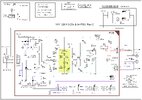
3A_C_Sch.jpg

Switch_Sch.jpg

Current_Shunt_Resistor.jpg

Meters.jpg

 
Last edited:

deepak.roy.alchemist

Aug 15, 2010
12
Joined
Aug 15, 2010
Messages
12
hello Arklite! your on off switch is excellent! i have a 0-350volt 0-0.25A dc variable power supply and i want to use this circuit there as a load switch with a soft touch. but the problem is that i am getting no such relays which can switch 350volts dc. plz help.

 
E

elboa8

Jan 1, 1970
0
Hi. I got the relay from Ebay (were else), but my requirements were more modest. anything over 3A and 50V. Anyway try searching there. If you just want to use the switch as a simple ON/OFF switch, you must remove ZD1,R6,R4,R5 and Q1. It will not work otherwise. Note also the driver transistor, the BC107 has a MAX rating of 100mA! Regards

 
Last edited:
E

elboa8

Jan 1, 1970
0
Hi I thought I might as well finish off with a block diagram of the PSU project. As always there is more to it than the main PCB!
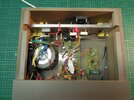
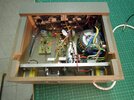
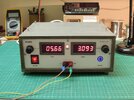
Also some pictures of working PSU.

PSU_Block_Diagram.jpg

3A_PSU_04.jpg

3A_PSU_06.jpg

3A_PSU_05.jpg

 
Last edited:
Top