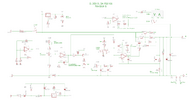
I found this description of our PSU by
Rod Elliott on
www.sound-au.com and he also introduces some improvements and shows how to use this power supply as bipolar unit. The schematic below is an example, and although simulated it's not been tested on the bench. Copying description:
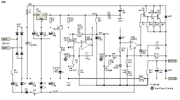
A single supply might be attractive for some people, and it's certainly simpler than a dual tracking version. Of course, if you only have one polarity that limits your options as to what you can test, but they are commonly available from any number of suppliers. The circuit shown below is adapted from one that's shown on a number of different websites [
2, 3, 4]. As such, it's difficult to know which one was 'first', and there have been many improvements (or at least changes, which aren't always the same thing!) made to it over the years. The basics haven't changed much, and the one shown below dispenses with one voltage regulator in favour of a simple diode regulated negative supply. Because I used LM358 opamps, the negative supply only needs to be around -1.2V at fairly low current.
When the supply is in current limit mode, the LED will come on, indicating 'constant current' operation. It's normally off, so you can tell at a glance if the load is drawing the preset current with a reduced output voltage. Constant current operation is particularly useful for testing high power LEDs or LED arrays, as that's the way they are meant to be driven. You also need an 'on/ off' switch, which reduces the output voltage to zero when in the 'off' position. This is an essential feature (IMO) as it lets you make changes without having to disconnect the supply. The best arrangement is to provide the switching at the output of the supply, as that lets you set the voltage while the DC is turned off. Consider using a relay (or two) for the switching, otherwise you need a heavy duty switch. Wile the voltage can be reduced to (near) zero by pulling the non-inverting input of U1B to ground, there may be 'disturbances' when AC power is first applied. This is avoided by switching the output.
The supply shown below is fairly basic, and you'd need to add meters for voltage and current, and thermal management (a fan and over-temperature cutoff) at the very least. There are countless improvements that can be made, but they would make the circuit more complex, more expensive, and provide more 'exciting' ways to make a seemingly minor error and cause the supply to blow up the first time it's switched on.
U1 is a 7815 regulator, but with a 15V zener from the 'ground' pin to raise the voltage to 30V. Additional zener current is provided by R3 to ensure a stable output. U2A is the current regulator. When the voltage at the inverting input (U2A, Pin 2) is greater than that on the non-inverting input (Pin 3), the output goes low, pulling down the reference voltage provided to U2B (the voltage regulator). The voltage is reduced by just the amount required to ensure that the preset current is provided to the load.
The current limit is variable from (theoretically) zero to 2.5A. VR4 allows adjustment to ensure the reference voltage for U2A (TP2) is as close as possible to 825mV (825mV across R18 (0.33Ω) is 2.5A output current). It may be possible to increase the output current to 3A (990mV reference voltage), but you would need to add another series pass transistor to keep the transistors within their SOA at minimum voltage and maximum current. Some ripple breakthrough at maximum output (voltage and current) is likely unless you add more capacitance (C1).
When in voltage mode, U2B compares the reference voltage from VR2 with the voltage at the output, reduced by R16, R11 and VR3 (voltage preset). If the output falls due to loading, U2B increases the drive to the output series-pass combination (Q3, Q4 and Q5) to maintain the desired voltage. The upper output voltage limit is imposed by the opamp (U2), which can't force its output to much above 25V with the typical output current of around 2mA (this depends on the gain of the output section, Q3, Q4 & Q5). Note that the reference voltage is itself referred to the negative output terminal - this ensures that the regulator will correct for any voltage drop across R18. If it were otherwise, regulation would be badly affected, especially at maximum current.
Note that the heavy tracks are critical, and any significant resistance in these sections will upset the current sensing. Also, be aware that the points indicated with a 'ground' symbol are marked 'Com' (Common). They are not connected to chassis or any other ground. The 'Com' designation means only that all points so marked are joined together. Also note the diodes with an asterisk (*), which must be 1N5404 (3A continuous) or better. All other diodes are 1N4004 or equivalent (other than the 25A bridge rectifier of course). Bench power supplies often get connected to 'hostile' loads, and the high current diodes (D8 and D9) are to protect the supply.
The supply uses 'low side' current sensing, so it needs some tricks to use it as a dual tracking supply with both positive and negative outputs. The current sense resistor (R18) is a compromise between voltage drop and dissipation. At maximum current (2.5A), R18 will dissipate a little over 2 watts, which is easily manageable using a 5W wirewound resistor. Both voltage and current regulation are very good (at least according to the simulator), and there's no sign of instability. In theory (always a wonderful thing), the current can be regulated down to a couple of milliamps, but in reality it will not get that low. Expect around 50mA or so, but it might be a bit lower than that (depending on the opamp's own DC offset). Another trimpot can be added to correct for opamp DC offset, but it shouldn't be necessary (and adds something else that needs adjustment).
All of the alternative versions specify a single 2N3055 for the output, but with a shorted output and maximum current, the dissipation will be about 80W, and maintaining the series pass transistor(s) at 25°C will be impossible. The TIP35 devices have a higher power rating (125W) and a good SOA (safe operating area), but there is still a case to be made for using three, rather than the two shown. The BD139 also needs a heatsink, but a simple 'flag' type will normally suffice. In common with any transistor that dissipates significant power, excellent thermal bonding to the heatsink is essential, and you will need to use a fan. This can be thermostatically controlled, and can use PWM (pulse width modulation) for speed control, or it can just turn on and off. Figure 8.1 shows a suitable circuit for both operating the fan and shutting down the supply if it gets too hot (which in this context is no more than 50°C heatsink temperature).
The original article has many more information and useful add-ons. Read more here:
https://sound-au.com/articles/bench-supply.htm