12V - 350V 200mA converter for motorcycle CDI

abuhafss

Aug 3, 2010
348
Joined
Aug 3, 2010
Messages
348
If we're lucky, using the method in post #98 we can avoid the big spikes that are visible in post #86.

I want to resolve the issue. If you guys can share your experience helping me, why can't I do that. I'll do that and revert.

As well as the primary current, we need a clear and accurate picture of the base drive voltage. The last one we have is in post #68. It look wrong. But since then you've replaced the transistor. Can you take another picture?

Surely, I will do it again with both, the old and the new TIP41C.

And now, I'll do all future tests with SLA battery.
 

KrisBlueNZ

Sadly passed away in 2015
Nov 28, 2011
8,393
Joined
Nov 28, 2011
Messages
8,393
Do the test I suggested where you connect the scope probe to the earth clip, to see whether there is common mode noise. I'm pretty sure there will be. Then you can try different ways to avoid it, and repeat the test to see how successful they are. Using an SLA battery may help. Also be aware that there is a strong magnetic field coming from your transformer, and you may find that moving wires and probe leads further away from it will make a difference.

You may find that the post #98 method is the best way to measure the primary current waveform while avoiding common mode noise.

You may find that using an SLA battery instead of a power supply affects your circuit. SLA batteries have a very low internal resistance and present a very "stiff" voltage to the circuit. Normally this makes things work better, but it may also make the overheating problem worse.

Be careful working with SLA batteries. I would put a fuse - say 5A - in series near the battery, and make sure the battery contacts are insulated. SLA batteries can deliver very high currents and can cause damage (as well as burn injuries).
 

abuhafss

Aug 3, 2010
348
Joined
Aug 3, 2010
Messages
348
If you want a better result using the two probe method, you could connect the resistor at the top end of the primary, instead of the bottom end, and use AC coupling on the inputs. This will allow you to increase the gain of both channels and get a larger and more accuate trace.

Please correct me if I am wrong, for measuring primary current:

CH1 - between resistor and primary (inverted)
CH2 - collector

ADD CH1 and CH2
 

abuhafss

Aug 3, 2010
348
Joined
Aug 3, 2010
Messages
348
Do the test I suggested where you connect the scope probe to the earth clip, to see whether there is common mode noise. I'm pretty sure there will be. Then you can try different ways to avoid it, and repeat the test to see how successful they are. Using an SLA battery may help.

If using SLA battery, do I need to check for the common mode noise?

I have 1.2A SLA battery but, I'll buy a 4.5A and do the tests.
 

KrisBlueNZ

Sadly passed away in 2015
Nov 28, 2011
8,393
Joined
Nov 28, 2011
Messages
8,393
Connect the resistor between the positive rail and the top of the primary. So the bottom of the primary connects directly to the collector of the transistor.

Then connect the probes to the two ends of the resistor.

Yes you should check for common-mode noise. That's what you're trying to eliminate. Using a battery instead of a power supply may reduce it. You need to check to see whether it's working or not.
 

abuhafss

Aug 3, 2010
348
Joined
Aug 3, 2010
Messages
348
Connect the resistor between the positive rail and the top of the primary. So the bottom of the primary connects directly to the collector of the transistor.

CH1 connected to the positive rail and CH2 connected to the top of primary.

Photo0381.jpg

Photo0380.jpg
Photo0382.jpg
 

abuhafss

Aug 3, 2010
348
Joined
Aug 3, 2010
Messages
348
As well as the primary current, we need a clear and accurate picture of the base drive voltage. The last one we have is in post #68. It look wrong. But since then you've replaced the transistor. Can you take another picture? You won't be able to show it alongside the primary current waveform if you use the two probe method to measure that, but we don't really need to see them both in the same display.

When you connect your scope to measure the base-emitter voltage waveform, try disconnecting the probe from the base and connecting it to the emitter. Since the probe is shorted to the ground connection, theoretically you shouldn't see any signal. But if you do, there is common-mode noise being generated by the converter, and it will affect the waveform you see when you move the probe to the base.

Photo0375.jpg
Photo0377.jpg
Photo0384.jpg

Probe shifted to EMITTER

Photo0385.jpg

All tests with 12V/5A SLA battery and the new TIP42C.
 

(*steve*)

¡sǝpodᴉʇuɐ ǝɥʇ ɹɐǝɥd
Moderator
Jan 21, 2010
25,510
Joined
Jan 21, 2010
Messages
25,510
I assume you mean a TIP41C (not TIP42C).

I would recommend that you place an 80V (or thereabouts) zener between the collector and the base. Place the anode on the base. This will turn the transistor on if the inductive voltage spike threatens the transistor.

I am recommending this because I think the traces are showing a reverse current spike.

You're using a 12V SLA now. What were you using previously? (I scanned back, but I couldn't find the post where you detailed this)
 

KrisBlueNZ

Sadly passed away in 2015
Nov 28, 2011
8,393
Joined
Nov 28, 2011
Messages
8,393
I don't think those spikes are real Steve. Though adding the zener couldn't hurt.
 

abuhafss

Aug 3, 2010
348
Joined
Aug 3, 2010
Messages
348
I assume you mean a TIP41C (not TIP42C).
Sorry, yes I meant TIP41C.

I would recommend that you place an 80V (or thereabouts) zener between the collector and the base. Place the anode on the base. This will turn the transistor on if the inductive voltage spike threatens the transistor.

I am recommending this because I think the traces are showing a reverse current spike.

Neither 82V nor 56V zener worked.

You're using a 12V SLA now. What were you using previously? (I scanned back, but I couldn't find the post where you detailed this)

I think, I had mentioned it 3-4 times, I have been using power supply 13.5V at 2A.

Now, some progress of last two days:

I removed R2, C3 and D3. Connected R1 to the base of Q1 and added a 56V zener as you suggested.
This combination slightly improved the heating but, R1 also was getting hot. Next, I gradually increased the value of R1 upto 10k. At 10k, it remained cool but Q1 got hot. In between 2k and 3k things seems to be getting under control but still the heating of Q1 was not satisfactory.

Today, I took chance and reduced three turns of the feedback winding. And to my surprise, it worked with R1 100R/1W. Now, TIP41C is at ambient temperature (without heatsink) and R1 is warm. The frequency is only about 650Hz. Here is the final schematic.
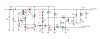
Screenshot 2014-09-04C.png

I am extremely thankful and grateful to both, you and Kris, for sparing your time to help me. Not only I got my circuit working but, also had a good practical experience of using oscilloscope and learning important tips.
 

abuhafss

Aug 3, 2010
348
Joined
Aug 3, 2010
Messages
348
Hi

After getting the circuit work in proper manner with the above schematic, I decided to test it with the original schematic at #88.
It worked perfectly on bench test. I installed it on bike for test run, it performed fine for two days.

After two days, the engine started misfire. I examined the circuit carefully, it was in perfect order.
I started with C8, replaced with new one, the output got back to 322V.
But within moments, R5 roasted and output dropped again.
I replaced C4 and R5 with new one and removed one zener, the output came to about 240V.
But after few moments, it raised to 500V+ and the transformer emitted sharp whistle sound.
Now the situation is that when it is powered on, the output climbs more than 500V for a fraction of a second and then drops down to a few volts. I have also replaced Q2 and Q3 but no change. Q1 remains at ambient temperature.

Any comments/suggestions shall be highly appreciated.
 

debe

Oct 15, 2011
278
Joined
Oct 15, 2011
Messages
278
I tried building just the powersupply & had the same results, 500V, I think 140 turns on the secondary may be too many.
 

KrisBlueNZ

Sadly passed away in 2015
Nov 28, 2011
8,393
Joined
Nov 28, 2011
Messages
8,393
Hmm, that sounds strange. I'm not sure what to suggest.

Did you leave the resistor across D8? If not, try it again and see whether it fixes this problem.

Also, can you upload a clear photo of the component side of your PCB, and either a photo or a software-generated image of the copper side.

I think your turns ratio is about right. Look at the duty cycle in the last photo in post #106. It's about 80% which is about right for a flyback converter.

If the circuit is consistently starting up then shutting down, and the main transistor is not getting hot, can you measure its terminal voltages when it is shut down? Also scope the collector and see if there's any activity there.
 

abuhafss

Aug 3, 2010
348
Joined
Aug 3, 2010
Messages
348
I tried building just the powersupply & had the same results, 500V, I think 140 turns on the secondary may be too many.

I have checked another for OEM Suzuki, it has 150 turns and about 1mH. 500VAC is normal because the zeners would regulate it. As mentioned, it worked for two days with regulated output 322V.
 

abuhafss

Aug 3, 2010
348
Joined
Aug 3, 2010
Messages
348
Hmm, that sounds strange. I'm not sure what to suggest.

Thanks for jumping in again. :)

Did you leave the resistor across D8? If not, try it again and see whether it fixes this problem.

It is there.

Also, can you upload a clear photo of the component side of your PCB

What do you want to see? So that I may focus accordingly.

and either a photo or a software-generated image of the copper side.

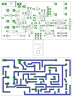
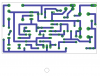
DC-CDI PCB.png DC-CDI PCB Copper side mirrored.png

If the circuit is consistently starting up then shutting down, and the main transistor is not getting hot, can you measure its terminal voltages when it is shut down? Also scope the collector and see if there's any activity there.

Shall revert later
 

abuhafss

Aug 3, 2010
348
Joined
Aug 3, 2010
Messages
348
I tried building just the power supply & had the same results, 500V, I think 140 turns on the secondary may be too many.

I hope you have connected the large capacitor 1.5µF/500V.
 

debe

Oct 15, 2011
278
Joined
Oct 15, 2011
Messages
278
I only had a 450v capacitor. But I didnt use the regulator part of the circuit. As I will probably use less windings as its only for a single cylinder engine, & when you short the HV windings the freq of the supply rises & the current draw is less. I will re visit the project later. Im enjoying your journey on this project & learnng a lot from it & its very interesting.
 

abuhafss

Aug 3, 2010
348
Joined
Aug 3, 2010
Messages
348
I only had a 450v capacitor. But I didnt use the regulator part of the circuit. As I will probably use less windings as its only for a single cylinder engine, & when you short the HV windings the freq of the supply rises & the current draw is less.

I have stripped a few CDIs and dismantled the transformers, all had more than 130 turns for the secondary.

Im enjoying your journey on this project & learnng a lot from it & its very interesting.

:)
 
Last edited:

abuhafss

Aug 3, 2010
348
Joined
Aug 3, 2010
Messages
348
I didnt use the regulator part of the circuit.
Even though you reduce the turns of secondary winding to get your desired output, you should use the regulator part...........see post #40 of this thread for details.
 

abuhafss

Aug 3, 2010
348
Joined
Aug 3, 2010
Messages
348
After a lot of frustration, I decided to make a fresh circuit. But before assembling, I played with LTSpice for different of components to see the behavior of the output. I found these values to be the most suitable:

D3, D4 = 1N4007
R2 = 1k 0.25W
R3 = 3.3k
R5 = 5.6k
C4 = 100nF

I assembled the circuit posted at #88, on a breadboard with above values. The result was excellent! I operated the circuit for 30 minutes, Q1 and R1 remain super cool and the transformer was silent.

I also used another smaller transformer with EE16 core (salvaged from an old CDI)

Primary 100µH
Feedback 170µH
Secondary 3800µH

The result was same.
 
Top