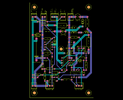
0-30V Stabilized Power Supply

Status
Not open for further replies.

audioguru2

Apr 6, 2004
12,026
Joined
Apr 6, 2004
Messages
12,026
Hi Liquibyte,
On your measurements it looks like Q1 turns on a little too late to completely squash the voltage spike but it reduces it a little.

Are we barking up the wrong tree?? (I haven't said that for about 50 years)
Without Q1 the 'scope photo from Redwire shows 24MHz ringing when the power is turned on and when it is turned off. But in post #? (this site does not have post numbers) he shows no ringing when he replaced U1 with a voltage regulator. I don't think he uses Q1.

 
L

liquibyte

Jan 1, 1970
0
Here's the fun part.  The board he sent me and the one I'm doing this testing on is the one with the linear regulator on it in place of U1.  I've added Q1 into this board but perhaps I'm not using a fast enough transistor.  The one I'm using is from Radio Shack which is marked on the package as a 2N2222A but is more than likely a MPS2222A made by either Motorola or ON Semi.  I found the datasheet here, sorry they zipped this one for some reason.  The package came with 3 types, 2N4401, 2N3904 which is actually a MPS3904, and the above 2222.  I have a few others laying around that I got in a grab bag from Jameco to play around with but would have to look up datasheets to see if I can find something faster.

From oldest reference of the added regulator to the newest that I could find quickly.
http://www.electronics-lab.com/forum/index.php?topic=19066.msg1016994#msg1016994
http://www.electronics-lab.com/forum/index.php?topic=19066.msg1017015#msg1017015
http://www.electronics-lab.com/forum/index.php?topic=19066.msg1017302#msg1017302

MPS2222A_datasheet_2.pdf

switching-characteristics.png


Attachments

  • MPS2222A_datasheet_2.pdf
    123.5 KB · Views: 16

audioguru2

Apr 6, 2004
12,026
Joined
Apr 6, 2004
Messages
12,026
Doesn't the linear regulator eliminate the voltage spikes caused by U1? Redwire said it did.
Does the linear regulator produce less noise than the zener diode/U1 circuit?

When the mains power is turned off then the 47uF filter capacitor C3 for the negative supply takes time to discharge. The speed of any little NPN transistor is much faster.
Then the slow discharge time of C3 delays activation of Q1. Then the voltage spikes are not completely squashed.

When a powered inductor is suddenly unpowered then it produces a voltage spike.
Then does a powered transformer that is suddenly unpowered when its mains current is at a peak also produce a voltage spike? 

 
L

liquibyte

Jan 1, 1970
0
audioguru said:
Doesn't the linear regulator eliminate the voltage spikes caused by U1? Redwire said it did.
Not that I've seen, maybe reduced it a bit.

His version without Q1 suffers from a ramp in voltage at the output once power is cut until the filter caps drain, a runaway spike if you will.  I removed the the paralleled 4K resistors on his board across C1 and put a resistor across each cap (3 4700's in parallel with a 15k each) and it reduced the bleed time but the spike remained higher than 30V no matter where the voltage pot was set.

With Q1, the spike is limited to the ranges I posted.  My version without Q1 behaves in the same way as his version with Q1 with a subtle difference, my version holds the voltage at P1 until the caps drain, no runaway.  With Q1, the caps drain quicker on his version.  My version holds voltage for ~10 seconds or so.  I haven't removed my boards to put a Q1 in yet but will soon.  The way I've got mine hooked up makes it a pain to remove the boards once everything is hooked up, live and learn.  I get no voltage spikes on power off, just a slow bleed.  Power on gives me the same results I posted, identical in fact.

Does the linear regulator produce less noise than the zener diode/U1 circuit?
I never put the scope accross the output of U1 or the regulator, just the output of the supply.  His version is much cleaner on the output than mine, even at very, very low V/div so I think it's probably an avenue worthy of exploration though I'll say it's having an odd effect on the results so far.  People keep talking about inversion and that if a TL081 were there and Q1 were hooked to pin 3 it would induce that.  I don't know, I get lost at that point.

When the mains power is turned off then the 47uF filter capacitor C3 for the negative supply takes time to discharge. The speed of any little NPN transistor is much faster.
Then the slow discharge time of C3 delays activation of Q1. Then the voltage spikes are not completely squashed.

When a powered inductor is suddenly unpowered then it produces a voltage spike.
Then does a powered transformer that is suddenly unpowered when its mains current is at a peak also produce a voltage spike? 
I know that an inductor produces a voltage spike and that inrush current is also an issue with any type of inductor.  Inductance is still kind of a foreign issue to me though.  Bear with me, I'm learning.  How long can an inductor hold the charge that it releases though?  My thinking on this is that while an inductors spike can be an issue, what I'm seeing with voltage over time is related to the filter caps stored energy and U2 doing something I don't understand.  As I said, my version isn't suffering this problem on power off.  With Q1, this is limited in scope to a couple of volts depending on P1.  Without Q1, at least on redwire's version, the spike rises to 36V regardless of where the voltage pot is set and then slowly drains.  I'll try and get one of my boards modified with a Q1 within a day or two and post the results from that vs. the other board I have where I'll leave it off for now.
 

audioguru2

Apr 6, 2004
12,026
Joined
Apr 6, 2004
Messages
12,026
liquibyte said:
People keep talking about inversion and that if a TL081 were there and Q1 were hooked to pin 3 it would induce that.
Certainly, But we are not using the low max supply voltage TL081 opamp that has the inversion problem.

I know that an inductor produces a voltage spike and that inrush current is also an issue with any type of inductor.  Inductance is still kind of a foreign issue to me though.
The opposite.
An inductor does not producer an inrush current. Charging the main filter capacitors quickly produces the inrush. The inductance of a transformer slows the rise in current for each half cycle.
I don't know how many half cycles it takes to fully charge the huge main filter capacitor.

As I said, my version isn't suffering this problem on power off.  With Q1, this is limited in scope to a couple of volts depending on P1.  Without Q1, at least on redwire's version, the spike rises to 36V regardless of where the voltage pot is set and then slowly drains.  I'll try and get one of my boards modified with a Q1 within a day or two and post the results from that vs. the other board I have where I'll leave it off for now.

I do not know what produces a 36V spike or high frequency oscillation at power off. Maybe you will kill the spike or oscillation with Q1 without knowing why it happened.
 
P

peterk

Jan 1, 1970
0
Hi guys, I haven't visited for a few weeks but see that the discussion has taken a new turn.
Liquibyte, would you mind to correct the png Parts list  (top right corner) to show Rev7 and delete the "cosmetic" line, just to keep things less confusing.

[easy way...right click the .png ; edit; add text to a blank spot; use Select tool to drag/place "7" over the "6" and "Aug" over "July"; select a rectangle over a blank spot on page - right click copy - drag over the 2nd line to blank it].

Edit your posting on the Sticky blog with this corrected one.

 
L

liquibyte

Jan 1, 1970
0
peterk said:
Hi guys, I haven't visited for a few weeks but see that the discussion has taken a new turn.
Liquibyte, would you mind to correct the png Parts list  (top right corner) to show Rev7 and delete the "cosmetic" line, just to keep things less confusing.

[easy way...right click the .png ; edit; add text to a blank spot; use Select tool to drag/place "7" over the "6" and "Aug" over "July"; select a rectangle over a blank spot on page - right click copy - drag over the 2nd line to blank it].

Edit your posting on the Sticky blog with this corrected one.
Thank you, forgot to edit that part.  As soon as I get things worked out and tested to make sure this isn't going to cause issues I'm going to redo my Eagle files too.  After having to remove my board to add in Q1, I've found that my design isn't as user friendly as I thought it would be.  In my defense, it was the first board I ever designed and had made.

Certainly, But we are not using the low max supply voltage TL081 opamp that has the inversion problem.


The opposite.
An inductor does not producer an inrush current. Charging the main filter capacitors quickly produces the inrush. The inductance of a transformer slows the rise in current for each half cycle.
I don't know how many half cycles it takes to fully charge the huge main filter capacitor.
I stand corrected.  Told you I was still learning.  I guess it'll come to me with time and study.

I do not know what produces a 36V spike or high frequency oscillation at power off. Maybe you will kill the spike or oscillation with Q1 without knowing why it happened.
I've added the Q1 circuit to one of the boards in my dual supply and will test out various things to compare between them before I finalize everything and button it up.  I did a quick test and the spikes still happen on power up based on the voltage 30V > 36V, 12V > 19V etc. but now my caps drain immediately and I still am not seeing a spike on power off which I guess is a good thing.  You are right that I should find out why it's happening and see if I can come up with a solution.
 
P

peterk

Jan 1, 1970
0
@liquibyte
Could you edit your preamble statement in the "Sticky" page.
I could have PM'd you but I want to note it here that 90% credit goes to AudioGuru for his huge contribution to this forum's answers.

amend ".....the troubleshooting guide was written by peterk" to read "collated by peterk". Thankyou.

 
Last edited:
L

liquibyte

Jan 1, 1970
0
peterk said:
@liquibyte
Could you edit your preamble statement in the "Sticky" page.
I could have PM'd you but I want to note it here that 90% credit goes to AudioGuru for his huge contribution to this forum's answers.

amend ".....the troubleshooting guide was written by peterk" to read "collated by peterk". Thankyou.
I put "collated and assembled from the two very large threads", twas no small feat to go through those threads and pick out those issues and put them all in one place.

I also gave credit for the "redesign that works" to audioguru because it does work rather well even if it has a few quirks and also to redwire for sending me the board I was testing for him for the issue of the spikes and that gave me the leap to Q1 being needed.  Some of the credit for that goes to David Hess over at eevblog forums for mentioning the Tektronics PS-503A and a discussion he had a week earlier about this issue.  While I was trying to figure out how to shoehorn something like that into this circuit it hit me that Q1 was this circuit.  If I didn't have redwire's board, I may have procrastinated taking out one of mine because they are a pain in the ass to get out and back in again.

I think a lot of credit goes to several other builders and testers as well.  I just realized that xristost had basically some of the same thoughts I had on it.  I'm still learning so it was important that I made the leap myself to understand the circuit better.  I've not really read his page over at http://diyfan.blogspot.com/2013/03/adjustable-lab-power-supply-take-two.html until just now.  One other thing I just noticed is that in this version, he's removed RV1.  I also wonder why it's there because in my build there's no measurable effect on the circuit.  I know it's are supposed to zero the voltage but, as far as I can tell, it doesn't do anything.  I also don't like the idea of adding voltage regulators unless they do something special that discrete components can't, the op amps themselves for instance.  I'm not against it per se, I just think that nothing is learned by adding black boxes to the mix.  That makes me wonder if it would be possible to do this in an all discrete version.  I need to quit thinking now.

Also, redwire was right about the placement of the terminal blocks.  My next version will be changed to have them nowhere near the standoffs.
 

redwire

Nov 10, 2007
244
Joined
Nov 10, 2007
Messages
244
I'll second the comment about RV1 having no measureable effect on the circuit. 


audioguru2

Apr 6, 2004
12,026
Joined
Apr 6, 2004
Messages
12,026
Why does Texas Instruments show the RV1 circuit we are using for nulling the input offset voltage of their TLE2141 opamp then?
Please double-check your pcb that pin 4 of U2 and R10 both connect together and to the 0V of the main filter capacitor.

If C7 is an electrolytic then its dielectric absorption will produce a positive output of the project when there is no load.

Since U2 no longer has a negative supply then it cannot cause an output negative offset voltage so adjusting the output offset should be zero to positive only.
I think the output of U2 should be monitored when RV1 is adjusted because it should never go below about +1V (two low current base-emitter voltage drops) when the voltage pot is zero. With too much negative input offset adjustment on U2 then the output of the project will be 0V (it can't go negative) but the output of U2 will saturate at close to 0V instead of being linear at about +1V.

Also check that adjusting RV1 slightly increases or slightly decreases an output voltage. 

 
L

liquibyte

Jan 1, 1970
0
audioguru said:
Why does Texas Instruments show the RV1 circuit we are using for nulling the input offset voltage of their TLE2141 opamp then?
Please double-check your pcb that pin 4 of U2 and R10 both connect together and to the 0V of the main filter capacitor.
Yep.

If C7 is an electrolytic then its dielectric absorption will produce a positive output of the project when there is no load.
C7 is a polyester film type on both mine and redwire's version.

Since U2 no longer has a negative supply then it cannot cause an output negative offset voltage so adjusting the output offset should be zero to positive only.
I think the output of U2 should be monitored when RV1 is adjusted because it should never go below about +1V (two low current base-emitter voltage drops) when the voltage pot is zero. With too much negative input offset adjustment on U2 then the output of the project will be 0V (it can't go negative) but the output of U2 will saturate at close to 0V instead of being linear at about +1V.

Also check that adjusting RV1 slightly increases or slightly decreases an output voltage. 
Adjusting RV1 and monitoring the output of the PS with P1 set to zero the voltage never goes above or below 31.7mV.

Adjusting RV1 and monitoring the output of pin 6 on U2, the lower half of RV1's range does nothing.  From about half to full, the voltage goes from 73.6mV to a fluctuating 124-125mV.  I get nowhere near 1V.0-30V-gnd.png

 
Last edited:

audioguru2

Apr 6, 2004
12,026
Joined
Apr 6, 2004
Messages
12,026
The maximum input offset voltage of a TLE2141C is only 1.4mV so the input offset adjustment should change the output plus and minus 1.4mV or more.
The minimum output voltage of the TLE2141C (when the output is saturated as low as it can go) is about +100mV.

U2 has no negative feedback when the output of this project has no load. A small leakage current in the driver or output transistors will cause the output voltage to rise then the negative feedback will force the output of U2 to go as low as it can go and maybe oscillate up to 1V and back down over and over. We should add a low current load from the output of the project to ground. Maybe 2.7k at 1W.

 
Last edited by a moderator:
L

liquibyte

Jan 1, 1970
0
With a 2.965K load, I get down to around 15mV + or - using five 15k resistors in parallel so I can get a good power rating.  If I add one more to get 2.467K I get exactly the same if I recalibrate max at 30V.  I could be getting an error in reading here due to my meter.  Regardless, I'm still get voltage spike at turn on.  I've been testing at 10V to make the mental calculations easier.  Without the load, I get around a 7V spike.  With the load, I get around 6.5V.  Q1 has eliminated the spike at power off.

From David Hess:

That answers that then.  The output from U1 is actually the problem.

The inverting input should follow the non-inverting input if the operational amplifier is acting as an operational amplifier.

My WAG (wild ass guess) is that U1 operating open loop during startup before D8 conducts results in overshoot caused by windup of its internal compensation capacitor.  If U1 had a negative offset voltage, then I think it could latch off but we need not worry about that since it is not happening at the moment.  In a production design I would want to test for that.

Try adding a capacitor across D8.  I am not sure what the value should be but a .1 microfarad ceramic or film would be a good place to start.  This will force U1 to operate closed loop during startup and lower noise from the reference as a side effect.
My answer over there:
I've added a 0.1uF ceramic across D8 but I'm still getting about 16.7 volts on startup before it settles back to 10 volts.  I have a jar of many values of ceramics from 1pF to 100nF that I got off Ebay for doing just this kind of thing.

The funny thing is that the version that I have that has a vreg in place of U1 has the exact same issue and it doesn't have a D8 either.

I've even tried loading the output from 2.5K to 3K (6 & 5 15K parallel resistors) to see if it helped but it didn't.  It does help load enough so that RV1 can get the offset of U2 down to around 15mV though.  I'm not sure if the difference between 35mV and 15mV is worth the trouble considering the transient voltage problem.  If it helped in that regard, I'd definitely keep it.
I can't imagine that U1 is the issue because redwire's version is suffering the same problem and it doesn't have a U1.
 
Last edited:

redwire

Nov 10, 2007
244
Joined
Nov 10, 2007
Messages
244
audioguru said:
Doesn't the linear regulator eliminate the voltage spikes caused by U1? Redwire said it did.
Does the linear regulator produce less noise than the zener diode/U1 circuit?
I proclaimed victory too early.  I found the spike on the posted board with certain settings on the scope.  I replaced U1 with a linear regulator and with the scope on the same settins I did not see a spike ,probably because it was happening at a significantly lower frequency.    I failed do anymore testing thinking the issue was resolved until I sent a populated board to Liquibyte.  He noticed the spike.  Unfortunately, I had already packed up my other board, scope, and test equipment while I'm remodeling a room at my house to work in.  Right now I don't have an adequate workspace to do any testing.

When the mains power is turned off then the 47uF filter capacitor C3 for the negative supply takes time to discharge. The speed of any little NPN transistor is much faster.
Then the slow discharge time of C3 delays activation of Q1. Then the voltage spikes are not completely squashed.

When a powered inductor is suddenly unpowered then it produces a voltage spike.
Then does a powered transformer that is suddenly unpowered when its mains current is at a peak also produce a voltage spike?
I suspect that the transformer is the source of the spike but I don't know how to test or eliminate.

As for the output transistor, I am using a darlington MJ11016 driven by a STN 851 transistor.  I have plenty of headroom so there is no problem reaching 30V and no heatsink is required for the STN851. 

 
L

liquibyte

Jan 1, 1970
0
redwire said:
I failed do anymore testing thinking the issue was resolved until I sent a populated board to Liquibyte.  He noticed the spike.  Unfortunately, I had already packed up my other board, scope, and test equipment while I'm remodeling a room at my house to work in.  Right now I don't have an adequate workspace to do any testing.
You should see the frankencircuit I've made of it.  I've got Q1 bodged back in and have been trying various techniques to tame the spike down but to no avail so far.  One thing I've learned is that I hate working with surface mount components.

I suspect that the transformer is the source of the spike but I don't know how to test or eliminate.

As for the output transistor, I am using a darlington MJ11016 driven by a STN 851 transistor.  I have plenty of headroom so there is no problem reaching 30V and no heatsink is required for the STN851.
I've tried all of the suggestions so far with no luck with one small exception.  On your board it doesn't work but on mine if I load the output a bit, I can get RV1 to pull a little more towards zero.  Not that there's that much difference between 37mV and 15mV but it's something that needs more exploration to see if true zero can be had.  I don't know if it's because I used 10 turn trimmers and they're a good quality but I can see a bit of a result there where as on yours I can't.

Like I said, I'm getting some advice on another board too.  I figure it can't hurt because I don't have very good equipment and not near enough experience to even begin to figure out why this is happening.  I've tried looking at inrush articles thinking transformer too because I'm also getting 61 volts on power up before settling to 43 volts or so on the cap bank.  I guess the good news is that I've tamed some things but there's still a little bit to do.
 

redwire

Nov 10, 2007
244
Joined
Nov 10, 2007
Messages
244
Hey liquibyte,  if you need more boards, I've got one or two populated through hole variants without the linear regulator and film cap if you run out of space to place jumpers on the smd variant.  ;D
 
L

liquibyte

Jan 1, 1970
0
redwire said:
Hey liquibyte,  if you need more boards, I've got one or two populated through hole variants without the linear regulator and film cap if you run out of space to place jumpers on the smd variant.  ;D
I might take you up on that.  My boards are fairly inaccessible when hooked up due to the way I mounted everything so the one you sent me is easier to work with even though the smd stuff is harder to work with for me.  I thought the design was mostly complete when I build this so I didn't expect to be taking things back out very often when I put everything together.

After thinking about things a bit after measuring both my filter cap and your cap bank, I'm wondering if something like this across the inputs might help by clamping anything over 45 volts.  I'm seriously starting to think this surge at the input is the problem.
 

audioguru2

Apr 6, 2004
12,026
Joined
Apr 6, 2004
Messages
12,026
The output of the project should go down to exactly 0V when it has 2.7K for a load and C7 is a film cap. Then the output of U2 will be about +1V (it can go down to at most 100mV).

 
L

liquibyte

Jan 1, 1970
0
I think the bigger issue here is the surge that's happening.

I have also been told that keeping the TLE2141 at its limit may be causing unexpected issues and reliability could be an even bigger issue.  U3 probably isn't going to suffer as much from this due to D13 but the other two may.  I'm starting to think that xristost was on the right track with his V3 with it's positive and negative regulators and more common op amps.

The bottom line is that I'm getting a transient at 61V at the V+ inputs of U1 and U2 on power up which is why I can't seem to eliminate the spike at the output which can't be good for the op amps by any stretch of the imagination.

While a few people have tested this design and at least two are in the process of doing so, no one has really documented the results.  Since you've never built one and are relying on the math to fix the design I'm not too confident that this is working out.  Having said this, I'm in no way saying that you're calculations are wrong but I'd have more confidence on the redesign if it had been built and tested by you personally and as you've stated several times that you haven't, well...  I guess what I'm saying is that while the original design may have been bad, this one is still not finished.  I know you're going to get pissed for me saying this but the reality is different from the theory and I've got issues that the theory isn't addressing.

At the point where I can see no transient issue at the output I'll recommend people build this but at this point I suggest anyone wanting to build this, other than trying to help fix the issues, to stay away from it.  It's a waste of money for no added benefit over just buying something off the shelf that works.

 
Status
Not open for further replies.
Top