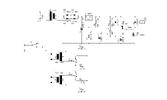
0-30V Stabilized Power Supply

Status
Not open for further replies.
L

liquibyte

Jan 1, 1970
0
thiagoas said:
That voltage supressor will help a lot, try it.
Tell me how you'd select this device and where would you recommend placing it in the circuit?

Quick edit: I have been looking at these as a solution but I'm told it might be better to limit the input voltage using a zener in line with the op amps to keep things in their correct operating range.  With that in mind, the output of the PS would have to be reduced because we'd never get near the 44V upper limit.

Also: A nice application note.
 
Last edited:

audioguru2

Apr 6, 2004
12,026
Joined
Apr 6, 2004
Messages
12,026
The circuit at diyfan.blogspot has some of the problems of the original circuit here plus one:
1) The new problem is that the datasheet for the TL081 shows that its negative supply should be a minimum of 4V so that its inputs work properly all the way down to ground. Then when you add the +33V supply the resulting 37V is higher than its maximum allowed supply of 36V. The TLE2141 has a max supply of 44V and does not need a negative supply.
2) When you calculate the minimum beta for the driver and output transistors then the maximum current required from the TL081 is 1.6mA and its maximum voltage drop is about 2V.
The total maximum voltage drop of the Vbe of the driver and output transistors is 2.1V. The maximum voltage drop of R14 is 1.6V. Then the total voltage drops are 2V + 2.1V + 1.6V= 5.7V so the maximum output at 3A is only 33V - 5.7V= 27.3V if the main filter capacitor has no ripple (but it does have some ripple).
3) If the output has a low voltage or is shorted then at 3A the output transistor heats with 40.4V minus 1V for R7 = 39.4V x 3A= 118W. It will melt.

 
L

liquibyte

Jan 1, 1970
0
audioguru said:
The circuit at diyfan.blogspot has some of the problems of the original circuit here plus one:
1) The new problem is that the datasheet for the TL081 shows that its negative supply should be a minimum of 4V so that its inputs work properly all the way down to ground. Then when you add the +33V supply the resulting 37V is higher than its maximum allowed supply of 36V. The TLE2141 has a max supply of 44V and does not need a negative supply.
2) When you calculate the minimum beta for the driver and output transistors then the maximum current required from the TL081 is 1.6mA and its maximum voltage drop is about 2V.
The total maximum voltage drop of the Vbe of the driver and output transistors is 2.1V. The maximum voltage drop of R14 is 1.6V. Then the total voltage drops are 2V + 2.1V + 1.6V= 5.7V so the maximum output at 3A is only 33V - 5.7V= 27.3V if the main filter capacitor has no ripple (but it does have some ripple).
3) If the output has a low voltage or is shorted then at 3A the output transistor heats with 40.4V minus 1V for R7 = 39.4V x 3A= 118W. It will melt.
Good points.  I didn't suggest using it, just that it was on the right track.

I've been told that I could eliminate the input transient surge by adding a 33-36V zener to the V+ of U1 and U2.  I was thinking http://www.onsemi.com/pub_link/Collateral/1N5333B-D.PDF although I'm sure the 5W rating is probably too conservative but I haven't calculated for it yet.  I'm thinking that if we can get the input stable that the output will follow and things will be right with the world again.  I've got too much invested in this in both time and money to give up on it.
 

audioguru2

Apr 6, 2004
12,026
Joined
Apr 6, 2004
Messages
12,026
With a 30V power transformer that is 31V when the project has no load then the peak voltage is 43.8V and the bridge rectifier drops it to about 42.6V which is the positive supply for U2. Then what voltage will you use for a spike cutting zener diode?

A 28V transformer will be 29V when the project has no load has a peak of 41V and the bridge rectifier drops it to about 39.8v. Zener voltage?

 
L

liquibyte

Jan 1, 1970
0
thiagoas said:
In a company that I used to work they use this suppressor. http://www.littelfuse.com/~/media/Electronics/Datasheets/TVS_Diodes/Littelfuse_TVS_Diode_P6KE_Datasheet.pdf.pdf

I would put a bi-directional on the input of AC voltage from the transformer.

This Zeners in the opamps are good too.

The more the better.  ;D
Fixed your url.

I had thought about trying a TVS but the suggestion I'm getting is to use a 36V 5W zener with a 180R 1W resistor in series with the remaining two op amps.  I may try this way first and see how it works out.

I'm getting a 61V spike after the rectifier and filter cap.
 
L

liquibyte

Jan 1, 1970
0
I have a slightly different circuit than the one shown below but essentially this is what we need to be doing.  I've been told that it might even be better if the anode of the 36V zener was tied to the negative supply and increased to -2.5 to -5 volts if 36 volt op amps are used.  I think if that's the case then the 10V zener would still have to be in play as far as U3 is concerned though.  I'm not sure as I haven't done the math on it.  Theory disproved.

I've tested this with the 10V zener in place but connected between the 180R resistor and the positive side of C1 and the anode of the 36V zener tied to the ground at C1's negative side.  I can still reach 30 volts output with no issue and I'm not getting the very serious 61 volt spikes anymore but I am still getting a P1 dependent spike.  The really odd thing is that at 30 volts it's a 6 volt spike and around 20 volts it increases to around an 8 volt spike and then falls off again at about 10 volts back to a 6 volt spike.  I'm going to keep working on it but I think there's something inherently wrong with the design and may require more changes to work reliably.  I'm getting really odd results but I don't have the equipment that I'd like to have to test this fully.  A more modern scope would help immensely but I just don't have the cash to get one right now.  Donations accepted.  :p

I'm going to say to anyone that hasn't built this, DON'T.  This thing suffers from too many problems to work reliably.  Find something else that's stable and proven.  It does work and it also does almost everything you'd want it to with the one exception that when you turn it on, you're going to get a voltage spike that can possibly destroy anything you have hooked up to it at the time.  If you have one of these built already, turn on the power first and then hook it up to your circuit.  If audioguru would build one of these and test it, we might get quicker results.  As it stands, I'll be working on this and I believe redwire will as well in about a month.

Edited to remove schematic, it was wrong.

 
Last edited:
T

thiagoas

Jan 1, 1970
0
I'm going to put a TVS, varistor and zener.

Just in case.  :p


audioguru2

Apr 6, 2004
12,026
Joined
Apr 6, 2004
Messages
12,026
liquibyte said:
I have a slightly different circuit than the one shown below
I guess you know the 180 ohm resistor reduces the maximum output current to almost zero for an output voltage of 30V. The maximum output current with an output of 5V is only about 150mA.
 
T

thiagoas

Jan 1, 1970
0
audioguru said:
I guess you know the 180 ohm resistor reduces the maximum output current to almost zero for an output voltage of 30V. The maximum output current with an output of 5V is only about 150mA.
I was gonna say that. hehe
 
L

liquibyte

Jan 1, 1970
0
audioguru said:
I guess you know the 180 ohm resistor reduces the maximum output current to almost zero for an output voltage of 30V. The maximum output current with an output of 5V is only about 150mA.
Yeah, you're right.  I was just following a suggestion from somewhere else.  I didn't think about the output current when I put this in under no load.  If it gets loaded at 3A, the magic smoke's gonna happen.  I guess what we're going to have to do is some sort of soft start circuit.  The inrush current from the filter cap is wreaking havoc.
 

audioguru2

Apr 6, 2004
12,026
Joined
Apr 6, 2004
Messages
12,026
The voltage drop of 180 ohms at 3A is 540V! If you use 1.8 ohms then its voltage drop at 3A is 5.4V which might prevent the output from reaching 30V.
With 1.8 ohms then the size of the zener diode must be huge.

 
L

liquibyte

Jan 1, 1970
0
Have you ever used anything like this or anything simple like that?  Most of the issues have been solved, at least as far as I can see with the equipment I have.  The last issue would be some way to slow the inrush current so that it doesn't destroy things.


audioguru2

Apr 6, 2004
12,026
Joined
Apr 6, 2004
Messages
12,026
I have used very high power audio amplifiers and they do not limit the inrush current to the main filter capacitor. But they used torroid transformers that might not saturate like an ordinary power transformer.

When the power switch is turned on then maybe the inrush current almost saturates the core of the transformer then after a short time the main filter capacitor is charged and the transformer current becomes much less which causes it to develop a flyback voltage that we are measuring. A power resistor will reduce the inrush current and a relay can short it for normal operation. 

 
L

liquibyte

Jan 1, 1970
0
Thanks, that's what I wanted to know.  I'll order a relay in a few weeks and calculate out the resistors and report back if it works alright, I'm guessing it should.  I have to now pull out the zener and put back the 10V model to the right place.  Crap this thing is wearing me out.

 
L

liquibyte

Jan 1, 1970
0
redwire said:
How about a soft start such as:
I'm going to go with this so I don't have to cut any traces on the boards.  I should be able to fit that in my case somewhere.  Oddly enough, I already have everything, including some 10 ohm power resistors, except for the relay and mosfet.  Even then, I may have something laying around that I could use but I figure I have to order the relay, I might as well get some mosfets while I'm at it.

I'm still feeling dumb after taking someone's word on the zener thing and not doing the math.  ::)

Edit:  I've simplified it a bit but I think it might be a good solution if it works.Soft-start.png

 
Last edited:
Status
Not open for further replies.
Top