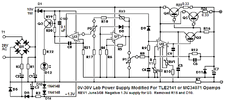
0-30V Stabilized Power Supply

Status
Not open for further replies.

bugmenot1

Aug 12, 2009
44
Joined
Aug 12, 2009
Messages
44
AudioGuru, I'm building the 5A version. therefore is the reason I want to put 3 or up to 4x 2N3055.
The measurements of Hfe of the four 2N3055 with the results of 159-180 Hfe where got under 2,5mA of current in the Hfe test. Under 1,5A of course the Hfe will be lower. But I don't know to make this conversion to have the results for the Hfe (159-180 Hfe - 2,5mA) under 1,5A.
I attached the SC Analyser 2005 project for information only.

SC_Analyser_2005.pdf


Attachments

  • SC_Analyser_2005.pdf
    393 KB · Views: 53

audioguru2

Apr 6, 2004
12,026
Joined
Apr 6, 2004
Messages
12,026
But I don't know to make this conversion to have the results for the Hfe (159-180 Hfe - 2,5mA) under 1,5A.
I always design circuits so that any transistor that meets the minimum or maximum spec's works fine.
Are you designing the circuit so it only works with the transistors you measured then it might not work if a transistor is replaced?

The minimum hFE is 20 at 4A. The datasheet has a typical curve where the hFE is 35 at 4A and is about 80 at 1.6A. The curve does not show below 100mA. Then the minimum hFE at 1.6A is 80/35 x 20= 45.7. Then the max collector current in the BD139 is 5A/45.7= 109.4mA and it will get very hot when the output is 5A and the voltage is low or is shorted.
 

dracu_n_dulap

Aug 11, 2009
21
Joined
Aug 11, 2009
Messages
21
Hi! I've built this psu and it works great :D
but I was wondering why is R22 (in the latest schematic) a 1W resistor? ??? From my standpoint is just a current limiting resistor for the led, isn't it?
and are 2W resistors enough in each power transistors emitter ? i've put 5w to be sure.

 
Last edited by a moderator:

audioguru2

Apr 6, 2004
12,026
Joined
Apr 6, 2004
Messages
12,026
Hi Dracu,
I am glad to hear that your psu works fine. ;D

R22 dissipated almost 1/2W when the transformer was 30VAC and the 10V zener diode was not installed. Now it can be a little 1/4W resistor.

It is easy to calculate the power in a resistor. The 0.33 ohm emitter resistors have a max current of 1.5A. Then they dissipate (1.5A squared) x 0.33 ohms= 0.74W. A 1W resistor will be pretty darn hot so use 2W resistors.


miske

Apr 17, 2010
1
Joined
Apr 17, 2010
Messages
1
Hi all.
My friend build the original version of this project thats don't work, like you guys sad many times here.
So is there any way to fix it, to replace any component with new one?
Or can anyone post new shematic and part list?
Ths in advance.
Cheers.


audioguru2

Apr 6, 2004
12,026
Joined
Apr 6, 2004
Messages
12,026
We have posted the latest circuit and parts list millions of times on these forums.


mendimano1

Dec 31, 2008
59
Joined
Dec 31, 2008
Messages
59
Hi to everyone, I'm planing to build an 5 amps version, with TLE2141 and 3X MJ11016, first question to audiguru how many MJ11016 to use , 2 or 3, and my transformer has an output of 31 volt AC without a load i was wondering is it to much is  there some risk for OP amplifiers ( with 31 AC) and finally i have 2 capacitors with 10.000 mF should i use them both or one is just enough.
Im planing to build acording to this schematic and scech.

Sketch1.GIF

PS_Parts_List_10-11-091.pdf


Attachments

  • PS_Parts_List_10-11-091.pdf
    85.1 KB · Views: 45

audioguru2

Apr 6, 2004
12,026
Joined
Apr 6, 2004
Messages
12,026
Hi Mendimano,
Your transformer is 30V when at its max rated load. Then its peak voltage is 42.4V and the bridge rectifier drops it to 40.4V. The ripple in the filter capacitor drops it to 39.4V.
The voltage across R7 is 1.35V and the voltage across each 0.33 ohm emitter resistor for the output transistors is 0.825V so when the output voltage is set very low or is shorted and the current is set to 5A then the output transistors have 37.2V across them. If two output transistors are used then each one has a current of 2.5A and dissipates 37.2V x 2.5A= 93W!
If 3 output transistors are used then each dissipates 62W.

Your transistors are rated at 200W only when their case is cooled to 25 degrees C somehow (liquid nitrogen?) and their chip is at the max allowed temperature.

At 62W the heatsink for each transistor will be pretty big and might need a fan. You probably will not find a single heatsink big enough for all 3 transistors.


Without a load your transformer is 31VAC. It produces a positive unregulated supply of 42.4VDC.
But the opamps have a max allowed supply of 44V so they are fine.

Use both 10,000uf capacitors in parallel.


mendimano1

Dec 31, 2008
59
Joined
Dec 31, 2008
Messages
59
Thanx Audioguru for that clear answer, im posting the photo of heatsink that im planing to built, what do you think is it big enough? or stil i have to put some fan (fans) to reduce enough  heat from  tranzistors

View attachment 40966


audioguru2

Apr 6, 2004
12,026
Joined
Apr 6, 2004
Messages
12,026
Heatsinks that are made by heatsink manufacturers have datasheets that detail their "thermal resistance" spec'd so you can calculate the chip temperature of the transistor at various dissipations. They are usually anodized black to radiate heat better.


dracu_n_dulap

Aug 11, 2009
21
Joined
Aug 11, 2009
Messages
21
Hi Dracu,
I am glad to hear that your psu works fine. ;D

R22 dissipated almost 1/2W when the transformer was 30VAC and the 10V zener diode was not installed. Now it can be a little 1/4W resistor.

It is easy to calculate the power in a resistor. The 0.33 ohm emitter resistors have a max current of 1.5A. Then they dissipate (1.5A squared) x 0.33 ohms= 0.74W. A 1W resistor will be pretty darn hot so use 2W resistors.
I have modified the schematic and the part list. It now has R22 at 1/4W, then i gave names to the emitter resistors and put their values in the parts list, the same with the 10v zener and D7.
Hope no one minds. :pView attachment 40967

View attachment 40968


noworries2004

Jan 16, 2009
18
Joined
Jan 16, 2009
Messages
18
Finally connected up m ypower supply unfortunately it is not working,
Measuring from Ground, using a 29.4 volt transformer 4 A.
I am getting an input to R1 of 41V, how ever i am also getting this 41V at the output,
Measuring voltage pot, i am getting  a range from 1.1V up to 10.86V.
I am reading 1.082 V across R5+R6, 0.541 across R5.

Some how the input voltage is going straight through to the output?
Has anyone got any ideas or suggestions. Email me back for further information.
I am using th PCB recieved from Red wire so that is definetly ok.

Cheers
Really need some help guys


audioguru2

Apr 6, 2004
12,026
Joined
Apr 6, 2004
Messages
12,026
Ho No Worries,
The output transistors or driver transistor are shorted or have their pins mixed up.
The current-limiting LED should not be turned on when there is no load so it is another problem.

The voltage pot should have an output from 0V to 11.2V.

R5 plus R6 should have 11.2V. R5 should have 5.6V.

Did you make the latest circuit with its parts?


noworries2004

Jan 16, 2009
18
Joined
Jan 16, 2009
Messages
18
Thanks audio guru i will recheck the pins of the output transistors, and ill let you know how i got on, yes it is the latest parts list + Schematic
Cheers


redwire

Nov 10, 2007
244
Joined
Nov 10, 2007
Messages
244
Hi noworries2004.
 
            Knowing that you are using a pcb that has been comercially produced , its got to be the output transistors.  Are you using the BD139 with the metal tab facing you as shown in the pictures on the 1st page.  I guess you are trying this with one output transistor until you get things going? 

To help with transistor setup-from the attached photo
  1.  The blue wire is attached to the transistor base and pin 8 on your pcb. 
  2.  Pin 7A or 7 on the pcb needs to connect to the collector of the transistor.  On the pcb photo it is black with a red stripe.  On the transistor photo is black)
  3.  Emitter: (red wire on the transistor photo, Yellow wire on the pcb photo) The wire from the emitter resistor should branch off  with two wires athough only one is shown in the transistor picture, with one connecting to Pins 1 or 3 of the PCB (shown as yellow) the other wire is your output. 

make sure you print out the data sheet to get the pins correct. 

hope this helps

View attachment 40974


noworries2004

Jan 16, 2009
18
Joined
Jan 16, 2009
Messages
18
I have checked the power transistors but i am still getting 41v at the output,
I used a single power transistor but still no joy,
How can i check if the power transistors are blown?

 
Status
Not open for further replies.
Top