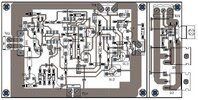
0-30V Stabilized Power Supply

Status
Not open for further replies.

audioguru2

Apr 6, 2004
12,026
Joined
Apr 6, 2004
Messages
12,026
KevinIV said:
picotrain, this design is underdeveloped. It only works for a simple, solitude variable power supply.
No.
This is my improved design. It works very well.
Recently we found out that the MC34071 opamps are no longer available in through-hole packages so the Texas Instruments TLE2141 opamps should be used instead.
 

Kevin Weddle

Feb 23, 2004
1,620
Joined
Feb 23, 2004
Messages
1,620
The error amplifier opamp is two transistors away from the output. Low gain and high input current means low beta. So this isn't the best voltage regulator.


audioguru2

Apr 6, 2004
12,026
Joined
Apr 6, 2004
Messages
12,026
KevinIV said:
The error amplifier opamp is two transistors away from the output. Low gain and high input current means low beta. So this isn't the best voltage regulator.
What are you talking about, Kevin?
With an output current of 3A from the project, the driver transistor is an emitter-follower with a voltage gain of 0.9. The two output transistors have a voltage gain of about 0.85 which is reduced to 0.8 by their emitter resistors. Then their total voltage gain is 0.72 times.

These transistors are inside the negative feedback loop of the error opamp.
The TLE2141 opamp has a typical voltage gain of 450,000 so the total voltage gain is 0.72 x 450,000= 324,000 which is divided by the closed loop gain of 2.7 so the total is 324,000/2.7= 120,000 times.

Then if the output voltage tries to drop 1V it will actually drop only 1V/120,000= 8.3uV which is almost nothing.
But we know that circuit wiring has some resistance that will increase the voltage drop a little.

You talked about beta:
1) The typical beta of the output transistors at 3A maximum load (1.5A for each transistor) is 80 so the collector current of the driver transistor is 3A/80= 37.5mA.
2) The typical beta for the BD139 driver transistor at 37.5mA is 135 so the output current of the error opamp is only 37.5mA/135= 0.3mA.
The error opamp works perfectly with an output current up to 20mA so here it works perfectly.
 

Kevin Weddle

Feb 23, 2004
1,620
Joined
Feb 23, 2004
Messages
1,620
The opamp having a very high voltage gain should regulate it's output at the voltage set by the offset RV1. The 0.85 gain of the negative feedback loop transistors combined with R12 is where the loss in load regulation is. However, the voltage response is quick.


audioguru2

Apr 6, 2004
12,026
Joined
Apr 6, 2004
Messages
12,026
KevinIV said:
The opamp having a very high voltage gain should regulate it's output at the voltage set by the offset RV1. The 0.85 gain of the negative feedback loop transistors combined with R12 is where the loss in load regulation is.
No. The load regulation is excellent. The line regulation is also excellent.

The very high open-loop voltage gain of the opamp driving the driver and output transistors allow the negative feedback from R11 and R12 to keep the output voltage at almost the same voltage as at the voltage-setting pot.
If the output voltage tries to drop 1V then the opamp output rises almost 1V to cancel the output voltage drop.
In my previous post I calculated that a 1V attempted drop actually causes only an 8.3uV drop.

RV1 adjusts the output voltage only a tiny amount, about plus and minus 0.05V to adjust the output to exactly 0.0V when the voltage setting pot is at minimum. The maximum input offset voltage of the TLE2141 opamp is only 0.9 milli-volts (0.0009V).

R12 from the output of the project to the negative input pin of the error opamp plus R11 to ground set the voltage gain of the entire amplifier to 1+(56k/33.4k)= 2.68 times so that when the voltage setting pot is at maximum then the reference of 11.2V is amplified to 30.0V.
 

Kevin Weddle

Feb 23, 2004
1,620
Joined
Feb 23, 2004
Messages
1,620
I'm wrong. The voltage regulation looks very good at around a gain of 3.

RV1 doesn't need any offset adjustment unless the regulated output voltage is more than 15 volts.

 
Last edited by a moderator:

audioguru2

Apr 6, 2004
12,026
Joined
Apr 6, 2004
Messages
12,026
KevinIV said:
The voltage regulation looks very good at around a gain of 3.
The voltage regulation is good at any amount of gain. A gain of 2.7 is used because the reference zener diode D8 is 5.6V which has the best regulation and opamp U1 is a current source for it that doubles the reference voltage to 11.2V. Then for a maximum output of 30V a gain of 30V/11.2V= 2.6786 is needed.

RV1 doesn't need any offset adjustment unless the regulated output voltage is more than 15 volts.
RV1 has nothing to do with output regulated voltages. Opamp U2 has a small input offset voltage when its input is zero then its output has a voltage that is called its offset voltage. With an input voltage of zero from the voltage setting pot then RV1 is adjusted until the output voltage is zero.
 

redwire

Nov 10, 2007
244
Joined
Nov 10, 2007
Messages
244
audioguru,  Why is U1 and the associated negative and positive feedback necessary to output 11.2 V, used instead of a simple voltage regulator in the 11-12 volt range?


audioguru2

Apr 6, 2004
12,026
Joined
Apr 6, 2004
Messages
12,026
redwire said:
audioguru,   Why is U1 and the associated negative and positive feedback necessary to output 11.2 V, used instead of a simple voltage regulator in the 11-12 volt range?
A single 11.2V zener diode powered from a resistor has much worse voltage regulation than a 5.6V one and the 5.6V one is powered by a constant current opamp circuit that makes it even better.
 

redwire

Nov 10, 2007
244
Joined
Nov 10, 2007
Messages
244
What I was referring to was L7812 type.  These have poor voltage regulation ? 
TO92.jpg


audioguru2

Apr 6, 2004
12,026
Joined
Apr 6, 2004
Messages
12,026
redwire said:
What I was referring to was L7812 type.   These have poor voltage regulation ?
It will be fine if it has a load of at least 5mA and an input from 19V to 35V.
 

redwire

Nov 10, 2007
244
Joined
Nov 10, 2007
Messages
244
audioguru said:
It will be fine if it has a load of at least 5mA and an input from 19V to 35V.
Then why not eliminate D8, U1, R5, R6, and R4  and replace with one T0-92 that can handle a 40V input voltage that would get power from the 10V zener?  These voltage regulators are pretty indestructible with thermal, voltage and current cutoff features.

L7812AC.pdf


Attachments

  • L7812AC.pdf
    903.9 KB · Views: 17
P

_pike

Jan 1, 1970
0
hello and  HAPPY NEW YEAR to all !!!!!!! Well i finished my psu and now i am facing a new problem.I have output of 36v no matter what. The pontesiometer doesn't change the output voltage.Can you imagine what it might be wrong?

Regards Panagiotis


audioguru2

Apr 6, 2004
12,026
Joined
Apr 6, 2004
Messages
12,026
_pike said:
hello and  HAPPY NEW YEAR to all !!!!!!! Well i finished my psu and now i am facing a new problem.I have output of 36v no matter what. The pontesiometer doesn't change the output voltage.Can you imagine what it might be wrong?
You might be using old TL081 opamps that have failed because the unregulated supply voltage is too high for them.
You might have the pins on the driver or output transistors connected backwards.

When the problem is fixed then you might find opamp U2 destroyed from excessive heat.
 
P

_pike

Jan 1, 1970
0
i use the mcp chips.The bd transistor is placed correctly.Can you tell me what i can measure with my multimeter (Voltages) To spot the problem? Thoughts of what might be how can i test the op amps?on ic1  i get +5,5v on pin 2 and 11,2v on pin6

Regards Panagiotis


audioguru2

Apr 6, 2004
12,026
Joined
Apr 6, 2004
Messages
12,026
_pike said:
i use the mcp chips.
What is "mcp"? It should be an MC34071 or a TLE2141.

on ic1  i get +5,5v on pin 2 and 11,2v on pin6
Perfect. The +11.2V feeds the voltage setting pot whose slider moves from 0V to +11.2V. The slider feeds opamp U2 and it has negative feedback from the output of the project setting its voltage gain at 2.68 times.

The driver and output transistors are simple emitter-followers with an output that is about 1.5V less than their input and a voltage gain of about 0.95 times.

Then if the slider of the voltage-setting pot is +5V then the output of the project is 5V x 2.68= +13.4V and the output of U2 is about +14.9V.

Does the output of U2 go from about +1.3V to about +31.5V when the voltage setting pot is turned from zero to maximum?
 
D

DrinkH2SO4

Jan 1, 1970
0
Hello people, i want to ask you something.  First i started building the original project but since reading this nice thread, i started building the revised version. I now got the rev 5 parts list, but i already had made the pcb from Picmaster. Now there are some layout inconsistency, i cant find R17 anywhere, or it says R16 instead R17 and in the place of Q1 which is not used there is a 3 pin gap. Is there a revised version of this pcb, or i need to make the another one, that is in the zip with rev 5? Any help would be appreciated. (still learning)

Thanks

3.JPG

 
P

_pike

Jan 1, 1970
0
yes audioguru its MC34071 my mistake.well i get constantly 28,8v on pin 6 of u2 although i turn the pontesiometer.

 
Status
Not open for further replies.
Top