C
Canyoncruz
- Jan 1, 1970
- 0
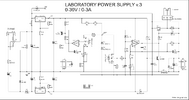
Something similar was discussed several pages back. IC1A seems to be missing the connections on pins 4 and 7. It lists older OpAmps Tl082 which has a maximum voltage rating of 36 which is where it must operate. I think the components used for the 9.5 V reference voltage is overkill, but I support the concept. This design uses a voltage regulator for the negative rail. I prefer the simplicity of the dual diodes to create the negative reference voltage and the 10V zener to tame down the rail voltage for the op amps that Audioguru has suggested. It may be a matter of preference.Canyoncruz said:Have you guys seen this variation?
Thanks I wish I could read Czech to see the designers write-up from the original article.Canyoncruz said:Redwire, here is the link:
http://diyfan.blogspot.com/2013/03/adjustable-lab-power-supply-take-two.html
what design did you use and what values did you use for R13 and R14? The reason I ask is because if you use the latest design that has a negative rail of -1.2 V instead of -5.6V and you use the original values for R13 and R14 then the voltage to the base of Q1 may be positive all the time instead of being slightly negative until shutdown.By the way the only change I have made to the design is I added an NPN (BC546) transistor between the neg rail and pin 6 of U2 to eliminate any voltage at output after the PS is switched off and a 24v Zener at pin 7 of U1
Can you please save it and attach the file in plain text or PDF format, as the forum software doesn't allow Word documents.Canyoncruz said:I google translated it and I copied to word, too long to past here. Send me an email address and I will forward
I used this one. $24.46 each isn't too bad considering the prices on transformers lately. I know a lot of people tend to use toroids but I had a large case that wasn't doing anything so I went with traditional transformers.EmbeddedCom said:Hi All,
Ive decided to build this power supply. Where can I find the transformer ?
Thank you.
The improved and corrected circuit uses a 28VAC or 30VAC transformer. If you use half your transformer (24V) then the maximum output voltage from the project will be about 25VDC at 3A, not 30VDC.VittoYi said:Hi everyone!
I'm trying to build this power-suppy as well, however, I'm doing it as a "low-cost" power supply, spending as less as I can.
Given that, I already have a 24V + 24V 300VA transformer (from an old project) which provides at top 6A for each output line.
Can I use this one to supply the circuit? Would the circuit current consumption get up to 6A or it can be limited to 3A ?
Can you please send me the link of the new version? Because I could only find one where a 24VCC is required. Anyway, it still seems to consume 3A to me. So, the transformer I have would work fine with that.audioguru said:The improved and corrected circuit uses a 28VAC or 30VAC transformer.
I guess you found the original old project that has many errors. It cannot produce 30V at 3A and it is not reliable because many parts are overloaded.VittoYi said:Can you please send me the link of the new version? Because I could only find one where a 24VCC is required. Anyway, it still seems to consume 3A to me. So, the transformer I have would work fine with that.
I mean, the fact that the transformer can supply 6A doesn't mean that the circuit would consume 6A, right?
Thanks, and sorry for my questions, I'm still learning! ;D
VittoYi said:Is there a PCB scheme avaliable?
There are so many PCBs that I really can't find the one for the fifth version.audioguru said:Yes, there are a few pcb designs posted in one of these threads about it.
Does the one from liquidbyte work fine? I don't really need a PCB, but since I want to get two of these circuits working together in the same box, a PCB will make it easier to fit in a standard eletronics box. I'd like to get the copper traces (if anyone designed them already) so that i can get the PCB through photoengraving.Yeah, I double checked the part and it has reversed legs, why I don't know. I mirrored it and corrected the board file and gerbers to reflect the correct part I used. I deleted the zip file from my previous post so I don't cause confusion and I'm attaching the corrected version here for anyone that wants to use the files. Included are the schematic and board files plus the gerbers that I used at Itead to get the boards made. The recommended weight should be 2oz copper for 3A given the trace width, however, that adds $25 to the cost of the boards with them. I used 1oz and am going to run 22awg jumper wire along the bottom between the components and the outputs to handle the current. Probably not the best solution but I imagine it will work alright.
Edited to include a parts list of Digikey part numbers.
Can you please post your modified schematics ?redwire said:A few weeks ago I changed the board by deleting U1 and associated components and replaced it with a 12V linear voltage regulator (PN L78L12ACUTR). I added two cap to keep the voltage regulator smooth. Today the new PCB boards came in. The only other board change was C7. I switched to a film instead of electrolytic. I ran the same tests on the scope and there was no ringing. Based on that, I assume the ringing was U1 trying to stabilize when the power supply was removed but C1 still had a charge.