0-30V Stabilized Power Supply

Status
Not open for further replies.

audioguru2

Apr 6, 2004
12,026
Joined
Apr 6, 2004
Messages
12,026
When you make two completely separate supplies, one can be 0V to +30V and the other can be 0V to -30V. If one or both outputs are shorted to 0v then that supply will safely regulate its output current to the amount of current that is set at.
The supplies have no protection from an output voltage or current of the wrong polarity so if +30V is shorted to -30V then one or both supplies might blow up.

 
R

rvendrame

Jan 1, 1970
0
audioguru said:
When you make two completely separate supplies, one can be 0V to +30V and the other can be 0V to -30V. If one or both outputs are shorted to 0v then that supply will safely regulate its output current to the amount of current that is set at.
The supplies have no protection from an output voltage or current of the wrong polarity so if +30V is shorted to -30V then one or both supplies might blow up.
Thanks.  In that regard,  a dual supply with a central-tap transformer (like this one http://www.electronics-lab.com/projects/power/030/index.html) would be more 'fail proof'?  Or will blowup / smoke exactly like?  My goal is to work with audio in hobby projects (preamps, amplifiers etc)


audioguru2

Apr 6, 2004
12,026
Joined
Apr 6, 2004
Messages
12,026
I have never seen a power audio amplifier that needs a regulated dual-polarity supply. They use a center-tapped transformer, bridge rectifier and two big filter capacitors.

If you build two of this project and power them from a center-tapped transformer, joining the projects at the tap then I think the negative supply in each project will not work properly.

 
R

rvendrame

Jan 1, 1970
0
audioguru said:
I have never seen a power audio amplifier that needs a regulated dual-polarity supply. They use a center-tapped transformer, bridge rectifier and two big filter capacitors.

If you build two of this project and power them from a center-tapped transformer, joining the projects at the tap then I think the negative supply in each project will not work properly.
Sorry, I want a dual PS to use in the bench.  I've build some power amplifiers and might use the PS just for testing them during repair.  I'm just trying to find one more 'fail proof' to short circuits, nothing else.


Hero999

Oct 28, 2007
2,433
Joined
Oct 28, 2007
Messages
2,433
A transformer with a dual 28V secondary winding will do.

D11 will protect the output in case of reverse polarity.

Another diode can be placed with the anode on +Vout and the cathode to the positive of the bridge rectifier to protect against brief positive high voltage spikes entering +V. You could also consider a transorb across the bridge rectifier to protect against transients.

 
T

thiagoas

Jan 1, 1970
0
What are the parameters I should look in the opamp selection? I am a bit confused looking the datasheets.


Now I find MC34074 here, It is good?

 
Last edited:

audioguru2

Apr 6, 2004
12,026
Joined
Apr 6, 2004
Messages
12,026
The corrected and improved circuit used MC34071 or uses TLE2141 SINGLE opamps. They have a case that has 8 pins. The single opamps have 2 of the pins for the input offset voltage adjustment trimpot used on opamp U2. The MC34071 single opamp is not available anymore as a through holes type and is now only available as a surface-mount type.

If you use the MC34074 QUAD opamp (it has 4 opamps in its 14 pins case) then all the pins numbers must be changed on the schematic, a different pcb must be designed and it will probably overheat. Its opamps do not have input offset voltage adjustment pins.

 
T

thiagoas

Jan 1, 1970
0
I will be using 3 of them, to avoid overheat.

Offset adjustment is something I can live without?

Thanks for the help.


audioguru2

Apr 6, 2004
12,026
Joined
Apr 6, 2004
Messages
12,026
You must properly disable the opamps you will not be using. Even though they are not used their idle current causes heating in opamp U2 which might be too high.

The opamps in an MC34074 have a maximum input offset voltage of 5mV so when the voltage setting pot of this project is set to zero volts, the gain of opamp U2 will cause the output to be from -15.4mV to +15.4mV.

 
T

thiagoas

Jan 1, 1970
0
Finally I found TLE2141! \o/

I'm going to use the Picmaster designed board, is everything ok with that?

 
E

EmbeddedCom

Jan 1, 1970
0
audioguru said:
Picmaster's pcb is perfect.
audioguru, redwire in an old post talk about some issue with the power supply. It generate some output ripple at both startup and  shutdown. He resolved this issue by changing U1 and associated components by an integrated 12V linrear regulator.

Do you think that U1 was the problem ?
Is there any other solution to this issue?
Is there any new schematics using this new regulator?
 

audioguru2

Apr 6, 2004
12,026
Joined
Apr 6, 2004
Messages
12,026
EmbeddedCom said:
audioguru, redwire in an old post talk about some issue with the power supply. It generate some output ripple at both startup and  shutdown. He resolved this issue by changing U1 and associated components by an integrated 12V linrear regulator.

Do you think that U1 was the problem ?
Is there any other solution to this issue?
Is there any new schematics using this new regulator?
I do not see why the U1 voltage reference would cause a voltage spike when powered or shutdown. If it did then it would be attenuated by R8 and C4 on my schematic.
You can use a 12V linear regulator IC instead if you want.
 

redwire

Nov 10, 2007
244
Joined
Nov 10, 2007
Messages
244
EmbeddedCom said:
audioguru, redwire in an old post talk about some issue with the power supply. It generate some output ripple at both startup and  shutdown. He resolved this issue by changing U1 and associated components by an integrated 12V linrear regulator.

Do you think that U1 was the problem ?
Is there any other solution to this issue?
Is there any new schematics using this new regulator?
Hi EmbeddedCom,  I built a smd version of this PS and it seemed to work fine, except I finally bought an oscillosope and started testing things and noticed a ripple at start up and shut down.  I always wanted to try a linear regulator instead of U1 so i built another smd board.  I didn't not observe the ripple on the board with the linear regulator.  Well ,this leaves a lot of reasons why the previous board had ringing. 1) Bad solder joint; 2) bad component 3) interference on board 4) bad layout,  and this list goes on.  I requested others who have built the board and have a oscilloscope to test their boards and report the findings. No one has yet.  If just one person reports back that they have no ringing then it is likely a individual problem.  I am not convinced that the linear regulator was the fix or that there is anything wrong with the current design.          The good news is that the only smd part that gets fairly hot is the resistor for "power on" led.  No problem with the smd op amps. 
 
L

liquibyte

Jan 1, 1970
0
redwire said:
Hi EmbeddedCom,  I built a smd version of this PS and it seemed to work fine, except I finally bought an oscillosope and started testing things and noticed a ripple at start up and shut down.  I always wanted to try a linear regulator instead of U1 so i built another smd board.  I didn't not observe the ripple on the board with the linear regulator.  Well ,this leaves a lot of reasons why the previous board had ringing. 1) Bad solder joint; 2) bad component 3) interference on board 4) bad layout,  and this list goes on.  I requested others who have built the board and have a oscilloscope to test their boards and report the findings. No one has yet.  If just one person reports back that they have no ringing then it is likely a individual problem.  I am not convinced that the linear regulator was the fix or that there is anything wrong with the current design.          The good news is that the only smd part that gets fairly hot is the resistor for "power on" led.  No problem with the smd op amps. 
I don't have a DSO so I can't really see much more than what I have is capable of but I do see spikes on power on and off when I have an old analog hooked up across the output.  I haven't had much time to implement some of the suggestions offered for mitigating this due to other things taking up my time.  I was hoping that you'd found out the cause and figured out a way to fix it, or at least minimize it.  The boards I did do work extremely well except for that one issue.
 
T

thiagoas

Jan 1, 1970
0
I ordered the last 3 of 4 tle2141 in my country.  :eek:

Just waiting them.

IMG_20140806_223349801.jpg


redwire

Nov 10, 2007
244
Joined
Nov 10, 2007
Messages
244
liquibyte said:
I don't have a DSO so I can't really see much more than what I have is capable of but I do see spikes on power on and off when I have an old analog hooked up across the output.  I haven't had much time to implement some of the suggestions offered for mitigating this due to other things taking up my time.  I was hoping that you'd found out the cause and figured out a way to fix it, or at least minimize it.  The boards I did do work extremely well except for that one issue.
Thanks for the feedback. 
 
T

thiagoas

Jan 1, 1970
0
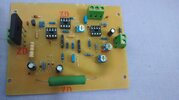
I finished my power supply!

Just a little problem, when my current pot is on minimum, the LED turn on, without any load on the output. Adjusting the trimpot doesn't help.

My BD139 was without the heatsink and fried when I put a big load.  ;D
Isn't more safe a greater power transistor?


audioguru2

Apr 6, 2004
12,026
Joined
Apr 6, 2004
Messages
12,026
thiagoas said:
I finished my power supply!

Just a little problem, when my current pot is on minimum, the LED turn on, without any load on the output. Adjusting the trimpot doesn't help.
 
T

thiagoas

Jan 1, 1970
0
Now I understand better, thank you for the clarification.

I put 68 ohms and resolved that.  :)

BTW, Texas send me 3 samples of the tle2141, it's a good choice for who is having trouble finding it.

 
Status
Not open for further replies.
Top