In my opinion 3A is on the low-side. 5A would be nice, 8A would be excellent, 10A and you have an outstanding PSU, capable of powering most projects (eg an audio ampilfier).
Each to their own I suppose. I thing 1.5A is good enough for most applications, for high powered stuff a regulated power supply becomes less important so I make my own unregulated supply using a Variac, a mains transformer, a rectifier and a filter capacitor.
Now as this supply isn't going to be for me, it's whatever everyone here needs.
Maybe I could design it for 5A and include some modifications to increase it to 10A?
Don't forget even 5A would require a 250VA transformer which will be quite large.
Hero, I was not able to find the MOSFETs on the IRF website, they are not real parts, are they?
It's just a MOSFET in a TO-220 package I could find on LTSpice. The datasheet can be foud on Google easilly enough. I don't know how easy it is to buy though.
I would prefer using a tad more expensive MOSFETs with lower RdsON than using more MOSFETs to keep it compact.
I would agree in general but I think common and easy to get hold of is more important here, besides power dissipation is the main problem here, not on resistance or current capacity.
Regarding gate current, a driver IC can be used (non standard?) or maybe an op-amp connected as a buffer. But then you need an extra device on the PCB as you already have 4 op-amps.
Perhaps I could add a transistor to the current limiting section but it'll probably need more phase compensation as it would increase the gain.
I think 10% regulation is quite high for a power supply where a constant voltage source is important.
I was talking about a typical 100VA transformer. I hope the power supply will have a much tighter regulation factor than 10%.
Anyway, I calculated the no-load RMS output voltage as 13.3V for a 12V transformer rated at 3A with 10% regulation. Assuming sine wave, that is 18.86V peak, not quite sure where the 0.2V discrepancy is coming from, maybe rounding error? We both used a calculator for sqrt(2) so 0.2V is quite high.
12V + 10% = 13.2V
If a 3A load is applied, the voltage will drop back to 12V, 13.2 - 12 = 1.2V
The impedance is 1.2/3 = 400mOhm.
One thing to bear in mind here, is that the regulation will change as the power factor from the rectifiers changes, you are switching between half and full bridge rectification.
No, it always uses full-wave rectification. When running from the centre tap the rectifier is configured as a biphase rectifier, it's still full-wave the transformer ensures that, when switched to the higher voltage, it's configured as a standard bridge4 rectifier. I wouldn't even consider drawing such a large load from a transformer using a half-wave rectifier because it will cause core saturation and meltdown.
What I realise is that I used the word impedance and not resistance. The secondary will also have inductance that, unlike it's resistance, will not waste energy as heat but send it back to C1. I am not sure as to what range of secondary inductance such a transformer will have. So what I did is assume that the secondary inductance exhibits an inductive reactance that is equal to the secondary resistance and therefore equal to Zsec / sqrt(2) = 0.43 / sqrt(2) = 0.3 Ohm
The inductive reactance of an inductor is |Z| = ω L [Ohms]. Plugging 50Hz and 0.3 Ohm into that and rearranging, I got an inductance of 9.67 E-4, i.e 967 μH.
So, Hero, try simulating the transformer with two 18.8V peak sine sources each with an inductor of 967uH in series with a resistor of 0.3 Ohm. Sorry I can't help with simulation my LTSpice has a will of its own.
That doesn't look right to me.
I would have thought the only inductance would be the leakage inductance which will be negligible.
The primary and secondary resistances will dominate. The resistance seen a the secondary will be equal to the Rs + Rp/TurnsRatio.
Even if part of the impedance is inductive it'll still drop the voltage by limiting the current pules, it's true that power won't be wasted but that doesn't make that much difference for the purposes of this exercise.
You could sacrifice efficiency by using only the full bridge rectifier to drastically reduce the peak rectifier current. But I quite like that topology, and considering all of the above I think a higher current trafo is needed.
I think tap switching is the only sane way to build a high powered linear power supply. I would like to use a transformer with as many taps as possible but it wouldn't be a standard part.
Hero, could you zip and email me your lib folder and its subfolders and files?
Done.
EDIT:
I couldn't email you so I've uploaded it to Silicon Tronics.
http://www.silicontronics.com/Stuff/lib.zip
Don't expect it to be there forever, it's just a temporary thing.
EDIT:
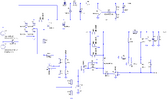
Here's a 35V 5A power supply.
The effect of the extra MOSFET capacitance has been reduced by bypassing R4 with 100nF which probably has slowed the over current limit response time.
The transformer model is 225VA which has a regulation factor of 8%.
It just about manages 35V and 5A simultaneously but I woundn't bet on it in real life; the ripple valley is very close to the output voltage.
I also wouldn't bet on my make shift high voltage zener (Q1, D8, R14 & R15) to have a votage drop below 44V, the maximum rating of the op-amps.
I think we need to accept that the output voltage and current won't be available simultaneously.
I'm tempted to go back down to 30V as the extra 5V isn't worth the trouble.
I can still keep the 5A requirement, it's just that beyond about 27V the voltage will drop and there'll be ripple, at high currents.
 0_to_35V_5A.asc.txt


