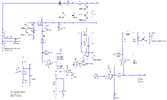
Design new 0 to 30V power supply.

Alex Tsekenis

Nov 29, 2009
299
Joined
Nov 29, 2009
Messages
299
Are you talking about finding a transformer which will allow 0 to 30V @ 5A?
Yeah, that is what I meant. Since using a higher volatge trafo will require more parts, in the final project it would be nice to have a trafo that can offer 5A without output ripple.

If most people here decide it's a must, then I'll look at redesigning for a 30V transformer. This will probably mean ditching the LDO MOSFET idea and going back to a more traditional transistor based approach.
How about arranging for the zener diode regulator across +V+6 and ground by increasing the zener voltage and recalculating the resistance? This will waste more power on the zener (series diodes?) but will allow a 30V trafo and you get a regulated supply for the op-amp.

I have to justify the space they take to myself...
Put them on ebay?
I tried in the past. The problem is that most people buying from ebay can't afford them and those who can, don't buy from ebay if you know what I mean. Might try again in the future.

I've decided on the IRLZ34N
Anything. That is one cheap MOSFET btw..

RS is cheaper for the 10,000μF
Anything than a single 22000uF/63V cap.

It's probably a good idea to put footprints on the PCB for two capacitors as well as one and different diameters if convenient.
Good idea since this is a kit.

I would have thought simulation would be good enough since the simulator performs loop analysis anyway.
Can LTSpice do Bode plots? I am asking, I don't know. We can optimise some of the components this way but as you say good enough. We can simulate some reactive loads too later on.

Surely it's more cost effective to use one voltage reference IC and obtain other voltage references using potential dividers?
Sorry, I get confused with multiple sources on the diagram.

The original idea was to use an LM78L05 but then I decided the tolerance is too wide.
Good thing you rejected that.

Now I'm thinking of using an LM431B which has a tolerance of 1%. I could use the C version which is 0.5% but it's probably harder to get hold of and will be more expensive.
It is not like we have much choice in TO-92 at this tolerange range... I looked on RS and Farnell, most products are the 431 from different manufacturers ::) 1% sounds reasonable. We should consider how much effect on the output a 1% reference error will have compared with using 1% resistors for the potential dividers. That said, TI's TL431 says A=1%, B =0.5%. The TL431A costs only 30p on Farnell and you dont have to buy a bag of 50 like on RS.

How about the LM317L? Just an idea. Never mind, the 1.25V bandgap reference is at +/- 0.05 V i.e. 4%.

I'm thinking 1% for all the gain and reference setting resistors and 5% for everything else.
Close tolerance is nice but <1% starts to get expensive and harder to get hold of.
Fully agree, 5% can also go for R16,17. 1% resistors are used more and more frequently so if we say 1% throughout I dont think the cost difference would be prohibitive, if any. It saves the effort of saying this 5% that 1% etc.
 

Hero999

Oct 28, 2007
2,433
Joined
Oct 28, 2007
Messages
2,433
How about arranging for the zener diode regulator across +V+6 and ground by increasing the zener voltage and recalculating the resistance? This will waste more power on the zener (series diodes?) but will allow a 30V trafo and you get a regulated supply for the op-amp.
Done.

A 39V zener such as the BZX85C39 or 1N4754A.

I've simulated this with three zeners in series giving 40V which is near enough.

I might as well upgrade the voltage to 33V as the simulation clearly shows it's possible.

Can LTSpice do Bode plots? I am asking, I don't know. We can optimise some of the components this way but as you say good enough. We can simulate some reactive loads too later on.
It does do Bode plots but it's not something I've used before so I'll need to have a play.

It is not like we have much choice in TO-92 at this tolerange range... I looked on RS and Farnell, most products are the 431 from different manufacturers ::) 1% sounds reasonable. We should consider how much effect on the output a 1% reference error will have compared with using 1% resistors for the potential dividers. That said, TI's TL431 says A=1%, B =0.5%.
I'll say TL431A or LM431B on the BoM

I'll say <1% for all of the reference and gain setting resistance and <5% for the rest. I don't like setting unnecessarily tight tolerances for anything. If it were me building it, I would just use 1% for everything but it isn't going to be me building it. I'll make it clear that 1% can be used instead of 5%.

I'm also sticking to E12 values where ever possible as I know lots of people only stock E12 values.

The TL431A costs only 30p on Farnell and you dont have to buy a bag of 50 like on RS.
RS are a bit more expensive but you can buy just one of them.
http://uk.rs-online.com/web/search/searchBrowseAction.html?method=getProduct&R=0428436

EDIT:
Here's the latest schematic.

View attachment 40802

 
Last edited by a moderator:

PicMaster

Feb 18, 2009
90
Joined
Feb 18, 2009
Messages
90
I might as well upgrade the voltage to 33V as the simulation clearly shows it's possible
I would say limit it to 30V has the extra 3 volts woudl not make that much difference

I'll say TL431A or LM431B on the BoM
I totaly agree has it's simple and an easy to obtain the part, Cost does play a apart in slightly but it want want to build a quality PSU then cost does not matter to much, After all if you had
 
Last edited by a moderator:

Hero999

Oct 28, 2007
2,433
Joined
Oct 28, 2007
Messages
2,433
PicMaster said:
I would say limit it to 30V has the extra 3 volts woudl not make that much difference
In theory that's fine.

In practise, I'll always design the output voltage to be a little be higher than 30V because it's possible that component tolerances could limit the voltage to less than 30V. I could include a trimmer so the user could trim to exactly 30V but I don't see the point.

I'm glad that you've stuck with the 5.6V reference this makes it easier to make it a digitally controlled PSU with no extra parts like bossting the voltage,

Would the 0.6V differnce make that much difference in the max output voltage/current has you can only get 5V out of the MCU, I now you could use a DAC but just aads to the cost and makes the a little harder in the design of it has I've never used DAC's so not reallt sure
I could easily go back up to 5V but I'll have to increase the gain of the current and voltage amplifiers slightly.

The problem boils down to tolerances again, with a 5V reference and the current gain of 1A/1V it's possible the current limit will be less than 5A.

Will there be a LED for the visual indication for over current, Would it be to hard to add some LEDs so you can see if the PSU is supply constant volatge or constant current only I've seen some of these on other deisgns
That's a good idea, I'll look into it.

I've just looked at the links for the cap's you posted is 40V cap going to be big enogh ?
That was selected when I was going to use a 24V transformer, with 30V it's going to be increased to 50V.

I was also thinking would it be better to have the bridge rectifier and cap mounted of the PCB, This would save people hunting the right Cap & rectifeier and aslo reduce the size of the PCB.  This is the way I would consider doing it.
That's a possibility. I'm going to leave that up to the person designing the PCB.

Another edit:Now I'm not sure if it's something over looked but when you have got the current pot turned down to zero(min current) you get no output voltage I have to set the pot to about 2% before I get voltage that's 0-15v then it will not go any higher than 20volts until I take the current pot to 3% to obtain 30Volts so to me the current limit is active even with no load.
That's pretty normal for power supplies I've seen except the current limit pot. only has to be adjusted to slightly above zero and the output suddenly jumps to the full voltage setting.

I suppose it's possible for it to be unstable if the user selects really low currents <1mA due to noise.
 
Last edited by a moderator:

PicMaster

Feb 18, 2009
90
Joined
Feb 18, 2009
Messages
90
The velleman power supply I have got had  2 pots that you had to calibrate min and max, the had to be set for about 2-6ma and the max was for 5amps, I suppose that's how they got around it so when the main current limit pot turned turned to zero the calibration pot prevented the volts from droping to zero

In practise, I'll always design the output voltage to be a little be higher than 30V because it's possible that component tolerances could limit the voltage to less than 30V. I could include a trimmer so the user could trim to exactly 30V but I don't see the point.
I never thought about that bit, It maks sense now  ;D
The problem boils down to tolerances again, with a 5V reference and the current gain of 1A/1V it's possible the current limit will be less than 5A.
I had a play around with the values of the TL43B to make vref 5.01 and the max current went to 5.01 where has before it only went to 5.63 has that what the vref voltage was, Would it possible just to alter the gain slighty so we can control it with 0-5V (4.95V), may be this where the min and max pots could be used just incase you overshoot 5amps and at the same time this will cure the volts problem with the current pot turned to 0
 

Hero999

Oct 28, 2007
2,433
Joined
Oct 28, 2007
Messages
2,433
LTSpice is annoying me.

I'm testing the stability of the over-current protection by connected it to a constant voltage linear ramp.

The first thing I noticed is it was taking ages. I attributed this to it being unstable when the power supply voltage is really low. To get round this I set the phase on the voltage sources to 90

0_to_30V_5A_sch3.png

0_to_30V_5A.asc.txt


Attachments

  • 0_to_30V_5A.asc.txt
    11.4 KB · Views: 5
Last edited by a moderator:

PicMaster

Feb 18, 2009
90
Joined
Feb 18, 2009
Messages
90
I'm simulating mine in ISIS and everything seems to work OK, To get it to Sim correct I've had to remove M1 and replace with relay has I could not alter the output voltage has the way it is drawn it always stayed at max output voltage, The way it is set up at the moment to me is working great according to the Sim, The voltage goes from 0-30.2(this is because I got veref set to 5V), I then close the switch on a 0.1R resistor and then alter the current from 0-5.01 amps the voltage drops right off to 0.16V, I have also tried bigger value resistors and gone through the range and the voltage/current remain stable,

I've tried to add the 2 100k resistors as per your latest drawing and  it will not Sim so I know that by adding these 2 resistors that cause's the problem, I removed them and everything back to working, Now this where I get confused and how much faith do you put in these Sim programs, Normally they are spot on if it does not work in ISIS then it does not work in the real world. Some times I get problems in simulating but in the real world everything OK  ???
My drawing attached, I've not really used LTspice at all, it is all new to me so i'm just playing and learning how do you alter the pots in LTspice

new_design_psu.pdf


Attachments

  • new_design_psu.pdf
    16.7 KB · Views: 15

Alex Tsekenis

Nov 29, 2009
299
Joined
Nov 29, 2009
Messages
299
So much information...I was only away for like 3/4 of a day!

I would overrate the outputs (I, V) slightly to ensure that despite tolerances we have 30V, 5A.

This has shaken my confidence in LTSpice.
Welcome to the club.

Will there be a LED for the visual indication for over current...
I think adding LEDs and indicators is trivial and could be left for later on.

I expected the minimum current setting to be 25mA maximum
Pretty high?

I was also thinking would it be better to have the bridge rectifier and cap mounted of the PCB, This would save people hunting the right Cap & rectifeier and aslo reduce the size of the PCB.
IMO the best of both worlds would be to put multiple cap sizes on the PCB. The same for some other components.

On a different note, I was thinking of the digital front end. An I2C bus would be nice as we can hang all digipots on it, plus say a temp sensor or a fan controller.

Thanks for the latest asc file. PICMaster, you have a relay in your schematic ??? Sorry I can't spend more time on this despite wanting to.
 

PicMaster

Feb 18, 2009
90
Joined
Feb 18, 2009
Messages
90
Thanks for the latest asc file. PICMaster, you have a relay in your schematic  Sorry I can't spend more time on this despite wanting to.
Yeah this is for testing purpose only, It was the only way that I could get to simulate it because with the mosfet in there i was only getting max voltage out and no variation in the output. I know that simulators can sometimes play up causing all sorts of problems let's just hope this does not happen real life.

IMO the best of both worlds would be to put multiple cap sizes on the PCB. The same for some other components.
Yes may be but we would have to complete the bom and source the components and the data sheets to get the correct sizes so the footprints can get made.

On a different note, I was thinking of the digital front end. An I2C bus would be nice as we can hang all digipots on it, plus say a temp sensor or a fan controller.
Why digital pots, You could just use a op-amp as a buffer/protection and read the the voltage/current,the temp and control a fan all at the same time, But if you like the idea of digital pots then may be we could have 2 interface add on's  ;D

think adding LEDs and indicators is trivial and could be left for later on.
Yes I know it's sounds trivial but needs to be thought of, Has for the LED's to state constant current or constant voltage is not so important but we need to add all the stuff soon before we come wup with a working prototpye.
Next year  ;D (week) I shall get the op-amp and a few other bits ordered ready to start biulding that's providing we stick with the chosen op-amp,

Well this has been very interesting and would love to continue working on this project but the wife telling me to get ready to go out,

Happy new year to you both and We'll speak next year  ;D ;D

Alex what language do you write your code in ?
 

Hero999

Oct 28, 2007
2,433
Joined
Oct 28, 2007
Messages
2,433
Pretty high?
I agree, I would have hoped it would be lower but I looked at the datasheet and the worst case is 25mV, 10mV  is typical and 5mV typical with 600R resistor.

I'm simulating mine in ISIS and everything seems to work OK
It doesn't look right to me, the PDF you posted says the voltage before the MOSFET is 88.8V which is much too high.

I've tried to add the 2 100k resistors as per your latest drawing and  it will not Sim so I know that by adding these 2 resistors that cause's the problem, I removed them and everything back to working,
So you're having problems with both of the pot's?

I'm only having a problem with R24 on my schematic. It works fine without it but goes wrong as soon as it's added.
 

Alex Tsekenis

Nov 29, 2009
299
Joined
Nov 29, 2009
Messages
299
I agree, I would have hoped it would be lower but I looked at the datasheet and the worst case is 25mV, 10mV  is typical and 5mV typical with 600R resistor.
Can we add a negative offset?
 

Hero999

Oct 28, 2007
2,433
Joined
Oct 28, 2007
Messages
2,433
You mean a negative supply?

It's certainly doable, 0.6V will do but it's more components, at least the doubler capacitors can be smaller.


PicMaster

Feb 18, 2009
90
Joined
Feb 18, 2009
Messages
90
Herro the 88.8 is the defualt value it just prints out like that, no both pots work fine if I have looked at the drawing correct you added 2 100k resistors iwill look at r24 bit later and let you know
Sorry this was after the new year party, I will explain better now

Herro the +88.8 is greyed out when the simulator is not running(this is there default state), Once I start the simulator they then read the correct voltage. I've re-looked at the drawing and made the correct modifaction to my drawing added C5,R23&R24, C5 is 1N and R23 is 100k, I changed the value of R24 to 680R. Yesterday when I tested it the sim did not run so I put it down to adding the above parts but I went through I sim log and found a couple of errors with s 100N cap I used and reinstated the above part and it ran fine, I placed a current porpe on the output with the pot set to zero the prope reads 1.70693e-05 coming output side of U2 is 0.096MV at 2% the probe reads 0.008A the output voltage U2 is .098MV and at 3% the probe reads 0.1398A and the voltage is 0.14875MV.

So I'd say if your having problems I'd put it down to LTspice. I hope this explains it a bit better for you

Steve
 
Last edited by a moderator:

PicMaster

Feb 18, 2009
90
Joined
Feb 18, 2009
Messages
90
I've start to look at part and The supplier I use I can't get the 22000uF caps but can get these
10000UF 50V 105C HE SERIES SNAP IN RC  Rapid part number  11-3165
from here
http://www.rapidonline.com/Electronic-Components/Capacitors/Radial-Electrolytic/Low-profile-snap-in-105-deg-C-2000hr.-electrolytic-capacitor/80204
I find these are cheaper than RS on most of there stuff but the draw back is not has much components at RS, If the crunch comes to the crunch I will order the correct ones, Rs always seem to have a SSM quanity but rapid most of there stuff is one off's


Alex Tsekenis

Nov 29, 2009
299
Joined
Nov 29, 2009
Messages
299
Maybe we can look at charge pump inverter for the op-amp supply, like the one attached. This config offers a -Vin and +2xVin.The only problem is tha te maximum Vin is 20VDC so some sort of preregulation will be needed from the V+ line.

Edit:  Wouldn't adding a resistor from Iout node to ground form a pot. divider with R23? Maybe you can change the gain of the dif amp.

View attachment 40808

 
Last edited by a moderator:

Hero999

Oct 28, 2007
2,433
Joined
Oct 28, 2007
Messages
2,433
Seems overkill when all is needed is a couple of capacitors and diodes.

2iw7wbs.gif


PicMaster

Feb 18, 2009
90
Joined
Feb 18, 2009
Messages
90
I have added the -9 supply and to me makes it worse, well in sim mode I now have to take the current pot to 8% before I get a voltage instead of 2%,

Unless some thing else needs altering.


Alex Tsekenis

Nov 29, 2009
299
Joined
Nov 29, 2009
Messages
299
Can you create a negative voltage without using a doubler with the way the centre tap is connected?
D3 and D4 route the negative half cycles to ground potential and the centre tap is connected to V+.
I dont think it's possible. Using a doubler to create just about -0.7 volts sounds overly wastefull to me..

[glow=red,2,300]EDIT:[/glow]

I have added the -9 supply and to me makes it worse,
That would exceed the LT1014 dif supply voltage by 5 volts!
 
Last edited by a moderator:

PicMaster

Feb 18, 2009
90
Joined
Feb 18, 2009
Messages
90
Can you create a negative voltage without using a doubler with the way the centre tap is connected?
D3 and D4 route the negative half cycles to ground potential and the centre tap is connected to V+.
I dont think it's possible. Using a doubler to create just about -0.7 volts sounds overly wastefull to me..
I did do that in the end I reduced the 39V zener to 36V and used a 4.7V zener and with no load the pot now can go to 0% and still obtain the voltage out, If  used 33V zener with 4.7V you don't obatin the full voltage out, I placed the current porbe on the output it reads 0.001A with the pot set to zero.

So far everything seems to be working great in the SIM,
 
Top