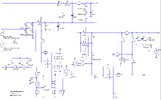
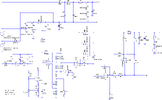
Design new 0 to 30V power supply.

Hero999

Oct 28, 2007
2,433
Joined
Oct 28, 2007
Messages
2,433
I had a feeling you lot would jump on me for posting that circuit with a 9V zener. ;D

That was never my intention, it was just a circuit I've already drawn.

I'm using an ordinary silicon diode to provide a negative voltage of 0.7V.

I might look into using a cheaper op-amp as there's no point in using a single supply omp-amp with a negative supply.

Alex,
A voltage doubler is required to get a negative voltage because one side of the rectifier is connected to 0V.

 
Last edited by a moderator:
Alex Tsekenis

Nov 29, 2009
299
Joined
Nov 29, 2009
Messages
299
I thought you posted that as a topology example as you had also already mentioned using -0.6V. But PICMaster copied that in his simulator. Maybe that's why you got even worse result PICMaster.

So we have decided to include a small negative supply to get the output to zero. Hero, will you look into a balanced positive/negative or +V+6 and say -0.7V?

The question now becomes whether there is a way to minimise the component count of the power supply's power supply.


Hero999

Oct 28, 2007
2,433
Joined
Oct 28, 2007
Messages
2,433
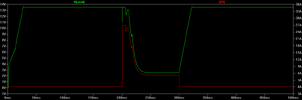
The recovery from a short circuit at the higher voltage settings is slow and ugly because it takes awhile for the filter capacitor to charge when it's switched to the higher voltage. This is an inherent problem with reducing the input voltage at lower output voltages. I don't think it matters, the short ircuit characteristic is more important.

Here's a plot. The supply starts off short circuited, the current is interrupted for a time before being chort circuited again. The short circuit is simulated by connecting a diode in series with a 40V voltage pulse, LTSpice got funny when I started playing around with MOSFETs, I'll post the .asc tomorrow.

View attachment 40809

 
Last edited by a moderator:

Alex Tsekenis

Nov 29, 2009
299
Joined
Nov 29, 2009
Messages
299
This is great Hero, as you say the charging of C1 is evident as it is during a normal star-up.
I agree, the recovery profile is not too important. I see that the under/overshoot is minimal.

Could you also run a sim with the load changing from 10% to 100% and back? That would be important. Also, please post the asc you are working on.


Hero999

Oct 28, 2007
2,433
Joined
Oct 28, 2007
Messages
2,433
Here's the latest .asc

I've experimented with a current limit delay by increasing the value of C5 to 100nF. Connecting C5 to 0V just resulted in oscillation.

The short circuit curve is not pretty, first there's a short transient spike caused by C7 and C5, then an exponential decay with some ripple superimposed on top of it. The oscillation is worse at lighter loads, I've tested it with a short circuit and it still died away so I don' think it's a big problem.


The delay also slows down the recovery time which is no big surprise. Incidentally with C5 at 1nF and the output set to 13V the recovery time is nearly instantaneous which is to be expected as the rectifier voltage doesn't change much.

0_to_30V_5A_SC2.png

0_to_30V_5A_SC3.png

0_to_30V_5A.asc.txt


Attachments

  • 0_to_30V_5A.asc.txt
    12.6 KB · Views: 4
Last edited by a moderator:

Hero999

Oct 28, 2007
2,433
Joined
Oct 28, 2007
Messages
2,433
You're right, attachment edited.


You mentioned simplifying the rectifier part of the supply; I don't think this is possible because two voltage doublers are required. I think it's probably best to just minimise the size of the capacitors. I don't see any point in going below 10μf, for the negative supply, because it's a fairly cheap and common value but I should be able to reduce C2 and C3 considerably. I'm also questioning the added value of having two separate capacitors for the main filter rather than one large capacitor.


PicMaster

Feb 18, 2009
90
Joined
Feb 18, 2009
Messages
90
The MCU with LCD 6/8 push buttons and may be 2 digital pots I would say no more than 100-200MA may be well lower, I would say if you allowed a max of 500ma this should more than enough,
I will look into it for a more accurate figure, but the 5V supply would need to be filtered well.

I will try altering the Load resistor and run some more graphs just to compare

I like the idea of adding a boost transistor so that it can be rum from a 5V source, Now that I've got the latest drawing I will compare it agaisnt mine aswell


Hero999

Oct 28, 2007
2,433
Joined
Oct 28, 2007
Messages
2,433
Don't forget that the higher the current the larger the transistor and heat sink needs to be. I would like to use the same heatsink as used for the MOSFET but I don't want to use long leads for a voltage reference.

I'll rate the reference power supply to 250mA for now which will allow a cheap transistor such as the TIP31A to be used and a small clip-on heat sink.

I've noticed that I've grossly over-sized C1, I managed to reduce its value to 8000


Alex Tsekenis

Nov 29, 2009
299
Joined
Nov 29, 2009
Messages
299
allowed a max of 500ma this should more than enough,
I'll rate the reference power supply to 250mA
You will probably find that less current will be needed. Most of this will be going to the LCD backlight, about 20mA. Digipots will draw about <1mA (excluding resistor ladder). Dual or more versions can be found. The MCU itself needs not run off 5V (the LCD accepts TTL signals). It can run at 3.3 and at relatively slow speeds like 1MHz. 20mA will be a conservative guess.
 

Hero999

Oct 28, 2007
2,433
Joined
Oct 28, 2007
Messages
2,433
20mA means I could happily remove the booster transistor or do you think that would be a bad idea?

Here's the latest schematic, I've added the current delay in.

I'll probably precede to the final version and the BoM soon.

I'm not going to worry about getting exactly the right models for the MOSFETs and diodes that I'm actually going to use, I don't see the point.

0_to_30V_5A_Sch3.PNG

0_to_30V_5A.asc.txt


Attachments

  • 0_to_30V_5A.asc.txt
    13 KB · Views: 9
Last edited by a moderator:

PicMaster

Feb 18, 2009
90
Joined
Feb 18, 2009
Messages
90
Oh no I see that we have lost 3 pages of the topic What's going wrong ?

I no this is jumping the gun a little but I've been playing around with the Digital part well laying out the GLCD for volts and amps, I shall try the bigger fonts and aslo the standard font, If we use the standard font there is a lot more room to play around with.

What do we need to display apart from the voltafe/current readings, We could have a max set volts/current .

Herro how is the final sechematic and parts list looking ?


Alex Tsekenis

Nov 29, 2009
299
Joined
Nov 29, 2009
Messages
299
We have a problem as many pages are missing. From other topics too.

I can't think of a reason to have max volts/amps.

Maybe we could say CC/CV for each channel?


Hero999

Oct 28, 2007
2,433
Joined
Oct 28, 2007
Messages
2,433
I'll get the final parts list and schematic finished tomorrow.

I'm still not sure it even needs the negative supply, I know LTSpice didn't like it without it but that doesn't mean anything. I'll include it on the schematic and ask whoever builds it to try connecting it to 0V to see if it still works and the output goes down to 0V.


PicMaster

Feb 18, 2009
90
Joined
Feb 18, 2009
Messages
90
I can't think of a reason to have max volts/amps.
Ok May be not max volts/amps setting so it cannot bed excceded but a amp setting reading so the use can see what the max curret is set rahter than geussing because if you set it to high and your PCB under testes have faults then bang ;D

I've add a quick look at the parts list/schematics, I shall print them off to have a good look over,
What about a LED for current limit indication, well thinking about it that will come later has we need to know that this will work first ;)

Could we not use a smaller heatsink with one or two fans on them, I use a heatsink 200mmX100mmX40mm with with 4 x .47R 100W resistors in parrell carrying 30amps constant between 4-6hrs with 2 60mm fans and the temp did not even get above 50 C, If the fans fail then the system shuts down.


Hero999

Oct 28, 2007
2,433
Joined
Oct 28, 2007
Messages
2,433
The physical size of the heat sink doesn't matter, as long as the

 
Last edited by a moderator:

redwire

Nov 10, 2007
244
Joined
Nov 10, 2007
Messages
244
As long as you are using the ADC on the IC,  why not measure and display temperature of the transistors or other critical parts.  This can be a secondary shut down method if something goes out of wack while in development or evaluation,  but it would give you a visual indicator of the system.  If you don't want to display temperature use one of the ic pins to light a yellow or red warning led on the front panel if temperature is elevated.  With a IC you have plenty of options to even blink the led based on the temperature.  You could even use the temperature to run the fans.  I would guess most the the time there would be very little current being used.

View attachment 40818

 
Top