12V - 350V 200mA converter for motorcycle CDI

(*steve*)

¡sǝpodᴉʇuɐ ǝɥʇ ɹɐǝɥd
Moderator
Jan 21, 2010
25,510
Joined
Jan 21, 2010
Messages
25,510
Let's look At some data for that mosfet and a 555.

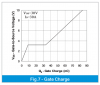
Firstly, here is the gate charge graph for the PJP75N75.
PJP75N75 gate charge.png

You'll notice that the plateau voltage is around 3V, which is also the maximum Vgs(th)

PJP75N75 Vgs(th).png

As an aside, although the Vgs(max) is 20V, you would be advised to protect the power supply to the 555 to ensure that voltage spikes do not reach it. Apart from damaging the 555, the gate could be damaged too.

Now we know that for the effective portion of the discharge of the gate charge, the gate voltage will be around 3 volts.

Now let's look at the output of the 555

555 output low.png

It's important to note that the output voltage rises as the amount of current we want to sink rises. We should probably use the maximum values and use Vcc = 15V as that is close to the conditions we're operating under.

A simple linear calculation tells us that Vlow ≈ 25 Isink at worst for the 10 to 100mA range.

OK, so now we can calculate the current available to discharge the gate charge.

We have

I = (3 - Vsink) / 100
and​
Vsink = 25 * I
so, substituting for Vsink, we get

I = (3 - (25*i)) / 100
100 * I = 3 - (25 * I)
125 * I = 3
I = 3 / 125
I = 24mA​

So discharging the gate capacitance at 24mA, the total gate charge (around 80nC) will take 80E-9 / 24E-3, or 3.3µs to turn off. Similar calculations can be done for the turn-on gate current, which will be about 50mA leading to a turn-on delay of about 1.6µs. So we switch for about 4.9uS each cycle.

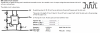
Now let's look at the frequency of your oscillator.
555 timing.png

The frequency of your oscillator is 21.5KHz, so the time spent switching every second is 21500 * 4.9uS = 0.1s -- the circuit spends 10% of the time switching! Now if we assume that the voltage and current being switched is 12V and 1.3A, the losses are about 0.1 * 12 * 1.3 / 2 = 0.78W. 0.78W is easily enough to make the device get fairly warm. Without a heatsink you're looking at almost a 50ºC rise in temperature. (and this does not include the I²R losses which will be perhaps 15mW which is totally insignificant in this case)

So are there some simple things we can do to fix this?

The answer is yes. We should change the gate resistor so that the 555 cam provide 200mA gate current when switching the device on, and see what effect that has on the current used to discharge the gate capacitance.

Assuming a 12V supply (Vcc) and that Vout is about 2.5V lower than Vcc at Isource of 200mA, and that the gate voltage is 3V during the plateau whilst the mosfet is seeing a constant current, the resistor value should be:

R = ( (12 - 2.5) - 3) / 0.2
= 6.5 / 0.2
= 32.5 ohms
A 33 ohm resistor would fit the bill perfectly.

Assuming this gives us about 200mA, the turn-on time would be reduced to about 0.4µs. We should check this against the datasheet to make sure the device can turn on this fast, but this is still an order of magnitude slower that the device is capable of.

Going back to an earlier calculation for turn-off time, we now have

I = (3 - Vsink) / 33
and​
Vsink = 25 * I
so, substituting for Vsink, we get

I = (3 - (25*i)) / 33
33 * I = 3 - (25 * I)
58 * I = 3
I = 3 / 58
I = 52mA​

So discharging the gate capacitance at 52mA, the total gate charge (around 80nC) will take 80E-9 /52E-3, or 1.5µs to turn off. The previous calculation for the turn-on gate current, yielded about 0.4µs. So we switch for about 1.9uS each cycle.

So, at 1.9uS per cycle, we are switching for about 4% of the time, and dissipating around 0.3W in switching losses. This will result in a case temperature rise of about 18ºC which would qualify as "slightly warm" and probably not needing a heatsink.

A small capacitor across the gate resistor will speed up the switching further, however we are already asking the 555 to supply its maximum rated current.

Could we do better still? Yes! A gate driver could reduce the switching losses by at least another 50%.

And a different mosfet with a lower gate charge would also help.

However a larger problem is that you're operating this circuit with a very high duty cycle to get the required voltage, but no actual output power. Considering you're operating this open loop, it doesn't bode well. You probably want to reduce the number of turns in your primary so you can achieve a higher primary current (being careful not to saturate the core).

Once you've done this, you need to add feedback to limit the output voltage and possibly some form of current limiting to prevent damage should the output be shorted.

I think all of these things are probably more important than optimising the choice of mosfet.

HOWEVER

If I had to recommend a mosfet, I would probably look at an IRFZ14, a 43W 60V 10A 0.2 ohm mosfet with a total gate charge of 11nC.

Rough calculations suggest that a gate resistor of 27 ohms would be appropriate, resulting in a turn-on time of 55ns and a turn off time of 145ns (for a total of 200ns). These are much closer to the minimum times for the device. The time spent switching is now less than 0.5%, and the power lost due to switching is about 0.031W. The static power dissipates would be 0.29W, giving a total of 0.32W.

The faster switching would contribute to a higher secondary voltage and allow either (or both) a lower primary inductance or a higher switching speed.

Another alternative is the IRFZ24, a similar MOSFET, but with 25nC of total gate charge and an Rds(on) of 0.1 ohms.

The figures for this are a 27 ohm gate resistor, 125nS turn-on, 330nS turn-off, 1.4% time switching for 0.087W switching losses and 0.145W static dissipation, for a total of around 0.23W.

The latter mosfet is a little more expensive. It would be preferable if the primary current was higher as the static losses would be significantly lower, however it doesn't switch off nearly as fast using a 555 as a driver.
 

debe

Oct 15, 2011
278
Joined
Oct 15, 2011
Messages
278
I cant realy get my head around why the powersuply needs to be so complicated, when a self osc Royer type has been a main stay in CDI units for many years. one you don't need to disable the supply when the cdi unit fires. These powersupplys will handle a dead short on the output side. All it does is increase the current draw a small amount with the osc frequency rising. Also there is no need for a capacitor across the powersupply. the only one needed is the 1uf cap in the actual CDI part of the circuit.
 

abuhafss

Aug 3, 2010
348
Joined
Aug 3, 2010
Messages
348
I cant realy get my head around why the powersuply needs to be so complicated, when a self osc Royer type has been a main stay in CDI units for many years. one you don't need to disable the supply when the cdi unit fires. These powersupplys will handle a dead short on the output side. All it does is increase the current draw a small amount with the osc frequency rising. Also there is no need for a capacitor across the powersupply. the only one needed is the 1uf cap in the actual CDI part of the circuit.

Nowadays, the DC-CDIs are not that simple as were in the past. Different manufacturers use different topologies for powering their CDIs and all of them aim for minimum waste of energy and maximum output to have a more powerful spark. And the size of the complete CDI unit is also kept small.
 

abuhafss

Aug 3, 2010
348
Joined
Aug 3, 2010
Messages
348
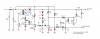
I constructed the 2nd schematic shown in the post #2, with some modifications shown in red color.

Screenshot 2014-09-04.png

Replaced the TVS diode D6 with 3 x 100V zeners. Didn't had 2.4K so I used 2.7k for R3 and R11.
I have used slightly thicker wires f or primary & secondary,as compared to the original. The inductance is shown in blue color.

When the circuit is powered on with 13.5V/2A supply, it oscillates at about 2kHz with transformer whistling. The voltage at collector of TIP31 is slightly less than 13.5V and the output at anode of UF4007 is

When simulated on LT Spice, it oscillates at about 80kHz and the collector voltage of TIP31 is 55VAC.

What does the transformer whistling indicates? Why the oscillation frequency is physically very low?
The circuit is built on a PCB.
 
Last edited:

KrisBlueNZ

Sadly passed away in 2015
Nov 28, 2011
8,393
Joined
Nov 28, 2011
Messages
8,393
What's the output voltage at the cathode of the UF4007 in your constructed circuit?
How are the primary and secondary phased relative to each other? Can you add dots to the transformer symbol on your schematic to show the phase relationship between primary and secondary?
 

abuhafss

Aug 3, 2010
348
Joined
Aug 3, 2010
Messages
348
What's the output voltage at the cathode of the UF4007 in your constructed circuit?
How are the primary and secondary phased relative to each other? Can you add dots to the transformer symbol on your schematic to show the phase relationship between primary and secondary?

The output at the anode of UF4007 was around 13VAC. I didn't checked at cathode.
However, when discharging C8 after power off, the spark was not strong. I'll recheck the voltages in the morning and confirm.

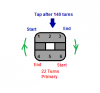
Below is the sketch of the top view of transformer bobbin showing how I did windings. Green arrows shows the direction of windings.

Transformer.png

Pin 1 connected to anode of UF4007
Pin 2 connected to ground
Pin 3 connected to R1
Pin 4 connected to cathode of D1+positive of C2
Pin 6 connected to collector of Q1
 

KrisBlueNZ

Sadly passed away in 2015
Nov 28, 2011
8,393
Joined
Nov 28, 2011
Messages
8,393
Before you measure the voltage at the cathode of the UF4007, connect two 3k3 1W resistors in series, across D8. You can (and should) leave those resistors in place. It will enable C8 to provide some smoothing on the converter's output voltage when no coil is connected.

Also, disconnect the anode of the SCR, U1, to eliminate that part of the circuit from suspicion.

Your transformer phasing is right.

Can you give the details of the transformer core you're using? Material, effective length, AL value?
 

abuhafss

Aug 3, 2010
348
Joined
Aug 3, 2010
Messages
348
Before you measure the voltage at the cathode of the UF4007, connect two 3k3 1W resistors in series, across D8. You can (and should) leave those resistors in place. It will enable C8 to provide some smoothing on the converter's output voltage when no coil is connected.

Also, disconnect the anode of the SCR, U1, to eliminate that part of the circuit from suspicion.

Your transformer phasing is right.

Can you give the details of the transformer core you're using? Material, effective length, AL value?

I forgot to mention earlier, I had added a 47Ω + 22nF (in series), across the SCR. One end of 47Ω is connected to the anode of the SCR and the other to 22nF. The other end of 22nF is connected to ground.

Normally, a CDI is not used without ignition coil. Only for testing, it might be used without it. Okay I shall add two 3.3k/1W resistors and disconnect the anode of SCR and see what happens. Or shouldn't I just remove the SCR?

I don't have the specs. of the material of the core, except that it is ferrite EE core with measurements 20mm x 18mm x 5mm.
 

KrisBlueNZ

Sadly passed away in 2015
Nov 28, 2011
8,393
Joined
Nov 28, 2011
Messages
8,393
I forgot to mention earlier, I had added a 47Ω + 22nF (in series), across the SCR. One end of 47Ω is connected to the anode of the SCR and the other to 22nF. The other end of 22nF is connected to ground.
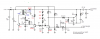
OK, can you mark up the changes on the schematic and re-post it.
Normally, a CDI is not used without ignition coil. Only for testing, it might be used without it.
Exactly.
Okay I shall add two 3.3k/1W resistors and disconnect the anode of SCR and see what happens. Or shouldn't I just remove the SCR?
Do whatever's easiest.
I don't have the specs. of the material of the core, except that it is ferrite EE core with measurements 20mm x 18mm x 5mm.
You wouldn't use a 10 pF capacitor instead of a 10 µF capacitor, but you're using an unknown core...? You know that the characteristics of ferrite cores vary quite widely, right?

Based on the number of turns and the inductances you measure, the AL value for that core is about 180. The unit for AL is nH/t2. So using this core, the inductance of a winding is roughly 180 nH multiplied by the square of the number of turns. This is a pretty typical value for DC-DC converter applications.

Let's see the result of your testing.

Edit: that's a pretty small core for a power output of 70W!
 

abuhafss

Aug 3, 2010
348
Joined
Aug 3, 2010
Messages
348
OK, can you mark up the changes on the schematic and re-post it.

Here it is.

Screenshot 2014-09-04B.png

You wouldn't use a 10 pF capacitor instead of a 10 µF capacitor, but you're using an unknown core...? You know that the characteristics of ferrite cores vary quite widely, right?

Based on the number of turns and the inductances you measure, the AL value for that core is about 180. The unit for AL is nH/t2. So using this core, the inductance of a winding is roughly 180 nH multiplied by the square of the number of turns. This is a pretty typical value for DC-DC converter applications.

Let's see the result of your testing.

Edit: that's a pretty small core for a power output of 70W!

Actually, I used the EE core/bobbin which was available with me in smallest size. And the original transformer is smaller than mine :)
 

KrisBlueNZ

Sadly passed away in 2015
Nov 28, 2011
8,393
Joined
Nov 28, 2011
Messages
8,393
OK, cool. Are you going to add the resistors across D8 on the schematic? They'll have almost no effect on the circuit's operation with a coil connected - the coil current will be over 1000 times higher! So I would make them a permanent part of the circuit.
Actually, I used the EE core/bobbin which was available with me in smallest size. And the original transformer is smaller than mine :)
OK.

Do you have an oscilloscope? I would really like to see the primary current waveform.

How do you know that the circuit was running at about 2 kHz?
 

abuhafss

Aug 3, 2010
348
Joined
Aug 3, 2010
Messages
348
Before writing the test results, just a comparison of the two transformers:

ORIGINAL:
14.5 x 13 x 4.25mm
Primary 22 turns of 0.33mm wire
Secondary 140 turns + 30 turns of 0.2mm wire

And the actual circuit was designed for 200VDC. I planned to modify for 300VDC but, didn't had 3 x 100V zeners so used 4 x 82V.

MY VERSION:
20 x 18 x 5mm
Primary 22 turns of 0.38mm wire
Secondary 140 turns + 30 turns of 0.25mm wire

Yesterday, I measured the inductance it was as shown in the schematic, 83μH for Primary and 3.76mH+155μH for Secondary. And when powered up at 13.5V/2A, I could get only about 13VAC at the anode of UF4007 with transformer whistling (not very loudly). I measured the frequency at the collector of Q1 (TIP41 instead of TIP31) with a frequency meter and found it to be about 2kHz.

Today, first thing I removed the transformer and examined the core closely. I felt that one E was slightly longer than the other. I replaced one of them so that both were matching each other. But the inductance changed drastically, almost doubled! New measurements are 165μH for Primary and 7.55mH+310μH for Secondary.

After adding 2 x 3.3k/1W resistor across D8 and disconnecting anode of the SCR here are my findings:

Voltage at Collector of Q1 = 13.7V
Voltage at anode of UF4007 = 720VAC
Voltage at cathode of UF4007 = 329VDC

Now the whistling of the transformer is turned to low buzzing sound.

Next I removed the 2 x 3.3K/1W resistors (connected across D8) and connected the anode of the SCR, so that I could do an actual test on bike. After running the engine for 5-6 minutes:

R1 was warm.
R2 220Ω (1/4W in original 200V design) changed color to brown....maybe I need to change to 0.5W or rather 1W.
Q1 got fairly warm, asking for a heatsink (could not touch for 1 full second). But usually the regular CDIs (not the performance CDIs) have no heatsinks. They are just sealed in epoxy.

As mentioned earlier, I used TIP41 which is a 6A device. If I had used TIP31 (3A) it might have gone very hot.

Are you going to add the resistors across D8 on the schematic? They'll have almost no effect on the circuit's operation with a coil connected - the coil current will be over 1000 times higher! So I would make them a permanent part of the circuit.

Tomorrow, I shall do another test run adding 2 x 3.3K/1W resistors. If no change in operation, I shall include them in the schematic. But why 2 x 3.3K/1W, why not 1 x 6.8k/1W?

Do you have an oscilloscope? I would really like to see the primary current waveform.
Yes, I do....but, might need your assistance to get your required waveform. I am not yet fully familiar with the functions of the scope.
 
Last edited:

debe

Oct 15, 2011
278
Joined
Oct 15, 2011
Messages
278
Some SMPS have a gap in the center Ecore, if you don't have that gap it changes how the transformer reacts.
 

KrisBlueNZ

Sadly passed away in 2015
Nov 28, 2011
8,393
Joined
Nov 28, 2011
Messages
8,393
Yesterday, I measured the inductance it was as shown in the schematic, 83μH for Primary and 3.76mH+155μH for Secondary. And when powered up at 13.5V/2A, I could get only about 13VAC at the anode of UF4007 with transformer whistling (not very loudly). I measured the frequency at the collector of Q1 (TIP41 instead of TIP31) with a frequency meter and found it to be about 2kHz.
It would be really good to know what the actual waveform is...

Also, I suggest using some faster diodes in the oscillator. Also D1 is probably under-rated for current.

D1 use 1N5404 or similar
D3 use 1N4934/5/6/7, UF4002/3/4/5/6/7 etc
D4 same as D3 or 1N5817/8/9
D5 same as D3 or 1N914/4148
D8 can just be a 1N4007
Today, first thing I removed the transformer and examined the core closely. I felt that one E was slightly longer than the other. I replaced one of them so that both were matching each other. But the inductance changed drastically, almost doubled! New measurements are 165μH for Primary and 7.55mH+310μH for Secondary.
Right. The difference in length is deliberate. It's called a "gapped" core. The gap reduces the AL value and increases the core's Bsat. You need to go back to the gapped core.
After adding 2 x 3.3k/1W resistor across D8 and disconnecting anode of the SCR here are my findings:
Voltage at Collector of Q1 = 13.7V
Voltage at anode of UF4007 = 720VAC
Voltage at cathode of UF4007 = 329VDC
Now the whistling of the transformer is turned to low buzzing sound.
Next I removed the 2 x 3.3K/1W resistors (connected across D8) and connected the anode of the SCR, so that I could do an actual test on bike.
OK, so the SCR worked when you put it on the bike, so I guess the problem was that there was no DC path across D8.
After running the engine for 5-6 minutes:
R1 was warm.
R2 220Ω (1/4W in original 200V design) changed color to brown....maybe I need to change to 0.5W or rather 1W.
Right, good idea.
Q1 got fairly warm, asking for a heatsink (could not touch for 1 full second). But usually the regular CDIs (not the performance CDIs) have no heatsinks. They are just sealed in epoxy.
Right. We really need to know what's happening in the oscillator. The collector voltage waveform, and the primary curent waveform, would be a good place to start.

Using faster diodes may improve the heating in the transistor.
As mentioned earlier, I used TIP41 which is a 6A device. If I had used TIP31 (3A) it might have gone very hot.
The current rating doesn't have much effect on how hot it will get. That depends on the amount of power it dissipates (which depends on various factors) and the thermal resistance to ambient, which depends on the package (and heatsinking if present).
Tomorrow, I shall do another test run adding 2 x 3.3K/1W resistors. If no change in operation, I shall include them in the schematic. But why 2 x 3.3K/1W, why not 1 x 6.8k/1W?
High voltage spikes across them, and brief high power dissipation. I think it's probably best to use two 1W metal film resistors in series.
Yes, I do....but, might need your assistance to get your required waveform. I am not yet fully familiar with the functions of the scope.
Right! That's great. Just Google how to use an oscilloscope. There's plenty of stuff out there.
 

Arouse1973

Adam
Dec 18, 2013
5,178
Joined
Dec 18, 2013
Messages
5,178
Some SMPS have a gap in the center Ecore, if you don't have that gap it changes how the transformer reacts.

Yes correct, a gapped core adds reluctance to the core which lowers magnetic flux which in turn reduces saturation currents and improves core buzz from magnetostriction. And this also stabilizes the inductor value versus current.
Adam
 

abuhafss

Aug 3, 2010
348
Joined
Aug 3, 2010
Messages
348
Yes correct, a gapped core adds reluctance to the core which lowers magnetic flux which in turn reduces saturation currents and improves core buzz from magnetostriction. And this also stabilizes the inductor value versus current.
Adam

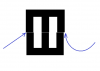
Actually I meant to say the EE cores were not properly aligned.

cores.png
 

abuhafss

Aug 3, 2010
348
Joined
Aug 3, 2010
Messages
348
It would be really good to know what the actual waveform is...

Also, I suggest using some faster diodes in the oscillator. Also D1 is probably under-rated for current.

D1 use 1N5404 or similar
D3 use 1N4934/5/6/7, UF4002/3/4/5/6/7 etc
D4 same as D3 or 1N5817/8/9
D5 same as D3 or 1N914/4148
D8 can just be a 1N4007

D1 = You are correct, it should be at least 3A.
Quite interestingly, D3, D4 and D5 all are 1N4007 in the original design.

It's called a "gapped" core. The gap reduces the AL value and increases the core's Bsat. You need to go back to the gapped core.

Though I changed the cores because of their non-alignment, I will change the pair to get back the original (halved) inductance.

OK, so the SCR worked when you put it on the bike, so I guess the problem was that there was no DC path across D8.
Do you mean, D8 is faulty?

How about increasing the value of R2?

We really need to know what's happening in the oscillator. The collector voltage waveform, and the primary current waveform, would be a good place to start.
For the primary current waveform, what value/wattage of resistor should I connect in series with primary?

Using faster diodes may improve the heating in the transistor.

Let's see. But, one strong argument.....how come the original design running warm with just 1N4007s?

The current rating doesn't have much effect on how hot it will get. That depends on the amount of power it dissipates (which depends on various factors) and the thermal resistance to ambient, which depends on the package (and heatsinking if present).

Correct. I was actually doubting some high current flowing thru Q1 but, in that case the primary of the transformer would also have turn warmer.

That's great. Just Google how to use an oscilloscope. There's plenty of stuff out there.

I have already acquainted myself with some basic usage. Still need lot of practice and learn tricks/tips.
 

(*steve*)

¡sǝpodᴉʇuɐ ǝɥʇ ɹɐǝɥd
Moderator
Jan 21, 2010
25,510
Joined
Jan 21, 2010
Messages
25,510
Misaligned cores are bad. However it might be sensible to place a thin piece of plastic (say 1/2 to 1 mm) between the halves of the E cores. This will give the small gap which will add the feature that people have been talking about.

I think people were misinterpreting (certainly I was) that one of the legs of the E core was shorter than the others.

If it turned out that you used mismatching E Core halves (and that sounds like the issue) then having a matching pair is a good thing.

Whilst you still have relatively easy access to it, it's a good idea to compare the performance with and without the gap. With all other things being equal, I'd go for the gapped version.
 

Arouse1973

Adam
Dec 18, 2013
5,178
Joined
Dec 18, 2013
Messages
5,178
Misaligned cores are bad. However it might be sensible to place a thin piece of plastic (say 1/2 to 1 mm) between the halves of the E cores. This will give the small gap which will add the feature that people have been talking about.

I think people were misinterpreting (certainly I was) that one of the legs of the E core was shorter than the others.

If it turned out that you used mismatching E Core halves (and that sounds like the issue) then having a matching pair is a good thing.

Whilst you still have relatively easy access to it, it's a good idea to compare the performance with and without the gap. With all other things being equal, I'd go for the gapped version.

Yes I agree Steve, the benefits of a gapped core far out way the downsides in most applications.
Adam
 

abuhafss

Aug 3, 2010
348
Joined
Aug 3, 2010
Messages
348
I replaced the diodes
D1 = 1N5406
D3 = UF1010
D4 = 1N5819
D5 = 1N4148
replaced R2 with 330Ω/1W
and
added 2 x 3.3k/1W resistors in series across D8.

Also I introduced 0.6mm gap between two EEs of the transformer,

Now, the transformer was quite such that I doubted it was not working at all. I checked the oscillation frequency at the base of Q1, it was 248 kHz. However, I noticed that this frequency decreased gradually. After about 5 minutes, it was 240kHz and then later it was 236kHz. I also noticed an increase in the temperature of the transformer.

Here are the Collector Voltage Waveforms:

Photo0332.jpg
At 2μs/div

Photo0333.jpg
At 0.5µs/div

Photo0334.jpg
At 0.2µs/div

For current waveform. I added 0.2Ω/5W resistor in series between Collector of Q1 and the primary winding. I connected the scope probe to the primary winding and the ground clip to the collector. Here are the waveforms:

Photo0329.jpg
At 2µs/div

Photo0330.jpg
At 0.5µs/div

Photo0331.jpg
At 0.2µs/div

During bench test with 13.5V/2A (without ignition coil), the TIP41 remain cool.
During test run with the two 3.3k/1W resistors connected, some fuse went off. After changing the fuse I removed the resistors and it worked normally. However, the TIP41 showed no improvement in heating..............asking for a heat-sink in just 3 minutes.
R1 was warm and the newly replaced R2 330Ω/1W was cool. Also the original C8 stopped working sometime during the bench test.
 
Top