- Joined
- Jan 21, 2010
- Messages
- 25,510
Let's look At some data for that mosfet and a 555.
Firstly, here is the gate charge graph for the PJP75N75.
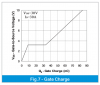
You'll notice that the plateau voltage is around 3V, which is also the maximum Vgs(th)

As an aside, although the Vgs(max) is 20V, you would be advised to protect the power supply to the 555 to ensure that voltage spikes do not reach it. Apart from damaging the 555, the gate could be damaged too.
Now we know that for the effective portion of the discharge of the gate charge, the gate voltage will be around 3 volts.
Now let's look at the output of the 555

It's important to note that the output voltage rises as the amount of current we want to sink rises. We should probably use the maximum values and use Vcc = 15V as that is close to the conditions we're operating under.
A simple linear calculation tells us that Vlow ≈ 25 Isink at worst for the 10 to 100mA range.
OK, so now we can calculate the current available to discharge the gate charge.
We have
I = (3 - (25*i)) / 100
100 * I = 3 - (25 * I)
125 * I = 3
I = 3 / 125
I = 24mA
So discharging the gate capacitance at 24mA, the total gate charge (around 80nC) will take 80E-9 / 24E-3, or 3.3µs to turn off. Similar calculations can be done for the turn-on gate current, which will be about 50mA leading to a turn-on delay of about 1.6µs. So we switch for about 4.9uS each cycle.
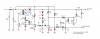
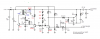
Now let's look at the frequency of your oscillator.
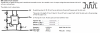
The frequency of your oscillator is 21.5KHz, so the time spent switching every second is 21500 * 4.9uS = 0.1s -- the circuit spends 10% of the time switching! Now if we assume that the voltage and current being switched is 12V and 1.3A, the losses are about 0.1 * 12 * 1.3 / 2 = 0.78W. 0.78W is easily enough to make the device get fairly warm. Without a heatsink you're looking at almost a 50ºC rise in temperature. (and this does not include the I²R losses which will be perhaps 15mW which is totally insignificant in this case)
So are there some simple things we can do to fix this?
The answer is yes. We should change the gate resistor so that the 555 cam provide 200mA gate current when switching the device on, and see what effect that has on the current used to discharge the gate capacitance.
Assuming a 12V supply (Vcc) and that Vout is about 2.5V lower than Vcc at Isource of 200mA, and that the gate voltage is 3V during the plateau whilst the mosfet is seeing a constant current, the resistor value should be:
Assuming this gives us about 200mA, the turn-on time would be reduced to about 0.4µs. We should check this against the datasheet to make sure the device can turn on this fast, but this is still an order of magnitude slower that the device is capable of.
Going back to an earlier calculation for turn-off time, we now have
I = (3 - (25*i)) / 33
33 * I = 3 - (25 * I)
58 * I = 3
I = 3 / 58
I = 52mA
So discharging the gate capacitance at 52mA, the total gate charge (around 80nC) will take 80E-9 /52E-3, or 1.5µs to turn off. The previous calculation for the turn-on gate current, yielded about 0.4µs. So we switch for about 1.9uS each cycle.
So, at 1.9uS per cycle, we are switching for about 4% of the time, and dissipating around 0.3W in switching losses. This will result in a case temperature rise of about 18ºC which would qualify as "slightly warm" and probably not needing a heatsink.
A small capacitor across the gate resistor will speed up the switching further, however we are already asking the 555 to supply its maximum rated current.
Could we do better still? Yes! A gate driver could reduce the switching losses by at least another 50%.
And a different mosfet with a lower gate charge would also help.
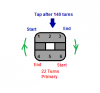
However a larger problem is that you're operating this circuit with a very high duty cycle to get the required voltage, but no actual output power. Considering you're operating this open loop, it doesn't bode well. You probably want to reduce the number of turns in your primary so you can achieve a higher primary current (being careful not to saturate the core).
Once you've done this, you need to add feedback to limit the output voltage and possibly some form of current limiting to prevent damage should the output be shorted.
I think all of these things are probably more important than optimising the choice of mosfet.
HOWEVER
If I had to recommend a mosfet, I would probably look at an IRFZ14, a 43W 60V 10A 0.2 ohm mosfet with a total gate charge of 11nC.
Rough calculations suggest that a gate resistor of 27 ohms would be appropriate, resulting in a turn-on time of 55ns and a turn off time of 145ns (for a total of 200ns). These are much closer to the minimum times for the device. The time spent switching is now less than 0.5%, and the power lost due to switching is about 0.031W. The static power dissipates would be 0.29W, giving a total of 0.32W.
The faster switching would contribute to a higher secondary voltage and allow either (or both) a lower primary inductance or a higher switching speed.
Another alternative is the IRFZ24, a similar MOSFET, but with 25nC of total gate charge and an Rds(on) of 0.1 ohms.
The figures for this are a 27 ohm gate resistor, 125nS turn-on, 330nS turn-off, 1.4% time switching for 0.087W switching losses and 0.145W static dissipation, for a total of around 0.23W.
The latter mosfet is a little more expensive. It would be preferable if the primary current was higher as the static losses would be significantly lower, however it doesn't switch off nearly as fast using a 555 as a driver.
Firstly, here is the gate charge graph for the PJP75N75.
You'll notice that the plateau voltage is around 3V, which is also the maximum Vgs(th)
As an aside, although the Vgs(max) is 20V, you would be advised to protect the power supply to the 555 to ensure that voltage spikes do not reach it. Apart from damaging the 555, the gate could be damaged too.
Now we know that for the effective portion of the discharge of the gate charge, the gate voltage will be around 3 volts.
Now let's look at the output of the 555
It's important to note that the output voltage rises as the amount of current we want to sink rises. We should probably use the maximum values and use Vcc = 15V as that is close to the conditions we're operating under.
A simple linear calculation tells us that Vlow ≈ 25 Isink at worst for the 10 to 100mA range.
OK, so now we can calculate the current available to discharge the gate charge.
We have
I = (3 - Vsink) / 100
so, substituting for Vsink, we getand
Vsink = 25 * I
I = (3 - (25*i)) / 100
100 * I = 3 - (25 * I)
125 * I = 3
I = 3 / 125
I = 24mA
So discharging the gate capacitance at 24mA, the total gate charge (around 80nC) will take 80E-9 / 24E-3, or 3.3µs to turn off. Similar calculations can be done for the turn-on gate current, which will be about 50mA leading to a turn-on delay of about 1.6µs. So we switch for about 4.9uS each cycle.
Now let's look at the frequency of your oscillator.
The frequency of your oscillator is 21.5KHz, so the time spent switching every second is 21500 * 4.9uS = 0.1s -- the circuit spends 10% of the time switching! Now if we assume that the voltage and current being switched is 12V and 1.3A, the losses are about 0.1 * 12 * 1.3 / 2 = 0.78W. 0.78W is easily enough to make the device get fairly warm. Without a heatsink you're looking at almost a 50ºC rise in temperature. (and this does not include the I²R losses which will be perhaps 15mW which is totally insignificant in this case)
So are there some simple things we can do to fix this?
The answer is yes. We should change the gate resistor so that the 555 cam provide 200mA gate current when switching the device on, and see what effect that has on the current used to discharge the gate capacitance.
Assuming a 12V supply (Vcc) and that Vout is about 2.5V lower than Vcc at Isource of 200mA, and that the gate voltage is 3V during the plateau whilst the mosfet is seeing a constant current, the resistor value should be:
R = ( (12 - 2.5) - 3) / 0.2
= 6.5 / 0.2
= 32.5 ohms
A 33 ohm resistor would fit the bill perfectly.= 6.5 / 0.2
= 32.5 ohms
Assuming this gives us about 200mA, the turn-on time would be reduced to about 0.4µs. We should check this against the datasheet to make sure the device can turn on this fast, but this is still an order of magnitude slower that the device is capable of.
Going back to an earlier calculation for turn-off time, we now have
I = (3 - Vsink) / 33
so, substituting for Vsink, we getand
Vsink = 25 * I
I = (3 - (25*i)) / 33
33 * I = 3 - (25 * I)
58 * I = 3
I = 3 / 58
I = 52mA
So discharging the gate capacitance at 52mA, the total gate charge (around 80nC) will take 80E-9 /52E-3, or 1.5µs to turn off. The previous calculation for the turn-on gate current, yielded about 0.4µs. So we switch for about 1.9uS each cycle.
So, at 1.9uS per cycle, we are switching for about 4% of the time, and dissipating around 0.3W in switching losses. This will result in a case temperature rise of about 18ºC which would qualify as "slightly warm" and probably not needing a heatsink.
A small capacitor across the gate resistor will speed up the switching further, however we are already asking the 555 to supply its maximum rated current.
Could we do better still? Yes! A gate driver could reduce the switching losses by at least another 50%.
And a different mosfet with a lower gate charge would also help.
However a larger problem is that you're operating this circuit with a very high duty cycle to get the required voltage, but no actual output power. Considering you're operating this open loop, it doesn't bode well. You probably want to reduce the number of turns in your primary so you can achieve a higher primary current (being careful not to saturate the core).
Once you've done this, you need to add feedback to limit the output voltage and possibly some form of current limiting to prevent damage should the output be shorted.
I think all of these things are probably more important than optimising the choice of mosfet.
HOWEVER
If I had to recommend a mosfet, I would probably look at an IRFZ14, a 43W 60V 10A 0.2 ohm mosfet with a total gate charge of 11nC.
Rough calculations suggest that a gate resistor of 27 ohms would be appropriate, resulting in a turn-on time of 55ns and a turn off time of 145ns (for a total of 200ns). These are much closer to the minimum times for the device. The time spent switching is now less than 0.5%, and the power lost due to switching is about 0.031W. The static power dissipates would be 0.29W, giving a total of 0.32W.
The faster switching would contribute to a higher secondary voltage and allow either (or both) a lower primary inductance or a higher switching speed.
Another alternative is the IRFZ24, a similar MOSFET, but with 25nC of total gate charge and an Rds(on) of 0.1 ohms.
The figures for this are a 27 ohm gate resistor, 125nS turn-on, 330nS turn-off, 1.4% time switching for 0.087W switching losses and 0.145W static dissipation, for a total of around 0.23W.
The latter mosfet is a little more expensive. It would be preferable if the primary current was higher as the static losses would be significantly lower, however it doesn't switch off nearly as fast using a 555 as a driver.