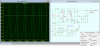
Volts/div & 0 volts=> Please bear with me, I am not an experienced user of scope. I shall get the reading again.
That's critical. And if you use DC coupling and you tell us where zero is, we can see exactly what the voltages are.
As stated earlier, the original Yamaha OEM circuit has no heatsink. And normally, the regular CDIs (not the performance CDIs) do not have heatsink; the entire PCB+components are covered/sealed with epoxy sealant.
Although the original circuit has TIP****, a mosfet can be considered if some cost effective device is available.
I think the issue may be the frequency this is operating at. Although the transistor you're using has an F
T of 3MHz, that's at a collector current of 500mA, and I suspect you've got a higher collector current. Also you may be pushing the transistor into saturation which has the double edged sword of lowering ON dissipation, but slowing the transition from On to Off.
I'm going back to review those oscilloscope traces again...
OK, I'm not certain where 0V is, but I'm seeing big spikes in both directions. I hope we're not seeing reverse currents. Is this a dual trace oscilloscope? I'd like to see base and collector voltage with respect to earth.
Rechecked the transistor. you have a TIP31, not a TIP41, but they're similar

Problem is that TIP41 has a breakdown of 40V, and that could easily be exceeded. A, B, and C variants have higher breakdown voltages. Is this a plain TIP31? The breakdown will damage the transistor, but it will also cause significant heating because you have both high current and a large voltage drop, even though the duration is small.
Oh sorry. Yes, I was referring to the 1μF/500V capacitor.
Shall appreciate, if you could elaborate please.
I had used something like this
http://i01.i.aliimg.com/wsphoto/v0/...400v-b-font-metallized-polypropylene-film.jpg
I'm no expert here. Is this is what is used in other CDI applications?
What it looks like doesn't help much. I'd have to look at the specs, but since I'm not sure exactly what I'd be specifically looking for, I'd look for recommendations about capacitors for this particular application.
Metalised polypropylene caps are generally "self healing", which means that breakdowns in the dielectric tend to vaporise the metal causing an open rather than a short. This reduces the capacitance a little.
How did it fail? short, exploded, something else?