0-30V Stabilized Power Supply

Status
Not open for further replies.
L

liquibyte

Jan 1, 1970
0
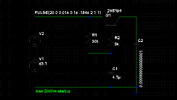
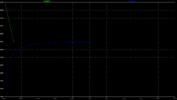
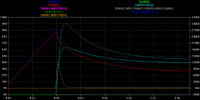
Ha! This is the first time I've been able to get something useful out of LTSpiceIV.  Behold, a simulation of your circuit redwire.

output.png


redwire

Nov 10, 2007
244
Joined
Nov 10, 2007
Messages
244
liquibyte said:
Do you have anything that you can load this at 30V @ 3A?  Out of curiosity, I'd like to see how it behaves at the full 90W.  I'm still trying to simulate the mosfet circuit but if yours works well through the full range, I think I'll just go with that.  I'll try hooking it up tomorrow and post some results if I can get pics of it.
No, let me do some thinking on what I could use to load it up.  I do have a headlamp that is 12V and about 4.5A. 
  Perhaps I can find a small electric heater.
 
L

liquibyte

Jan 1, 1970
0
Got any old stove eyes laying around?  Two small ones and one big one gets you right at 11 ohms in parallel.  You can also cut them down but it's kind of trial and error.  Make sure you have them up off of anything that can melt or burn because they get hot at the 3 amps.

 
L

liquibyte

Jan 1, 1970
0
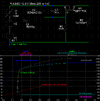
I have no idea if I'm really doing this right but I seem to be getting results from LTSpice.  I was trying to model the spike and then tune the turn on curve of the transistor to fall after that range.  I have no idea if this would work in the real world or not but it sure does look nice.  I've attached the .asc file zipped up if anyone wants to give it a whirl.

sim-sch.png

plot.png

soft-start.zip


Attachments

  • soft-start.zip
    605 bytes · Views: 41
L

liquibyte

Jan 1, 1970
0
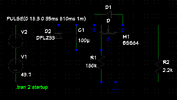
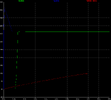
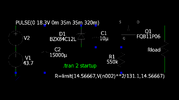
Here's the mosfet solution that I've been working on.  It seems to work except that LTSpice says that the gate is seeing the pulse (V[n003]).  Changing the delay is just a matter of changing the value of R1.

Edit:  I'd been measuring the gate to ground and should have been measuring gate to source.  I got a little help with that and now it shows the correct plot.  So, we have two working solutions now.  This one may be a little better because of the voltage drop across a traditional transistor.

mosfet-fixed-sch.png

mosfet-fixed.zip

good-results.png


Attachments

  • mosfet-fixed.zip
    722 bytes · Views: 30
Last edited:

redwire

Nov 10, 2007
244
Joined
Nov 10, 2007
Messages
244
I did some testing with the TIP141 and 5 amp load and nearly burned up the TIP because I didn't have a decent heat sink.  I put the Tip on medium sized heat sink and noticed the temperature rise to about 125 C which was hotter than anything else on the board, even the output transistor heat sink.    I wonder if I miscalculated something. I thought operating more or less like a switch would not generate that kind of heat (except at start up).  I was thinking that the voltage drop when fully on would be about 1.2V at 5 amps or 6 watts.  I'm definitely burning more than 6 watts.  The other thing I noticed is that the turn-on delay was nearly triple or about 3 seconds.

 
L

liquibyte

Jan 1, 1970
0
redwire said:
I did some testing with the TIP141 and 5 amp load and nearly burned up the TIP because I didn't have a decent heat sink.  I put the Tip on medium sized heat sink and noticed the temperature rise to about 125 C which was hotter than anything else on the board, even the output transistor heat sink.    I wonder if I miscalculated something. I thought operating more or less like a switch would not generate that kind of heat (except at start up).  I was thinking that the voltage drop when fully on would be about 1.2V at 5 amps or 6 watts.  I'm definitely burning more than 6 watts.  The other thing I noticed is that the turn-on delay was nearly triple or about 3 seconds.
That's definitely not a good thing.  You wouldn't happen to have a PFET to test my theory out with would you?  I haven't fully finished the simulations yet because I want to test using a load as well but I've just now figured out how to work some of the basic stuff so it may take a little time.

Edit: For example, here's the results with a 3A load.  I may be modelling things wrong but things definitely changed when I added the correct load for 3A and a 3A current source.with-current.png

 
Last edited:
L

liquibyte

Jan 1, 1970
0
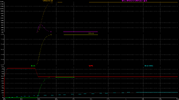
I rearranged some values and redid the plot.  If I'm doing this right, the power looks good for the zener and the mosfet so there doesn't seem to be any issues there.  I put in the filter cap too because it's part of the circuit right before the mosfet and I wanted to make sure it didn't alter the results.

power-results.png

 
Last edited:

redwire

Nov 10, 2007
244
Joined
Nov 10, 2007
Messages
244
You wouldn't happen to have a PFET to test my theory out with would you?
No, I don't have any beefy N or PFETs.  I'll probably order some in a week.
 
L

liquibyte

Jan 1, 1970
0
I have a boatload of NFET's but I don't think I have any PFET's.  I'll look around to make sure because I have everything else I'd need to test this and it would be a shame if I didn't at least have one. 

 
L

liquibyte

Jan 1, 1970
0
I think I'm starting to get the hang of this after doing a bit of reading.  Here's the results with things set correctly if I'm reading everything right.

Edit:  After getting some feedback and doing a bit more research, I think I've finally got something that gives fairly good results.  I'll have to wait to test it but hopefully this is a solution that works.

soft-start-sch.png

soft-start-plot.png

 
Last edited:
L

liquibyte

Jan 1, 1970
0
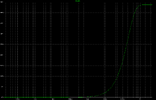
Redwire, can you give us a screenshot of pin 7 to pin 4 of U1 and U2 with 5V/div @ 500ms/div?  I'd do it myself but no DSO.

We've been discussing the shots you did here and here and the consensus is that this is RFI at the switch contacts or something like that.  What I'm really curious about, and I can't take a picture of, is what the two op amps are seeing at power up across their power pins.

The consensus of many people that work in the industry is that this design is a fail and that it should be scrapped and redone.  I've heard this several times from several people.  I'm not ready to give up on it myself but that could just be my OCD talking.  I think it works very good other than the surge problems.
 
L

liquibyte

Jan 1, 1970
0
Excellent, that's what I wanted to see, thanks.  I'm trying to get a few more eyes on the problem and was asked about the voltages across the voltage pins for those op amps.  One of these days I'm going to get at lease a cheap DSO.

 
L

liquibyte

Jan 1, 1970
0
That was the consensus by Tim too.  I'm wondering if the 2N3055's are at fault here in some way by allowing voltage and current through at power on by being hit by the initial surge.  Is that possible?  Would a higher Vceo help with that?  I'm certainly no expert either but since I started using LTSpice, I've been learning a bit faster than I was.  It's a neat program once you get used to how it works.

 
M

mehrdad125

Jan 1, 1970
0
Hi..
please...for guidens..If you remove the ac source. than...
What is the direction of the applied dc voltage solution.
thanks..


audioguru2

Apr 6, 2004
12,026
Joined
Apr 6, 2004
Messages
12,026
mehrdad125 said:
Hi..
please...for guidens..If you remove the ac source. than...
What is the direction of the applied dc voltage solution.
thanks..
I guess nobody replied is because we cannot understand your broken English.

1) "Remove AC source". Turn it off?
2) "Direction". North, south, east or west?
3) "Applied DC solution". DC applied to what? Solution of what problem?
 
L

liquibyte

Jan 1, 1970
0
audioguru said:
I guess nobody replied is because we cannot understand your broken English.

1) "Remove AC source". Turn it off?
2) "Direction". North, south, east or west?
3) "Applied DC solution". DC applied to what? Solution of what problem?
I don't think this was a legitimate question, more of a "let's get our post count up so we can spam with links" kind of thing.  I deleted a post that had
Hi ...
What software can simulate the circuit.
Thank you.
in it and probably should have deleted this one as well.  They don't like it because we've implemented more aggressive spam measures but at least it's wasting their time.
 
Status
Not open for further replies.
Top