0-30V Stabilized Power Supply

Status
Not open for further replies.
M

mehrdad125

Jan 1, 1970
0
I'm interrested about 0-30 VDC STABILIZED POWER SUPPLY WITH CURRENT CONTROL 0.002-3 A and have couple of questions.

-Is it possible  to inpute dc voltage apply?
any help is highly appreciated.

 
S

sbrutfl

Jan 1, 1970
0
This is my version of the PSU , All tested all working no problems complete with PCB and BOM aslo with connection drawing, I mounted the transistors on a seperate PCB but you don't have to use the PCB you can just hard wire them.
Hello, just a little curiosity: I've already built one based on the Rev2 (March 09), now I would like to try to build this one.

I recently stumbled upon the "troubleshot" pdf (by audioguru I suppose), where there's stated:

). The 3A version uses two output transistors with emitter resistors.
The 5A version uses three output transistors with emitter resistors.
So I've got two questions:

The first one is: This one uses 3 transistors on the output stage, could it really output up to 5 Amps using a 200VA transformer? (I've just noticed the original PDF, on the first page, lower right, says "0-30V 0-5A")

I'd like to avoid accidentally burning the whole thing down  :(

Second question: The TB4 port should host a Shunt Resistor, this is used to measure the current value right?

Which one should I use? (value and power dissipated)

Thank you very much :D
 

audioguru2

Apr 6, 2004
12,026
Joined
Apr 6, 2004
Messages
12,026
The 3A version uses two output transistors. Each emitter resistor has a max voltage of 1.5A x 0.33 ohms= 0.5V across it. When the output voltage is shorted or is low then each output transistor heats with (30V - 0.5V) x 1.5A= 44.25W.
   
The 5A version uses three output transistors. Each emitter resistor has a max voltage of 1.67A x 0.33 ohms= 0.55V across it. When the output voltage is shorted or is low then each output transistor heats with (30V - 0.55V) x 1.67A= 49.2W.

But both versions use a single BD139 driver transistor which heats a little more in the 5A version.

The peak voltage of a 28V transformer is 28V x 1.414= 39.6V. If the output voltage is low or is shorted with 5A of current then the transformer must deliver 39.6V x 5A= 198VA so a 200VA transformer will be hot but will be fine. If the transformer is 30V then it will be a little overloaded (212VA).
The circuit is designed for a max current detection voltage across the shunt resistor of 1.4V so the 3A version uses 0.47 ohms (3A x 0.47 ohms= 1.41V). The 5A version uses 0.27 ohms (5A x 0.27 ohms= 1.35V). It is simple to calculate the heating (power rating) which is 5A squared x 0.27 ohms= 6.75W so use a 10W resistor which will get pretty hot.   

 
S

sbrutfl

Jan 1, 1970
0
audioguru said:
The 3A version uses two output transistors. Each emitter resistor has a max voltage of 1.5A x 0.33 ohms= 0.5V across it. When the output voltage is shorted or is low then each output transistor heats with (30V - 0.5V) x 1.5A= 44.25W.
   
The 5A version uses three output transistors. Each emitter resistor has a max voltage of 1.67A x 0.33 ohms= 0.55V across it. When the output voltage is shorted or is low then each output transistor heats with (30V - 0.55V) x 1.67A= 49.2W.

But both versions use a single BD139 driver transistor which heats a little more in the 5A version.

The peak voltage of a 28V transformer is 28V x 1.414= 39.6V. If the output voltage is low or is shorted with 5A of current then the transformer must deliver 39.6V x 5A= 198VA so a 200VA transformer will be hot but will be fine. If the transformer is 30V then it will be a little overloaded (212VA).
Thank you for your reply.

So if I add one more output transistor in the output stage of the PicMaster's circuit, should I be able to get 5A out of the power supply?
Sorry if the question sounds dumb, I just wanna be sure.
Does the schematic need other changes (different values on other resistors etc?).

The circuit is designed for a max current detection voltage across the shunt resistor of 1.4V so the 3A version uses 0.47 ohms (3A x 0.47 ohms= 1.41V). The 5A version uses 0.27 ohms (5A x 0.27 ohms= 1.35V). It is simple to calculate the heating (power rating) which is 5A squared x 0.27 ohms= 6.75W so use a 10W resistor which will get pretty hot. 
Great, thank you :)
 

audioguru2

Apr 6, 2004
12,026
Joined
Apr 6, 2004
Messages
12,026
I have Picmaster's schematic of 10/10/2010 and it says 5A but it has only two 2N3055 output transistors that will fry. It might have other problems.

 
S

sbrutfl

Jan 1, 1970
0
audioguru said:
I have Picmaster's schematic of 10/10/2010 and it says 5A but it has only two 2N3055 output transistors that will fry.
Oh, I understand.

It might have other problems.
Do you mean in terms of reliability?

Do you mind if I ask you to point me out to the most reliable schematic versions (of both 3A and 5A) at the moment?

I've seen there're a lot of custom versions, I'm a little bit confused about which one to choose.

Thank you very much again for your assistance  :)
 

audioguru2

Apr 6, 2004
12,026
Joined
Apr 6, 2004
Messages
12,026
sbrutfl said:
Do you mean in terms of reliability?
Do you mind if I ask you to point me out to the most reliable schematic versions (of both 3A and 5A) at the moment?
I did not look at everything on Picmaster's schematic to see if it has any more problems.

Liquibyte made a new thread showing the latest version of the 3A supply here: http://www.electronics-lab.com/forum/index.php?topic=39481.0
 
S

sbrutfl

Jan 1, 1970
0
audioguru said:
I did not look at everything on Picmaster's schematic to see if it has any more problems.

Liquibyte made a new thread showing the latest version of the 3A supply here: http://www.electronics-lab.com/forum/index.php?topic=39481.0
Great, thank you very much, I'll go with the latest revision then :D
 

redwire

Nov 10, 2007
244
Joined
Nov 10, 2007
Messages
244
audioguru said:
The 3A version uses two output transistors. Each emitter resistor has a max voltage of 1.5A x 0.33 ohms= 0.5V across it. When the output voltage is shorted or is low then each output transistor heats with (30V - 0.5V) x 1.5A= 44.25W.
Why do you use 30V instead of the collector voltage of approx 40V (with a 28V transformer) when computing the power?
 

audioguru2

Apr 6, 2004
12,026
Joined
Apr 6, 2004
Messages
12,026
redwire said:
Why do you use 30V instead of the collector voltage of approx 40V (with a 28V transformer) when computing the power?
Did I calculate it wrong?
28VAC has a peak voltage of 39.6V and the rectifier bridge drops 2V to 37.6V and the capacitor ripple drops it to maybe 35.6V. if the current sensing resistor is 0.47 ohms then it drops 1.4V to 34.2V. Then the 0.33 ohm emitter resistor drop 0.5V to 33.7V so the output transistors have a total dissipation of 101.1W. I DID calculate it wrong. Sorry. 
 

red baron

Jun 26, 2012
16
Joined
Jun 26, 2012
Messages
16
I have two questions:
1) can the circuitry associated with RV1 be omitted?  What would be the consequence?
2) when mounting in a metal box with the chassis earthed to mains earth (green/yellow), should the -ve on the electronics also be connected to mains earth?


audioguru2

Apr 6, 2004
12,026
Joined
Apr 6, 2004
Messages
12,026
red baron said:
I have two questions:
1) can the circuitry associated with RV1 be omitted?  What would be the consequence?
RV1 nulls the input offset voltage of the voltage setting opamp U2 so that the output is exactly 0V when the voltage pot is set to zero. Without RV1 then the input offset voltage of the opamp (if there is any) will cause a small positive or negative voltage output instead of 0V.
But some people say RV1 does not do anything.

2) when mounting in a metal box with the chassis earthed to mains earth (green/yellow), should the -ve on the electronics also be connected to mains earth?
 

red baron

Jun 26, 2012
16
Joined
Jun 26, 2012
Messages
16
Thank you for the helpful response.
I am not sure what you mean by 'electrical outlets that were wired backwards'.  In Australia mains outlets have three wires - live, neutral and ground/earth (for earth leakage protection).  Would you recommend that I simply do not connect the earth to the chassis.  The danger is that if there is a fault (fingers in the wrong place!)  on the mains side of the transformer then the full 240V could be fatal.

 
L

liquibyte

Jan 1, 1970
0
Ground the chassis and the transformer frames to mains earth but leave the circuit ground isolated and floating.  I have built mine this way and would be the way I'd recommend doing it.  What audioguru is talking about is sometimes outlets in houses can have neutral and hot reversed which can lead to odd issues with certain equipment.  I live in a house that seems to have been worked on by prior homeowners so I actually checked my outlets for correctness before I built this to make sure that the fuses would be correct in the circuit.  So, make sure that your hot and neutral are correct so that you fuse on the hot side and make sure you don't connect the chassis or transformer frames to neutral inadvertently.


audioguru2

Apr 6, 2004
12,026
Joined
Apr 6, 2004
Messages
12,026
red baron said:
I am not sure what you mean by 'electrical outlets that were wired backwards'.  In Australia mains outlets have three wires - live, neutral and ground/earth (for earth leakage protection).  Would you recommend that I simply do not connect the earth to the chassis.  The danger is that if there is a fault (fingers in the wrong place!)  on the mains side of the transformer then the full 240V could be fatal.
In Canada we also have three wires, live, neutral and earth ground. I have seen electrical outlets wired wrong by drunk electricians or by homeowners who do not know how to do it correctly so the "earth" terminal is actually "live". Then if a person touched the metal chassis and an earth ground, the person would be electrocuted if the outlet was wired wrong and if the chassis was connected to the earth wire on the plug. If the chassis is not connected to the earth wire then there will not be a problem unless the transformer live wire or live wire in the cord shorted to the chassis.
 

red baron

Jun 26, 2012
16
Joined
Jun 26, 2012
Messages
16
Earthing matter sorted thanks.
Next question:  our DIYFAN option shows a 24V Zener and resistor across input +ve and -ve to provide a stable 24V supply voltage to pin 7 of U1.  Remove the connection of pin 7 to +ve. Since the +ve input voltage can drop at high loads, what do you think of this idea?


audioguru2

Apr 6, 2004
12,026
Joined
Apr 6, 2004
Messages
12,026
red baron said:
Next question:  our DIYFAN option shows a 24V Zener and resistor across input +ve and -ve to provide a stable 24V supply voltage to pin 7 of U1.  Remove the connection of pin 7 to +ve. Since the +ve input voltage can drop at high loads, what do you think of this idea?
Then you must replace the 10V zener diode with a resistor.
I do not think U1 needs its power supply voltage regulated because a TLE2141 opamp has a minimum Supply-Voltage Rejection Ratio of better than 90dB so 2V of ripple causes an output of less than 62.5uV (typically less than 2uV) which is very close to zero.
 
L

liquibyte

Jan 1, 1970
0
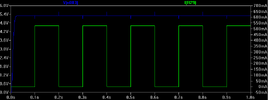
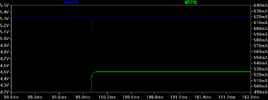
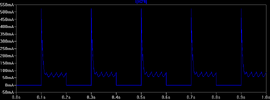
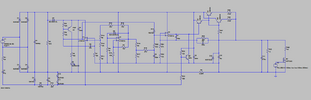
A member (homebrew) over at EEVBlog put together an LTSpice simulation of this circuit.  I've been trying to do this off and on for a little while but was never able to get it to run right.  I'm going to put this up here as well in the hopes that someone might find it useful, I know I will.  The screenshots are what was posted over there and the zip file contains the .asc for the spice simulation.

Maybe a better simulation model might help to debug the circuit. I have attached you a full simulation of your supply in LTSpice. Feel free to mess around :)

It has quite good regulation performance in voltage mode! However, in current mode it starts to oscillate ...
I'm leaving this simulation up but you'll want to see this post for the latest simulations.SupplyEEVBlog1.PNG

SupplyEEVBlog2.PNG

SupplyEEVBlog3.PNG

SupplyEEVBlog.PNG

SupplyEEVBlog.zip


Attachments

  • SupplyEEVBlog.zip
    2.3 KB · Views: 70
Last edited:

audioguru2

Apr 6, 2004
12,026
Joined
Apr 6, 2004
Messages
12,026
The very old LT1001A opamp is very slow like a lousy old 741 opamp. The TLE2141 is MUCH faster.
You have C6 as only 33pF but it should be 330pF.
Why does the circuit have C11? It is causing the current spike and maybe is causing the oscillation.

 
L

liquibyte

Jan 1, 1970
0
Changed C6 to 330p and re-uploaded.  I didn't do this simulation, I'm just putting it here for folks to play around with.  I asked about why some of the stuff, specifically the mosfet, was on the output but haven't heard back yet.  Like I said, I tried to simulate this but couldn't get it to work.  As far as the TLE2141 goes, if someone can get it out of UltraLibrarian from TI's website, I'll gladly add that in too.  I can't get UltraLibrarian to run on my system because it won't work under WINE (it is a VB6 app, ancient and crappy).  I've emailed them about this issue and was basically told to stuff it.  I think that it really shouldn't matter for the most part because the op amps are theoretical parts in spice and what we're looking for in this is a way to tweak the model in ways we like before trying it out in the real world.  In other words, we aren't going to be blowing these up.  If you can get the model out of its "packaging" from TI, I'll certainly use it instead.

 
Status
Not open for further replies.
Top