0-30V Stabilized Power Supply

Status
Not open for further replies.
L

liquibyte

Jan 1, 1970
0
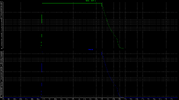
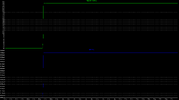
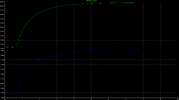
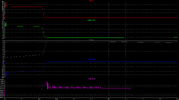
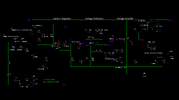
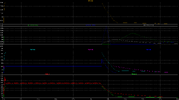
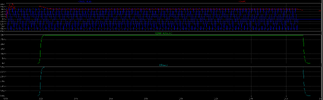
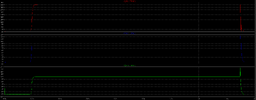
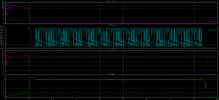
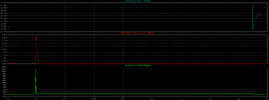
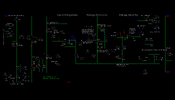
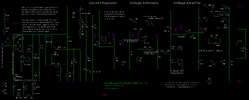
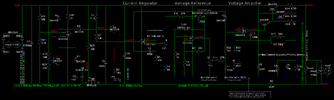
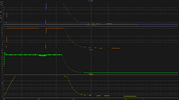
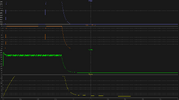
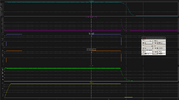
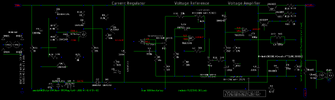
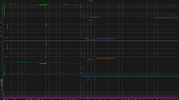
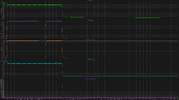
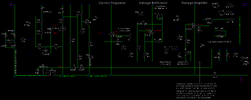
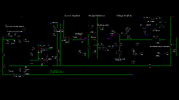
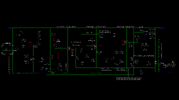
Here it is folks.  I got the soft start stabilized and had to add one component to the circuit to make it work well.  The U1 op amp (U3 original) needed a diode between its output and where U2's (U2 original) non-inverting input connected through D12 (D9 original) headed out to the BD557.  I don't know what effect this diode would have in the real world but it makes the simulation work and stops all the wonky current control issues.  I deleted the other simulations as this is going to be the final version of this with the soft start.  I'm now going to try and fix the circuit without a soft start.
schematic.png

30V@3A.png

30V@1mA.png

0V@0A.png

mosfet-transistor.png

0-30V-0-3A-w-2141.zip
 

Attachments

  • 0-30V-0-3A-w-2141.zip
    5.9 KB · Views: 119
L

liquibyte

Jan 1, 1970
0
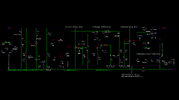
I've done some further testing on the design as I have it already built and I think I've solved the transient issues altogether without a soft start although it might not be a bad idea as it stands.  I even took back out the original Q1 circuit and am getting really good results, at least in the simulation.

The current control op amp needs a diode on its output pin.  That's it.  I think what has been happening is that the voltage control op amp has been destabilizing that part of the circuit where it connects at that point.  I'm going to do some further testing with a behavioral noise voltage on the input to see how it behaves.

My apologies for the renumbering, I've been playing with LTSpice to learn how it works better and I've figured out that ctrl-alt-shift-r renumbers the parts and I didn't feel like taking the time to make them line up with the schematic that's been posted here from time immemorial.  Left to right, top to bottom seems to be the convention so I'm going to stick with that.

schematic.png

plot.png

 
Last edited:

audioguru2

Apr 6, 2004
12,026
Joined
Apr 6, 2004
Messages
12,026
It is very confusing when each new schematic has different parts designation numbers.

Your new D10 has backwards polarity then the current regulation will not work.
When the new U1 detects over-current then its output goes low enough to pull down the voltage feeding the voltage amplifier opamp so that the current in the load is reduced.

 
L

liquibyte

Jan 1, 1970
0
audioguru said:
It is very confusing when each new schematic has different parts designation numbers.

Your new D10 has backwards polarity then the current regulation will not work.
When the new U1 detects over-current then its output goes low enough to pull down the voltage feeding the voltage amplifier opamp so that the current in the load is reduced.
You're right, I modified it and corrected the screenshots.  Needless to say, it still works better with a diode there.  Before I tried that, it would seriously mess up the output.

Edit:  I added the corrected diode polarity to redwire's board and it didn't do anything to stop the spike.  Would you be willing to build and test one of these to figure out where this issue is coming from if I sent you a board?
 
Last edited:
L

liquibyte

Jan 1, 1970
0
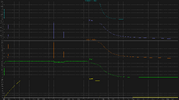
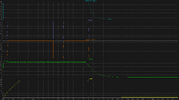
OK, scratch all that from before.  How does this look?  I've got a soft start and I moved Q1 (Q7 on this schematic) from the output of the op amp to the gate of the mosfet and now it starts up with a delay and shuts down rather quickly without introducing any oddities into the output(s).  I think the power across all the components are within tolerance but I may have missed something.  The soft start handles the startup transient and Q7 shuts everything off quickly.

Edit: a couple of modifications to the circuit plus changed the values and wattage of a couple of resistors to have lower values for bleeding the caps etc.

in-out.png

u1-u2-u3-out.png

q6-m1.png

q6-q7-m1-power.png

schematic.png

0-30V-0-3A-w-2141.zip
 

Attachments

  • 0-30V-0-3A-w-2141.zip
    6.1 KB · Views: 59
Last edited:
L

liquibyte

Jan 1, 1970
0
I've tweaked the circuit to have some really smooth waveforms during startup and shutdown.  I'm not going to post screenshots of those but I'll post the circuit and the spice file with accompanying models for the 2141's in LTSpice.  This is complete unless someone can find fault with it.  The soft start works great and I've added a small 12V normally closed relay to switch in a 10 ohm resistor on shutdown to bleed out the caps that keeps things powered up, I.e. C11, C12 and also the gate of the mosfet is hooked in as well to quickly power everything off.  I've been working really hard on this so be gentle.  I've tried to think of most things to check but I may have missed something.  This is the most complicated simulation I've done to date and the fact that it actually works amazes me.  LTSpice is, in my opinion, better than a video game for entertainment.

C10 is new because I was getting an oscillation through the zener at U1 in my simulations but I don't know if it's needed in the real world as I haven't tested that part of the circuit yet.  The bleeder resistor is only in circuit when the power is off and until the relay powers up fully so a larger power resistor would be needed but could probably live on board if you wanted.  I plan on using a couple chassis mount resistors that I have on hand but the rest of the circuit is going to be designed to live on the circuit board.

Edit:  Accidentally uploaded the wrong .asc file, sorry.

schematic.png

0-30V-0-3A-w-2141.zip
 

Attachments

  • 0-30V-0-3A-w-2141.zip
    6.6 KB · Views: 63
Last edited:
L

liquibyte

Jan 1, 1970
0
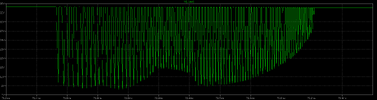
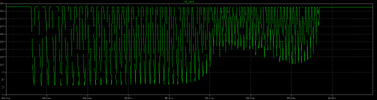
I've been playing around with the output of U3 and have been noticing an oscillation.  After trying various values for C8 from 100n to 10p and caps across the 10V zener and R20 I was able to minimize this to a small spike.  On a whim, I removed C8 altogether and the oscillation went away altogether.  I guess my question would be is C8 entirely necessary if the output of U3 doesn't oscillate without it?

Edit: Nevermind, I think I answered my own question.  The output of the supply drops when C8 isn't there.

1mA-w-330p.png

3A-w-330p.png

1mA-wout-C8.png

3A-wout-C8.png

 
Last edited:
L

liquibyte

Jan 1, 1970
0
I've been doing some serious tweaking on this circuit over the last few days and I'd like opinions about anything that won't work or what could be wrong.  I've managed to pull out the negative rail completely and I think it might work like this.  I've kept the mosfet that was part of the soft start but it's now a transient protection circuit.  I've also kept the 12V relay because it helps to shut everything down rather fast.  The only issue I've encountered with it in simulation is that when the current is low, the bleed off of the main cap and the other relevant parts of the circuit takes longer than at full current.  I'm still working on how to get these two consistent but haven't been successful to date.  I've tried to pay attention to the limits of the components but may have missed something so if you notice anything odd or off, let me know.

Edit: quick correction to the schematic.

2nd edit: I found a problem with the bleeder resistor and the base/gate of the transistor/mosfet.  I'll update when I get it figured out.

3rd edit: I thought I was right but I was wrong on the shutdown stuff.  I'm still working on it but I can't get low amperage to behave at shutdown.  Having said that, I think I'm on the right track for removing the negative supply and having things work.  Almost but not quite right.

schematic-no-negative-rail.png

1mA.png

3A.png

0-30V-0-3A-w-2141-falloff.zip


Attachments

  • 0-30V-0-3A-w-2141-falloff.zip
    5.8 KB · Views: 64
Last edited:
J

Jaxelo

Jan 1, 1970
0
What component libraries do you use? I've been trying to simulate a circuit but can't find a library with a lm7905.

 
L

liquibyte

Jan 1, 1970
0
I used the parts from here (self extracting executable that can be opened with 7zip and the like) which I found on the LTWiki.  It's a good resource for figuring out how the program works.  I've had to go and find several other resources to elaborate at times but for the most part, it's all there.

As far as the 7905 goes, I think that part library has one if it's not in the standard parts that come with LTSpice.  Look in F2 > Vreg.  If it comes with LTSpice, it'll be there.  If not, grab that library I linked and it should come with it.  I think you can take the generic xreg and use that but you'll have to define the part with your own spice stuff.

Edit to add that if you get a "time step too small" error, go to Tools > Control Panel > Spice and choose "Alternate" under Engine > Solver.  I had to search that one out after getting the error quite a bit.  Sometimes it won't work and you can then uncheck "Skip Gmin Stepping" but that's not advised unless you really need it because it gives non-standard results that won't match reality for the most part.  You can also raise the number under "MinDeltaGmin" from the default 0.0001 to 0.001, 0.01, or even 0.1.  Neither of these last two are recommended from what I've read unless it's absolutely necessary to solve a particular issue.

Here's a nice regulator PS simulation I found somewhere.  This showed me quite a few tricks with the program itself.

90_Watt_Regulated_Dual_Power_Supply.ZIP


Attachments

  • 90_Watt_Regulated_Dual_Power_Supply.ZIP
    9.8 KB · Views: 98
Last edited:

audioguru2

Apr 6, 2004
12,026
Joined
Apr 6, 2004
Messages
12,026
The negative supply is needed for the current regulating opamp to cause the output voltage to drop to zero when the current into a short circuited output exceeds the setting of the current-setting pot. Without the negative supply then the output of the current regulator opamp cannot cause the output voltage to go down to zero volts because it feeds the voltage regulator amplifier though a diode. Short circuit current will be unlimited.

 
L

liquibyte

Jan 1, 1970
0
audioguru said:
The negative supply is needed for the current regulating opamp to cause the output voltage to drop to zero when the current into a short circuited output exceeds the setting of the current-setting pot. Without the negative supply then the output of the current regulator opamp cannot cause the output voltage to go down to zero volts because it feeds the voltage regulator amplifier though a diode. Short circuit current will be unlimited.
That's what I thought too but the simulations I've been doing say otherwise.  I've modelled in a direct short using a voltage controlled switch and when it kicks in, the current limiting seems to kick in as well.  I obviously screwed up the bleeder part before and I'm still having a bit of trouble getting things to be stable at high voltage and low current but I'm making progress.  Here's a screenshot of 4 seconds worth shorting at 30V and 3A with the current limiting kicking in.  Obviously I've not build this and blown parts up to test it but according to the simulations it should work without the negative rail.  I'll try this out in the real world eventually just to satisfy my curiosity.2014-12-01-232014_1920x2100_scrot.png


audioguru2

Apr 6, 2004
12,026
Joined
Apr 6, 2004
Messages
12,026
Good point.
The current regulating opamp has its negative supply pin at the input of the 0.47 ohms sense resistor and the voltage regulating amplifier has its negative supply pin at the output of the current sense resistor which is 1.41V higher than the current regulator negative pin when the output is shorted and the current is set to 3A. Then the diode between them causes the output voltage to drop until the current is 3A. But when the output is shorted and the current is set lower than 3A then the current regulator will not work properly below a certain setting.
So the negative supply is needed after all.

 
L

liquibyte

Jan 1, 1970
0
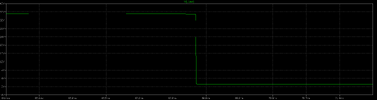
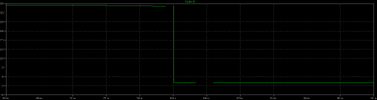
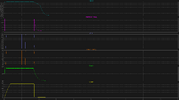
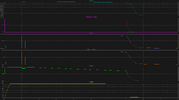
Here's the issue I'm running into currently.  I've got the circuit behaving at high current and high voltage but as I raise the load resistance the input gets unstable and the shutdown doesn't behave as I would expect and I can't figure out why.  For one thing, you'll notice in the 3A pic that shutdown occurs at around 1 3/4 seconds.  This is because I've got the input voltage set at 100 cycles.  In the 1mA pic, nothing has changed other than the load going from 10 ohms to 30k but the shutdown occurs at just over 7 seconds.  You'll also notice that the input voltage sags drastically where shutdown should happen but things don't bleed off as I would expect.  Both output conditions have a 200ms short for testing purposes.  If I could get the low current output to shut down like the higher currents do I'd probably breadboard this to see how it went.

Edit:  I wanted to add that adding in the negative supply doesn't change the behavior of the plots.  I started out with the negative supply and the above configuration and on a whim decided to see what would happen without it.  Since nothing changed whether or not it was there, I decided to try and see if I could get it to work without it.

current-schematic.png

3A.png

1mA.png

 
Last edited:
L

liquibyte

Jan 1, 1970
0
I have to test out the various components for being within their specs but I think I may have it.  There's about a 200ms difference in shutdown times at the mosfet but taking a page from the original Q1, I'm shunting the residual power to ground from the output cap instead of from the voltage op amp.  It seems to work so only a prototype will tell I guess.  The slope on the lower current is not as tight but I think I'm getting closer.

schematic-no-negative-rail.png

1mA.png

3A.png

 
Last edited:
L

liquibyte

Jan 1, 1970
0
I've tried to get this to do better but I'm stumped on how to get it to shut down quickly at lower current loads without actually using a separate voltage source for the relay.  In the grand scheme of things I guess I'm being a little anal about it but it still bothers me.

Edit: instead of taking out the current 2.2K 2W bleeder, I've made it 1K to match the output and it seems to help in getting the low current fall off time to be shorter by a couple of seconds or so.

Sorry about the part numbering.  LTSpice seems to be kind of inconsistent in that regard.

schematic-no-negative-rail.png

1mA.png

3A.png

0-30V-0-3A-test-falloff.zip


Attachments

  • 0-30V-0-3A-test-falloff.zip
    6 KB · Views: 27
Last edited:
L

liquibyte

Jan 1, 1970
0
I think I finally got the component limits within reasonable specs, especially the shutdown parts.  This is just a minor revision with rearranging a few parts, adding another resistor and kind of spreading things out so it's easier to read.

I've been thinking about the reasoning behind the negative supply and I'm starting to believe that it wasn't really necessary in the first place and may have just been a hack to make things behave.  Obviously these aren't real parts and actual results may differ from a prototype build but I think this may be a workable design for the most part.  Without a redesign on the current and voltage circuits I don't think we'll ever get a true zero on either but I've done my best to simulate the results accurately and to be honest if you really need that zero, you'll probably know you do and want to purchase something instead of building it based on this design.  The purpose of the mosfet and the relay, however, remain valid design choices due to the lack of control at startup and shutdown and I think they solve the problems that have been encountered.  You can use a different mosfet if you like as long as it falls within tolerance.  I have limited choices in the parts that I've obtained for simulation and haven't bothered to seek out a TO-220 part that would be a more accurate representation of reality and cost.  This is going to be my last post of this unless someone sees something glaringly wrong with it.  I've left out the transient and short circuit simulation parts and if you want to mess around with that part, let me know and I'll add them back and upload it.  Play with it, build it, let us know if it works reasonably well.

schematic-no-negative-rail.png

0-30V-0-3A-test-falloff.zip


Attachments

  • 0-30V-0-3A-test-falloff.zip
    6.1 KB · Views: 91
H

Hans7530

Jan 1, 1970
0
Hi,
today I began to build the power supply, with the part list and the schedule on the main project page. I used the pcb from the project page too.
As I would test the circuit, I note that the output of the supply only range from 0-7V and U2 was very hot. It looks like U2 is in the shortcut mode and can`t rise its output voltage above 7V.

I build the complete power supply with the same things like the part list. I also use a 24V AC trafo.

Maybe someone can help me. Thanks for all answers.
Sorry for my bad english.


audioguru2

Apr 6, 2004
12,026
Joined
Apr 6, 2004
Messages
12,026
The original project has errors that can destroy the TL081 opamps and overload many other parts. That is why we fixed it and talk about the fixes in a few long threads in the forum.

If the pins of Q1 are wired wrong and are mixed up then the reverse-biased emitter-base becomes a 8V zener diode that overloads the output of U2 and prevents the output from rising above about 7V. The pins on the European BC548 are CBE, but the pins on any American or Japanese little transistor are EBC.


nuljon

Aug 24, 2015
1
Joined
Aug 24, 2015
Messages
1
it seems many of the links to attachments (links to post numbers,zips and pdfs) have broken in even the more recent posts in this thread and ancillaries. Any idea how to recover? In particular i am looking for thn3 trouble shooter pdf liquidbyte compiled from advanced members like audio guru. I had a version of this PSU running for several months, blew a tl2041 replaced it and ran for a few more weeks, but now I have trouble. low volts -- cannot adjust higher than a few volts, but very high current. So there must be a short some where... I havent progressed past thinking about it yet. And I did not solve (or at least understand exactly) why the first opamp blew (the amperage control circuit if I remember right). I just seated another and it worked again. I suspect the present failure is related to whatever caused the first one. Hence reading the latest posts to see if anyone else had similar and having been tempted by mention of it, I am now looking for the trouble shooter pdf. Perhaps someone could email it to me?

 
Status
Not open for further replies.
Top