0-30V Stabilized Power Supply

Status
Not open for further replies.

audioguru2

Apr 6, 2004
12,026
Joined
Apr 6, 2004
Messages
12,026
The voltage regulation is provided by the reference voltage of 10.2V from U1, opamp U2, a driver transistor and an output transistor. The transistors are simple emitter-followers. then a few quick voltage measurements of the output with the malfunctioning occurring will show you what has failed.


wkt

May 19, 2016
2
Joined
May 19, 2016
Messages
2
Yes indeed, I fixed the V pot to ~2V (at pin 3 of U2) which gives me an output of 6V (at pin 6 and main output), when I'm connecting the load the output drops to near 0V, and the output of U2 goes high (~9V from 12V supply) while the input voltage stays the same.

I removed everything although I can't seem to find it easy to figure out because the U2 op-amp has a feedback loop and while I suspect that the op-amp is broken and i have to replace that next, I'm also thinking of some adjacent components like the small capacitors.

EDIT: I discovered that I had the diode D9 damaged, acting like a short. Removed it and the output now drops only a few volts when connecting the load.

FInal EDIT: I've put everything back on and it works ok. The problem was that shorted diode. Thank you for helping me.

 
Last edited by a moderator:

audioguru2

Apr 6, 2004
12,026
Joined
Apr 6, 2004
Messages
12,026
The output voltage is supposed to be regulated then it should drop only 0.01V or less when you connect a load. Your output drops a few volts when connecting the load then it is not regulated and needs to be fixed.


philliid

Jul 7, 2016
1
Joined
Jul 7, 2016
Messages
1
Many, many questions keep getting asked about this thing and people keep attempting to build it without even knowing the basics, why I don't know.  The power supply suffers from a couple of issues that have never really been adequately addressed so this is going to be my attempt at bringing this thing into the modern age.  What follows is just preliminary work to right several wrongs I've noticed with the design.  It's not complete but I'm posting it to get opinions and suggestions.

This paragraph is for the newbies:  DO NOT ATTEMPT TO BUILD THIS YET.  If you don't know what you're doing, do not even try and breadboard this.  Once I have a final design, I promise that I'll post it.

Now, onward.  I'm posting my spice simulation for anyone that wants to try and give this a go.  One of the things that concerns me is the power dissipation in the op amps but I'm not sure how to get this down to a more acceptable level because I don't think 150mW at load is very good so suggestions are most welcome.

First, the voltage reference in the old version was an extremely odd thing to me so what I wanted to do was get a precision reference in there to work with.  10V seemed like a nice round number so that's what I went with and I actually have one on hand to use.

Second, the sense resistor.  0.47 ohms?  Once again, odd.  Plus, it suffers from extreme power dissipation as well.  My idea is to have a nice 0.1 ohm 3W 4 wire resistor in there to hook a meter to so I adjusted things around the reference to get me to where I wanted to be and I also have some of these.

What I'd like to eventually do is design the meters along with the supply so that what we end up with is a relatively complete project with all the nice bits people seem to be after.  No one, I repeat, no one ever offers a suggestion as to what to build to replace this, not one single engineer.  They will, however, be the first people to tell you how bad the design is but never offer any sort of advice as to why.  I know, I've asked and so have many other people.

View attachment 42620

View attachment 42619
Hi liquibyte,

Did you ever progress this project? Did you solve/test the power on transient issue that is mentioned elsewhere in this thread?

Thanks for your help


lmester

Oct 26, 2015
6
Joined
Oct 26, 2015
Messages
6
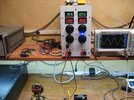
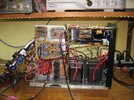
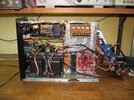
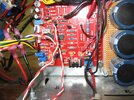
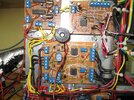
I finally have my power supply finished! It's on the shelf! I'm doing some full power tests.

I Started with a pair of the Chinese circuit board kits.  Lucky that I found this thread. I made the mods to the boards and added higher power components and  PWM fan control.

My transformers have multiple primary voltage taps. I Used a comparator to select a higher transformer input voltage tap when the power supply  output voltage is low. This greatly lowered the power Dissipation. With commercial power supplies this transformer voltage selection is done on the secondary of the transformer.  With the transformers that I got for free, I could only switch primary winding taps. This required triac switching circuits.

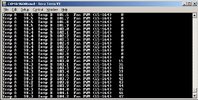
Pictures are attached.

PS4 001s.jpg

PS4 002s.jpg

PS4 004s.jpg

PS4 006s.jpg

PS4 007s.jpg

PS4 009s.jpg

PS4 010s.jpg


repairman2be

Dec 7, 2016
15
Joined
Dec 7, 2016
Messages
15
Hello all,

A lot of reading here and much more to learn. Also have the Banggood power supply board, still in the bag though - will likely stay there.

Have ordered PCB's at Elecrow from Gerber files provided by Liquibyte. So, thank you very much Liquibyte.

10PCB + shipping = US$ 18.50 that is about AUS$ 25.00

Since I have a 24V Toroidal already I will have to settle for a 25V 3A power supply. That is fine for me as it is more important

to build it.

Thanks to all here.

Regards, William


akkuzu1969

Apr 27, 2017
1
Joined
Apr 27, 2017
Messages
1
Hi everyone

Sorry my bad.

There go the schematic and the error. 

I joined the Proteus file too, so you can test it if you have Proteus. 

Best regards 

P.S::

Can i change TLE2141 by MC34071 without any problem?

My goal is controll the PSU using arduino, but need put its to work first :)


View attachment 42582

View attachment 42580

View attachment 42581


Hi everyone

Sorry my bad.

There go the schematic and the error. 

I joined the Proteus file too, so you can test it if you have Proteus. 

Best regards 

P.S::

Can i change TLE2141 by MC34071 without any problem?

My goal is controll the PSU using arduino, but need put its to work first :)


View attachment 42582

View attachment 42580

View attachment 42581


repairman2be

Dec 7, 2016
15
Joined
Dec 7, 2016
Messages
15
@mars

Hi there,

Look at Page 87 and 88 posts from Liquibyte and you will find PCB, schematic and gerber files to make a nice power supply that will work.

How would I know you might ask. Glad you asked. I have had PCB's made from those gerber files and built a power supply. And it works well.

Look here for my post:

"electronics-lab.com/community/index.php?/topic/40835-0-30v-0-3a-latest-data/&page=2"

All credit goes to member Liquibyte. Thanks a lot Liquibyte for making all files available.

Many thanks also to those who were actively involved in this thread and helped improve the original design.

Hope that will answer your question.

PS. I f you want to built one like I just mentioned, I still have some PCB's left. I only ask AU$2.50 per PCB plus shipping to your country in an envelope.

Cheers, William

 
Last edited by a moderator:

burrap

Aug 15, 2017
9
Joined
Aug 15, 2017
Messages
9
Hi Liquibyte,

I have bought two of your PCBs from repairman2be (rev. 8.), awaiting them any day now. I have studied the schematic pretty thoroughly and tried to read up on the threads.
Very interesting, and good to have something educating to do with my time :). So far I have one question that I can't find a comment on in the forums.

First, let me introduce myself. I'm a Swedish 30 year old mmWave/μWave/RF engineer (read: allergic to noise) and I just had a second son so I had to find something to do all the nights I stay up taking care of him. Designing a PSU seems like a good choice!
It started with me realizing that I today financially can handle some of the ideas I had when I was 20, now time is more of an issue instead. But hey, it doesn't matter if it takes time to reach the finish line.
I always wanted to build a boombox. I thought a good place to start was to design a PSU (to not waste battery when a socket is available) and a relay-circuit. I read up a lot on audio PSUs and actually designed a linear 10-18V, 10A supply, and hand drew the breadboard and everything. When I saw the end-price I reconsidered. This PSU is kinda useless for anything but the amplifer, it's better to have a 0-30V supply I can use for lots of things. Especially considering I have no use for or place to store a boombox. The reason I'm saying this is that I might be tainted by audiophiles in my way of thinking :). That I'm tainted by my RF-world at work I don't see as a problem, RF is probably what I'm going to use it for.

Then I found this design and got interested. But I still wanted it to be able to run the amplifier I had in mind for the boombox, which is something like 14V/6A. I considered paralleling two of these or use a LM723 regulator. I ended up with the idea of two 0-15V LM723 PSUs which I can parallel connect for  0-15V/0-10A or series connect for 0-30V/0-5A. I was pretty happy with this idea and started designing. However, I couldn't get the current limit to work as nicely as I desired for a bench PSU.
Then I came back to this design, and here I am now.

I'll start with building your 3A design pretty much identical to yours. To be able to do some measurements and see how it behaves before I try to improve it :). After that I will start designing my own board. I'll probably stick to 3A or 5A for a while, if I need an amplifier PSU I'll design it for that purpose. 
My ideas for improvements is to reduce the voltage drop a little, have a look at the negative supply (it hurts my eyes that it doesn't load both lines symmetrically). If I reduce the voltage drop and feel that I can't find an optimal transformer I might reduce the output voltage a little. I feel 30VAC is a little too high and 24VAC apparently is not enough so there is some unused power wasted there. We will see how it goes.

For later I might also take up the idea of LT1236 as reference. We will see. First I believe I have some startup transients to deal with!

So, now to my question:
Your R9 (original R17), is 68 Ohm. The original design says 33 Ohm but you changed it to 68 Ohm. Why did you change that? Have you found some issues with stability if it is too small? The reason I'm asking is that if I lower the current sense resistor I might want to increase this. Maybe I'm doing this wrong. I calculate the original design to give a minimum current limit of 10mA (while it says 2mA in the description), and your gives 20 mA.

Edit: I found the change, it was just to get the voltage divider to give the correct minimum voltage. However I'm still confused, but this can probably anyone answer. It should be simple. I don't get the formula for the current limit.
If we have a minimum of 5mV at the non inverting U3 input, that should allow for a 5mV drop over the current sense resistor right? That's 10 mA... Not 2..

Edit2: LTSpice seem to agree with me...

I might have more questions but I'll search and think a little more before I speak :)

Best Regards

Björn

Ps. Thanks for the pdf with QA and other useful info. Would have saved me some time if I read that before I started study the circuit. But imI might learn it better by figuring things out on my own.

 
Last edited by a moderator:

audioguru2

Apr 6, 2004
12,026
Joined
Apr 6, 2004
Messages
12,026
Audio amplifiers do not need a voltage regulator or a current regulator. A car radio amplifier is powered directly from the car battery with no voltage regulator but the low current radio parts might use a simple little voltage regulator.

14V at 6A is 84W!  One amplifier produces a maximum output of 16W into a 4 ohm speaker then 4 channels make 64W. If all 4 amplifiers are producing 64W then if they are linear they heat with an additional 36W and the current is 7.14W but it does not need to be regulated.


burrap

Aug 15, 2017
9
Joined
Aug 15, 2017
Messages
9
Yeah but it's a lot cheaper to use a regulator rather than quality caps to get rid of the 100 hz ripple :)

Plus I could make sure it runs on 14 V regardless of load (volume, usb charger etc) and temperature!

The two amplifiers I had in mind were 45W and 50W into two channels, with losses and other functionality I estimated 6A.

 
Last edited by a moderator:

burrap

Aug 15, 2017
9
Joined
Aug 15, 2017
Messages
9
I could add that when I was looking for a suitable amplifier I didn't know electronics-lab even existed. So I just browsed for the most suitable class d chip and went on from there :)

It was when I gave up on the 14V PSU idea because of a stronger need for a lab PSU that I found this design and this place!


AjitCS

Apr 22, 2017
1
Joined
Apr 22, 2017
Messages
1
Hi  Repairman

I am interested in Liquibyte Rev-8 PCB.  Do u have any left?

How to go ahead about ordering from u?  Any idea on the shipping costs from ur location to India (Kerala\Trivandrum )?

I understand u are charging 2.5 AUS$ per PCB. I want to know total costs before commiing.

rgds


BobRob77

Aug 31, 2017
6
Joined
Aug 31, 2017
Messages
6
New here, so Hi,

Was wondering if anyone have got any PCB's for this project for sale? Shipping would be to Sweden-

Cheers!


metasax

Jun 22, 2017
1
Joined
Jun 22, 2017
Messages
1
I vouch for @repairman2be 

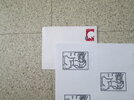
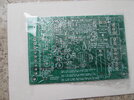
I got one from him recently and it was very neatly packed and arrived on time. Check out the pics below. If he still has some, you can get them from him if you only need one board. Otherwise, organize yourselves for a batch order from the fabhouse of your liking.

IMG_1876.JPG

IMG_1878.JPG


audioguru2

Apr 6, 2004
12,026
Joined
Apr 6, 2004
Messages
12,026
Nand,

Simply calculate the amplitude of the 120Hz (or 100Hz) ripple that will be produce when the load draws 3A. It won't be regulated with that much ripple.


BobRob77

Aug 31, 2017
6
Joined
Aug 31, 2017
Messages
6
So, I ended up getting the PCB:s from Repairman (great service there) and have put one together, I do have a weird issue someone might be able to help me with:

The circuit the PCB is based on is the Liquidbyte version from the top of page 88 of this thread (http://electronics-lab.com/community/index.php?/topic/29563-0-30v-stabilized-power-supply/&page=88). The things where I deviate a bit are:

  1. The ballast resistors for the 2N3055's are 0.1 Ohm rather than 0.33 since I didn't have those available at sufficient power rating
  2. The sense resistor is 0.46 Ohm: Rather, it's a small network of two 0.56 Resistors in parallell after which there is a single 0.18 one in series, yielding 0.56/2+0.18 = 0.46 Ohms, again for availability
  3. The single 10 uF Polyester cap was also lacking, so it's replaced by two 4.7 uF ones in parallell, they turn out to measure almost exactly 10 uF
  4. My rectifier bridge is only rated at 12 Amps at 250 V, this should be sufficient though
  5. The Transformer is a 30V/4A, yielding the same 120VA
Now, when I fire the thing up, I can adjust voltage fine from about zero (haven't been able to calibrate it yet) but only up to 17.56V (which may not be that exact given it's from my multimeter). Turning the trim pot adjusts down from this fine, but when adjusting up it goes to those 17.56 and stops. Now, if I disconnect the voltage adjust pot entirely the output shoots up to 40V, connecting it back makes things stop at 17.56 again. Have looked things over and can't find anything obviously wrong, maybe someone has an idea to what may be happening would be greatly appreciated!

Cheers


burrap

Aug 15, 2017
9
Joined
Aug 15, 2017
Messages
9
Hi!

I have bought the same board from the same man :) but not built it yet. Ive done lots of simulations though.

I guess this is unloaded? Repairman told me about the 100k trimpot, you need to short pin 1-2 there, did you do that? 

 
Last edited by a moderator:

burrap

Aug 15, 2017
9
Joined
Aug 15, 2017
Messages
9
Whats the voltage drop over your 0.46 ohm sense resistor?

It is past bedtime here, can think more tomorrow. But I think it could be current limit.

When you remove the voltage trim pot you get really high gain, which means that the input voltage at the rightmost op amp can be low (caused by current limit) and still provide a high output voltage.

If the 100k current limit trimpot is connected wrong it will always be 100k. This will mess up the current limit op amp.

So I hope the solution is to put a bridge/jumper/short between pin 1 and 2 on the 100k trim pot.

 
Last edited by a moderator:
Status
Not open for further replies.
Top