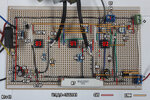
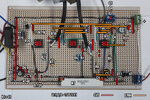
0-30V Stabilized Power Supply

Status
Not open for further replies.
B

Big zee

Jan 1, 1970
0
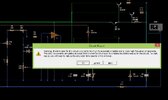
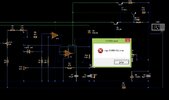
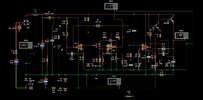
I tried to simulate it on circuit wizard
and there is some thing wrong !
???
I attached the circuit for you to tray it .

01.JPG

02.JPG

PS30Verror.rar


Attachments

  • PS30Verror.rar
    7.4 KB · Views: 12

audioguru2

Apr 6, 2004
12,026
Joined
Apr 6, 2004
Messages
12,026
I have never seen Circuit Wizard before so I do not know its errors.

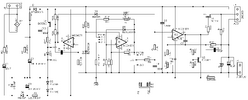
The part numbers on your schematic are different from the part numbers on the original and on my schematic:
1) You have IC3 as the 11.2V reference but I have U1.
2) You have D7 as a 20mA 5.6V zener diode but I have D8 as a 5mA 5.6V zener diode.
3) Many other parts have different part numbers.

It is a very simple circuit for you to see what is wrong.

 
B

Big zee

Jan 1, 1970
0
ok forget about the numbering its by default
I'm not sure about the current in the D8
what if its more than 5mA ?
check the attached
you can see the D8.

IMG_4643.JPG


audioguru2

Apr 6, 2004
12,026
Joined
Apr 6, 2004
Messages
12,026
Big zee said:
I'm not sure about the current in the D8
what if its more than 5mA?
R6 in your circuit is 1k. The voltage gain of IC3 is 2 so R6 has 5.6V across it then it sets the zener diode current at 5.6mA. My circuit uses a zener diode BZX79C5V6 rated at 5mA. There are a few other 5mA zener diodes available. Your older 1N752 zener diode is designed to be 5.6V at 20mA which will not happen and its voltage might be 3V, 4V or 5V at the current set by R6. IC3 cannot accurately supply much more current than 5mA.

The output of your IC3 should be 11.2V plus or minus 0.5V. What voltage is it?
 

Kevin Weddle

Feb 23, 2004
1,620
Joined
Feb 23, 2004
Messages
1,620
U3 probably doesn't need the negative supply, but adding resistors isn't power saving. Maybe R17 R18 could be changed. But this is an already designed project.

 
B

Big zee

Jan 1, 1970
0
audioguru said:
R6 in your circuit is 1k. The voltage gain of IC3 is 2 so R6 has 5.6V across it then it sets the zener diode current at 5.6mA. My circuit uses a zener diode BZX79C5V6 rated at 5mA. There are a few other 5mA zener diodes available. Your older 1N752 zener diode is designed to be 5.6V at 20mA which will not happen and its voltage might be 3V, 4V or 5V at the current set by R6. IC3 cannot accurately supply much more current than 5mA.

The output of your IC3 should be 11.2V plus or minus 0.5V. What voltage is it?
in circuit wizard I replaced the zener to BZX55C5V6 then its shows its 11.44 volt
but the output of the PS not stable if the voltage adjustment 15% and its shows error
if its 10% the volts sets at 3 volt then its jump to more than 30 volt then its goes slowly to 3 volt repeatedly
FYI the RV1 for U2 not connected in circuit wizard because there is no pin 5 or 1
and I will look into BZX79C5V6 and I will try it on my PS
 

audioguru2

Apr 6, 2004
12,026
Joined
Apr 6, 2004
Messages
12,026
The BZX55C5V6 zener diode has a little better voltage regulation than the BZX79C5V6 zener diode.

The reference voltage of about +11.2V should be stable and never change up and down.
U2 and the driver and output transistors are a very simple amplifier with an adjusted voltage gain of (30V/11.2V=) 2.68 so the output voltage will never vary up and down like in your simulation.

U3 uses a negative supply so that when the output of the project is shorted then the output of U3 can go to about -0.7V so that D9 can reduce the output voltage to zero. 


Kevin Weddle

Feb 23, 2004
1,620
Joined
Feb 23, 2004
Messages
1,620
My mistake Big Zee, Q3 appears as only a warning that the power supply is shorted. If it were a good power transistor it could reduce the voltage too. The negative power supply should be more than 700mV and a resistor used in series with D9.


audioguru2

Apr 6, 2004
12,026
Joined
Apr 6, 2004
Messages
12,026
KevinIV said:
My mistake Big Zee, Q3 appears as only a warning that the power supply is shorted. If it were a good power transistor it could reduce the voltage too. The negative power supply should be more than 700mV and a resistor used in series with D9.
No.
Q3 lights the LED to warn you that the current regulator is reducing the output voltage. It will light its LED even when the current regulator is set to 100mA and a load draws 110mA. It will also light when the output is shorted because then the output current will also be higher than the setting of the current regulator.
The current regulator opamp reduces the output voltage just low enough so that the load current equals the current regulator current setting.

A resistor in series with R9 is not needed because the current is very low and a resistor is not wanted.
 
B

Big zee

Jan 1, 1970
0
AG
can you check the attached and the link
I need your feedback
http://diyfan.blogspot.ro/2012/02/adjustable-lab-power-supply.html
because the thing is I got the TLE2141 not the other one .

PS_sch2.png

x7.JPG


audioguru2

Apr 6, 2004
12,026
Joined
Apr 6, 2004
Messages
12,026
You show two schematics with different parts designation numbers so it is confusing for me to say what is wrong.

The transistor connected to the output of the voltage amplifier opamp is needed when the opamp is the original TL081 because it has the "opamp phase inversion problem" where its output goes high when the power is turned off.
The transistor that shorts the output of this opamp to ground when the power is turned off is not needed (and might even turn on when it shouldn't) when the opamp is a TLE2141 or MC34071.

I selected the TLE2141 or MC34071 opamps because their max allowed supply is 44V. The the original TL081 was operating from a total supply that was far too high for it (the max for the original TL081 is only 36V) and these newer opamps work fine when their input voltage is as low as their negative supply (the TL081 needs a 5.6V negative supply so that its input voltage is far away from it). Also these opamps do not have the "phase inversion" problem.

View attachment 41911


xristost

Jan 15, 2012
23
Joined
Jan 15, 2012
Messages
23
Big zee said:
AG
can you check the attached and the link
I need your feedback
http://diyfan.blogspot.ro/2012/02/adjustable-lab-power-supply.html
because the thing is I got the TLE2141 not the other one .
You must rename all parts to be with same designation in two schematics. It will be much easier to check for mistakes.

And about the transistor Q2 in the output - I think it had another purpose - to shut down output voltage quicker when schematic is powered off.
 
7

78L05

Jan 1, 1970
0
I build this power supply, and it works perfect, except one thing.
I can't set output voltage on 0.0V. When I turn voltage potentiometer (10k) at minimum voltage on output is about - 0.3V, and I tried to rotate 100k trimer but I just can increase output voltage to - 0.4V but there is no way to fix output voltage on 0.0V. Please help me.  :'(
Best regards


audioguru2

Apr 6, 2004
12,026
Joined
Apr 6, 2004
Messages
12,026
78L05 said:
I build this power supply, and it works perfect, except one thing.
I can't set output voltage on 0.0V. When I turn voltage potentiometer (10k) at minimum voltage on output is about - 0.3V, and I tried to rotate 100k trimer but I just can increase output voltage to - 0.4V but there is no way to fix output voltage on 0.0V. Please help me.
It sounds like you made the original circuit that has TL081 opamps and many errors.
One error is the value of R10.

The offset trimmer should adjust the lowest output voltage from about -50mV to +50mV.
Without the trimmer the output opamp has an input offset voltage of maximum 15mV but the gain of 2.68 increases it to plus or minus 40mV maximum.
Since your offset voltage is more than 40mV then your output opamp is probably defective.
If it is a TL081 then the supply voltage to it is too high and has destroyed it.

If the output capacitor C7 is an electrolytic type then it has "dielectric absorption" which causes the output voltage to be too high without a load. A film capacitor will not have this problem.View attachment 41912

 
Last edited by a moderator:
7

78L05

Jan 1, 1970
0
I drew my own PCB design based on original schematic (with 3 TL081), and I will be very happy if I could fix it without major changes.
I tried to put 27k for R10, but the same thing hapeens. I didn't touch trimmer (it's now 100k). When I remove the capacitor on the output (C7) voltage is about - 0.15V. I put tantal capacitor at the same place but voltage is again about - 0.35V (like the first time).
What to do?


audioguru2

Apr 6, 2004
12,026
Joined
Apr 6, 2004
Messages
12,026
78L05 said:
I drew my own PCB design based on original schematic (with 3 TL081), and I will be very happy if I could fix it without major changes.
The TL081 has an absolute maximum allowed total supply of only 36VDC. The original circuit used a 24VAC transformer (that is too low) that produced a positive unloaded supply of 32.5VDC or more plus a negative supply of -5.6V so the total supply for the TL081 opamps is 38VDC or more which might blow them up!

I tried to put 27k for R10, but the same thing happens.
I showed that the datasheet for the TL081 uses 1.5k for R10.

I didn't touch trimmer (it's now 100k). When I remove the capacitor on the output (C7) voltage is about - 0.15V. I put tantal capacitor at the same place but voltage is again about - 0.35V (like the first time).
What to do?
1) Use a 20VAC transformer. Then the TL081 opamps will not have a total supply voltage too high but the max output from the original circuit will be only about +21VDC.
2) Change R10 to 1.5k.
3) Use a film capacitor for C7.
4) Adjust the trimmer for 0VDC output.

Or make the fixed and improved circuit.
 
7

78L05

Jan 1, 1970
0
I will try to make how you said to me, and then I will report results.
Thanks!

 
7

78L05

Jan 1, 1970
0
I change R10 into 1.5k and nothing, voltage on output is -0.3V.
I set voltage at 0.0V with potentiometer (10k), and measure resistance in that case, it's about 820R, so I added 820R resistor on the potentiometer and now when I turn potentiometer in the left side voltage is 0.0V, and when I turn it on the right side output voltage is 30.0V.

 
Status
Not open for further replies.
Top