0-30V Stabilized Power Supply

Status
Not open for further replies.
R

rencajs

Jan 1, 1970
0
Hi guys! I just builded original power supply project based on tl081 opamps and now i realised that there was some major problems vith original project but now i cant find solution :(
The problem is that U2 is heating up but in output there is only 200mV. I checked components and nominals and everything ir wright but still i cant find promlem :(
Could you please give me some advise?


audioguru2

Apr 6, 2004
12,026
Joined
Apr 6, 2004
Messages
12,026
The original project used a 24VAC transformer that was overloaded at maximum power. It produced about 25.5VAC with no load then its peak voltage was 36V that was reduced to 34.7V by the bridge rectifier.
The opamps used this as their positive supply but U2 also has a -5.6V negative supply so its total supply was 40.3VDC. Its maximum allowed supply is only 36V so it fails. the 24VAC transformer does not allow this project to make 30VDC at 3A anyway because its voltage is too low (its power rating is also too low).

Many more parts in the original project are overloaded especially the single output transistor and its driver transistor.

You can replace the TL081 opamp with a TLE2141 opamp that has a maximum allowed total supply of 44V but maybe the overloaded output transistor or driver transistor have also failed.

 
L

liquibyte

Jan 1, 1970
0
Is there a specific procedure that you use to calibrate this circuit?  I've finally got both of my circuits working but am not sure where to set RV1, 2, and 3 when I start this up.  I know that setting RV2 and RV3 sets the limits of voltage and current.  What am I setting with RV1, what do I look for and where am I measuring from to get this set right?  I don't want to release the magic smoke by doing things wrong so I figured I'd ask how others have started.


audioguru2

Apr 6, 2004
12,026
Joined
Apr 6, 2004
Messages
12,026
liquibyte said:
What am I setting with RV1, what do I look for and where am I measuring from to get this set right?
Set the voltage pot to zero and adjust RV1 so that the output voltage is exactly 0V. You will be able to adjust it from about +50mV to -50mV. If the output capacitor C7 is an electrolytic type then it will have dielectric absorption which will cause the output voltage to be a little positive instead of 0V. A film type of capacitor will not do this.
 
L

liquibyte

Jan 1, 1970
0
I'm actually pulling -100+mV at zero and no matter what I adjust, the voltage doesn't change that much.  In addition, the most I can get out of each circuit is around 10V, not the 30 I was hoping for.


audioguru2

Apr 6, 2004
12,026
Joined
Apr 6, 2004
Messages
12,026
liquibyte said:
I'm actually pulling -100+mV at zero
I do not know what "pulling" is. If RV1 can adjust the output +/-100mV then that is good. Simply adjust for 0V.

no matter what I adjust, the voltage doesn't change that much.  In addition, the most I can get out of each circuit is around 10V, not the 30 I was hoping for.
Then you have something very wrong. I will look back to see what modifications you have.
 
L

liquibyte

Jan 1, 1970
0
What I'm saying is that at zero adjustment on P1, RV1 will only adjust to -185mV and -170mV.  Won't go less than that won't go to more than that.  P1 at 100% only gives 10V tops.  I have two of these, isolated, and they are both doing exactly the same thing.  Something is definitely not right.


redwire

Nov 10, 2007
244
Joined
Nov 10, 2007
Messages
244
liquidbyte,  what is  the voltage at pin 6 on U1 and what is the voltage of pin 3 and pin 6 on U2 when you are at max voltage?


audioguru2

Apr 6, 2004
12,026
Joined
Apr 6, 2004
Messages
12,026
1) Which opamp part number is your U2?
2) What is the value of RV1?
3) Do you have an R10 connected to the slider of RV1?

Measure the voltage at the output of U1. It should be 11.2V. The voltage pot feeds 0V to 11.2V to the input of the output amplifier (it has U2 in it) that has a voltage gain of 2.68 times. Then when the voltage pot is at maximum the output of the project will be 11.2V x 2.68= 30.0V.

 
L

liquibyte

Jan 1, 1970
0
redwire said:
liquidbyte,   what is  the voltage at pin 6 on U1 and what is the voltage of pin 3 and pin 6 on U2 when you are at max voltage?
Pin 6 on U1 is 4V and 3.6V to gnd.  U2 pin 3 is 2.79V and 3.1V and pin 6 is 6.7V and 7.2V to gnd.

1) Which opamp part number is your U2?
2) What is the value of RV1?
3) Do you have an R10 connected to the slider of RV1?

Measure the voltage at the output of U1. It should be 11.2V. The voltage pot feeds 0V to 11.2V to the input of the output amplifier (it has U2 in it) that has a voltage gain of 2.68 times. Then when the voltage pot is at maximum the output of the project will be 11.2V x 2.68= 30.0V.
U1, 2, and 3 are all TLE2141's.  Rv1 is 5K both sides.  R10 is connected to the slider on both sides.

Output of U1 pin 6 is 4V and 3.6V to gnd as I said above.  I'm getting from 0 to 100% on RV1 a difference of only 9mV.  I may have to re-buy the parts and have a board made and start over because something is very wrong with these numbers.
 

audioguru2

Apr 6, 2004
12,026
Joined
Apr 6, 2004
Messages
12,026
liquibyte said:
U1, 2, and 3 are all TLE2141's.
Good.

Rv1 is 5K both sides.
Good.

R10 is connected to the slider on both sides.
R10 should be 1k ohms with the TLE2141 opamp.

Output of U1 pin 6 is 4V and 3.6V to gnd as I said above.
The 11.2V reference circuit using u1 is very simple. Its supply can be anywhere from 14v to 44V. Measure it.
Make sure its zener diode is 5.6V at 5mA because a 100mA zener diode voltage will be low like yours is.View attachment 42024


redwire

Nov 10, 2007
244
Joined
Nov 10, 2007
Messages
244
Liquidbyte,  can you post the values of all of the pins for U1

They should be close to:
Pin 2  5.6v
pin 3  5.6v
pin4  0V
Pin 6  11.2V
Pin 7 41 V

Also check the resistance value of R5 and R6  to see if they are both 10K.

 
L

liquibyte

Jan 1, 1970
0
redwire said:
Liquidbyte,  can you post the values of all of the pins for U1

They should be close to:
Pin 2  5.6v
pin 3  5.6v
pin4  0V
Pin 6  11.2V
Pin 7 41 V

Also check the resistance value of R5 and R6  to see if they are both 10K.
Sorry folks, the wife and I have been sick for a few days and I just didn't have the energy to keep working on this at the time.

OK, here are the results from both channels U1 voltages.

Left side:
2 = 1.48
3 = 4.03
4 = 0
6 = 3.24
7 = 3.3

Right side:
2 = 1.32
3 = 4.86
4 = 0
6 = 3.92
7 = 4.28

R5 and R6 are both 10K.  R10 is 1K on both sides.  U1 supply is 38V on right side and 37.5V on left side.  U1's zener is 5.6V from Digikey (http://www.digikey.com/product-search/en?x=6&y=14&lang=en&site=us&KeyWords=BZX79C5V6-ND).

The odd thing is that nothing is even getting warm to any significant degree even though both power supplies are only outputting around 10 volts.  Current limiting is working as well if I adjust the current pots.  I'm starting to wonder if I didn't accidentally solder a short on both sides that's causing this voltage drop to ground.
 

redwire

Nov 10, 2007
244
Joined
Nov 10, 2007
Messages
244
Liquidbyte,

On U1, Pin 7 is the supply voltage from the bridge rectifier, it should be around 41V.  You state that the U1 Supply is around 38V on the right side and 37.5 on the left.  I don't know how that is possible.  You list the voltages for every pin but 1 and 8. Those pins are not utilized.  Did you accidently connect pin 1 or 8 to the high side instead of pin 7.  It appears you have a error on your schematic and both boards are incorrect.

 
L

liquibyte

Jan 1, 1970
0
I've got U1 going through the 10V zener along with U3 to drop the voltages a bit because my rectified output was over the 44V limit.  I've also run U2 through 2 diodes to create another seperate voltage drop.  Excuse the reordering of the part numbers on the board image, it's also come back to bite me in the butt.  I think it's wired correctly but I'm starting to wish I had waited for the money for an etched board instead.  I may eventually do that with a new set of parts that populate the board.

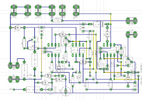
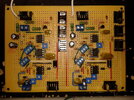
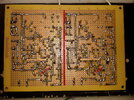
Attached is an eagle board layout I did to help me while soldering this up.  I'm also attaching pictures of the actual job itself.

0-30.png

top.jpg

bottom.jpg


audioguru2

Apr 6, 2004
12,026
Joined
Apr 6, 2004
Messages
12,026
Liquibyte,
Your unregulated positive supply is about +46V. It is reduced to about +36V with the series 10V zener diode.
Then pin 7 of U1 and U2 should be about +36V but pin 7 of your U1 is MUCH TOO LOW!


audioguru2

Apr 6, 2004
12,026
Joined
Apr 6, 2004
Messages
12,026
Liquibyte,
The parts designation numbers on your parts layout are all mixed up:
1) U1 on the original and on my modified schematic has it as the 11.2V reference but your U1 is the current regulator.
2) U2 on the original and on my modified schematic is the voltage regulator but your U2 is something else.

Whose schematic are you using?

 
Last edited by a moderator:
L

liquibyte

Jan 1, 1970
0
My U1 = U3, my U2 = U1, and my U3 = U2.  I renumbered the parts in the layout to follow current conventions regarding parts being numbered left to right and top to bottom on the schematic side of things.  I think I'm just going to redo this as the parts to redo the board will only run about $30 or so including the op amps.


redwire

Nov 10, 2007
244
Joined
Nov 10, 2007
Messages
244
Liqidbyte

Trace back from the bridge rectifier to pin 7 with your voltmeter to find where your voltage is dropping off.  You have a lot of solder on that board. Perhaps you have a short somewhere.

If you are getting 10 V output it seems U2 (on the original project) is functioning properly.  With an output of 3.92V on Pin 6 of U1 feeding U2, that has a gain of approx 2.6 equals approximatly 10 volts.  You problem may be minor.

 
Last edited by a moderator:
L

liquibyte

Jan 1, 1970
0
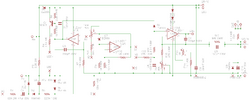
Give me a bit on that and I'll let you know how it goes.  I'm attaching the schematic I did in Eagle that I worked from to show the parts numbering that I redid.

0-30V-eagle.png

 
Status
Not open for further replies.
Top