0-30V Stabilized Power Supply

Status
Not open for further replies.

audioguru2

Apr 6, 2004
12,026
Joined
Apr 6, 2004
Messages
12,026
R21 simply allows C8 to slow down the switching of U3.
Instead increase the value of R17 so that the LED does not turn on when there is a small output load.


redwire

Nov 10, 2007
244
Joined
Nov 10, 2007
Messages
244
audioguru said:
R21 simply allows C8 to slow down the switching of U3.
Instead increase the value of R17 so that the LED does not turn on when there is a small output load.
Does adding another shunt resistor to this PS,  outside of the  feedback of U2 and input of U3  have any negative effects on the voltage regulation.  I don't know the value of the shunt resistor but what about current regulation.
 
P

philtherepairman

Jan 1, 1970
0
After more testing, I was able to turn-off the constant current LED by powering the LED display with 4 AA (6volts) batteries.
I built a separate supply for the led display, tapped off the transformer secondary, somehow there's some interaction. It seems like you have better results if you totally isolate these cheap $6.00 combo import meters from your circuit.

 
L

liquibyte

Jan 1, 1970
0
redwire said:
Have you considered something like this: http://www.adafruit.com/products/296.  Using AVR Studio 6 (free)you only need a usb cable to program the chip. No separate programmer is necessary.   If you plan to do future project then you may want to  consider a  Dragon.  I have a STK500 it is a bit bulky but rugged and versatile.  The breakout board I linked is small, fast, powerful and has enough pins to handle most projects.
Sorry, I was out of town last night because my wife's mother died.

Right now I'm just working with an uno to see what I can come up with.  I built this as a dual unit so I could play and learn so there's no real rush as far as the displays go.  I have an idea of the kind of thing I'd like to do but am not sure if it will be able to be done to my satisfaction or even the way I'm imagining it.
 
L

liquibyte

Jan 1, 1970
0
I just wanted to let you guys know that I've tested both sides at 30V and 2.72A with an 11 ohm load and everything is working perfectly.  I haven't yet turned down the voltage at a higher amp range yet because I want to get a power supply working for the fans before I do.  The transistors are barely getting warm and R7 gets just a touch warmer than that.  I used two small and one large stove top eyes wired in parallel to achieve the load because I didn't have a 10 ohm load to get to the full 3A but what I did works nicely because those eyes get too hot to touch after a few minutes.  Calibration is holding nicely, current limiting is working well and I'm one happy camper.  I may splurge on an IR thermometer now just to have a better idea of where all the components are at temperature wise as I test further.  I also haven't connected the two supplies together yet to achieve the positive and negative supplies yet but I plan to soon.

Phil, the boards are on their way to you.  Did you check my parts list against the parts list of the original schematic?  I was worried I might have missed something because I had two separate orders, one before I had the boards made that had the external parts on it and one after I had the boards made with a few changes to the on board parts and their footprints.  If you populate the boards with those parts and make sure you solder the wires on the bottom to handle the current and make sure the BC557 is oriented the right way everything tests out nicely.


redwire

Nov 10, 2007
244
Joined
Nov 10, 2007
Messages
244
liquidbyte,  what is the lowest voltage setting you are able to achieve with no load?

 
L

liquibyte

Jan 1, 1970
0
redwire said:
liquidbyte,   what is the lowest voltage setting you are able to achieve with no load?
31mV on the left side and 33mV on the right side, though I'm not sure how accurate my multimeter is in the grand scheme of things.
 

redwire

Nov 10, 2007
244
Joined
Nov 10, 2007
Messages
244
liquibyte said:
31mV on the left side and 33mV on the right side, though I'm not sure how accurate my multimeter is in the grand scheme of things.
While the current design works well and all parts work within safe operating conditions, I think the current design needs to be changed to connect  pin 4  of U2 to the negative rail (-1.3V), rather than ground to be able to adjust the voltage to a solid 0.  U2 would still be operating within it's design parameters.
 
L

liquibyte

Jan 1, 1970
0
redwire said:
While the current design works well and all parts work within safe operating conditions, I think the current design needs to be changed to connect  pin 4  of U2 to the negative rail (-1.3V), rather than ground to be able to adjust the voltage to a solid 0.   U2 would still be operating within it's design parameters.
What's the difference between 31-33mV and true zero?  I probably will never need to go below what I'm getting now, so I guess my question is what's the point of going to zero volts?  I'm happy with the way things turned out either way I suppose.  I have six boards left and I'll probably build at least two more just to have extra power around to use.
 

redwire

Nov 10, 2007
244
Joined
Nov 10, 2007
Messages
244
Liquibyte,
Although I quoted our discussion it was really a general statement for the board.  The project is advertised as 0-30V and many individual have discussed disappointment when they can not get to zero volts.    After reading over 140 pages of discussion,  you designed your board to utilize a expensive film cap in pursuit of achieving true zero volts.  Based on the results of your build and tests, it appears that the film cap really doesn't  provide any substantial improvement over the electrolytic cap.  Your boards are already made so I am certainly not suggesting any change to your boards.  Your tests are helpful and further the discussion on this board.  For those who come after, and expect to achieve the advertised project with easy to get parts, simply changing a connection may be the solution.  It would be simple to test by cutting  the  trace to pin 4 and putting a jumper wire to the negative rail.  RV1 may need to be adjusted .

 
L

liquibyte

Jan 1, 1970
0
redwire said:
Liquibyte,
Although I quoted our discussion it was really a general statement for the board.   The project is advertised as 0-30V and many individual have discussed disappointment when they can not get to zero volts.     After reading over 140 pages of discussion,  you designed your board to utilize a expensive film cap in pursuit of achieving true zero volts.   Based on the results of your build and tests, it appears that the film cap really doesn't  provide any substantial improvement over the electrolytic cap.  Your boards are already made so I am certainly not suggesting any change to your boards.   Your tests are helpful and further the discussion on this board.   For those who come after, and expect to achieve the advertised project with easy to get parts, simply changing a connection may be the solution.   It would be simple to test by cutting  the  trace to pin 4 and putting a jumper wire to the negative rail.  RV1 may need to be adjusted .
Wouldn't connecting it that way pull the voltage below ground and leave you with -1.27V while just leaving it alone gives 0.03V?  Oddly, RV1 has little to no effect on my readings.  While my current setting using RV3 is rock solid, RV2 can be set loaded or unloaded and I get an odd fluctuation in voltages.  It's not enough to really be a bother but kind of annoying trying to get things stable at 30V tops.  Sometimes I wonder if it isn't the pots themselves but I'm not sure.  I haven't hooked up to an o-scope yet but plan to soon.  The bad news there is that I only have a Conar 255 and won't really be able to see what's going on other than the fact that the output may be oscillating.
 

redwire

Nov 10, 2007
244
Joined
Nov 10, 2007
Messages
244
liquibyte said:
  The bad news there is that I only have a Conar 255 and won't really be able to see what's going on other than the fact that the output may be oscillating.
Understand.  I'm about to purchase a Rigol DS1074Z so I can have a 4 channel view.  I think it may take a couple of weeks to arrive.
 
L

liquibyte

Jan 1, 1970
0
redwire said:
Understand.   I'm about to purchase a Rigol DS1074Z so I can have a 4 channel view.  I think it may take a couple of weeks to arrive.
That's the one I'd like to get if I can ever get my hands on an extra $500.  If I luck out and find $800, I'd go for the DS1104Z.  The good news is that I have no idea how to really use one yet.  I understand the concept and have seen one being used but have never had the opportunity to use one myself.  I just got a couple of probes and an adapter for mine but I think I'll have to go through the calibration with it first which means I'll have to open it up as it's that old.  I'm just glad I have something to use and learn on.  I think once I figure out its limitations I'll understand enough to be able to want something more expensive.  ;D  I did basically get it for free so I can't complain.  I traded for it over at eevblog and just had to pay shipping on what I sent and being that it's a heavy bastard, I think I may have come out ahead on the deal.
 
J

jeffrey13

Jan 1, 1970
0
hey guys.  so ive built this suppy actually a duel both circuits being on the same pcb but totaly isolated from each other. except for the 3055's and bd139's which all mount to the same aluminum heat sink with resistors on a seperate pcb. its interesting what has been happening. ive had lots of issues with these boards and id solve them as i troubleshoot through them ive had them working fine then short circuit somthing on a test circuit and have to go through them and replace caps and chips. i now have 741's in u1 and u3 so i know that may contribute to not getting total current cutoff at my current cutoff setting. ill put a motor on output set my currrent limit then hold motor armeture. red light will come on and armeture force drops out but still have light voltage on output say 5v. i think with the right chip it would drop out to 0v. will be getting new chips until then its been a little dangourous to the board. any how after going through the entire circuit and getting my board corrected ive noticed somthing. when i fire one side up (oh i should state each circuit has its own toggle going from ac to bridge input) that both supplys will power up. now ive traced it back to one of the 3055's. now when all four 3055's are mounted to the heat sink and one toggle is on  both supplys power up they both operate what seems perfectlly fine going 0 to 30 seperatlly as typical. but i can pull one of the 3055's off the heatsink (the one that is bad) and the supplys will come on seperately and work as usual. am i possiblly seeing this cause the 3055's are in parrelle and i dont really see what is happining with the bad one till its tied to the heatsink. and how could this be suppying my other circuit if it is bad. i believe the chips heatsink is tied to the collector so i get 34v on the heatsink when eigther supply is on but how can it possibly be supplying my other circuit. it doesnt matter witch circuit i turn on while the bad one is mounted to the heatsink both circuits come on. i know were not all experts on how transistors fail but this whole progect was done so i may learn and understanding this failure is part of that any help would be appreciated. also i wanted to through this on there for other people who may see simular problems and reading through somthing like this with ya'lls input is a goldmine of understanding. i just want you guys to know how much we newbies appreciate your long time commitment to this thread. i've seen some of you guys here for years. and your comments are all that got me through this. thanks 


redwire

Nov 10, 2007
244
Joined
Nov 10, 2007
Messages
244
Wow!  I'm out of breath just reading this.

The case of the 2n3055's is the collector which means if you have all 4 on the same heatsink and not insulated, then all will be live when either transformer is live.  Separate each side first. when you trouble shoot.

 
L

liquibyte

Jan 1, 1970
0
I'm going with Redwire's assessment here.

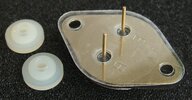
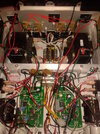
I hope you've been insulating the TO-3's with something like in the first picture.  This is how I have all four of mine on the same heatsink mounted to an all aluminum case.  A little non conductive thermal compound on both sides of the mica washer and you're good to go.  I went the extra mile in that the holes that the transistors leads and mounting screws go through also are lined with nylon tubing so everything is insulated just to be on the safe side.

As long as everything is insulated properly you'll never have issues.  If you can't insulate the transistors , you can insulate separate heatsinks with two 2N3055's each, just make sure the cases are at least tied together with a wire and don't just rely on the heatsink itself to act as a conductor, I wouldn't trust that.  I made sure that when mine were all mounted, I used a continuity tester to make sure the cases were isolated, as a matter of fact, I checked everything before powering up, three times.  Measure twice, cut once.  :p

MicaTo3Sk_a.jpg

new.jpg

 
J

jeffrey13

Jan 1, 1970
0
this is great advice. i'll surelly do this. but in retrospect i wonder why i did not see this problem earlier when i first put it all together im thinking my heat transfer compound must have been insulating the chips (im actually using the tip3055. i think its the st255 style.) i have changed all my transiters numorous times trying to solve this.


audioguru2

Apr 6, 2004
12,026
Joined
Apr 6, 2004
Messages
12,026
jeffrey13 said:
Im thinking my heat transfer compound must have been insulating the chips (im actually using the tip3055. i think its the st255 style.) i have changed all my transiters numorous times trying to solve this.
Texas instruments invented the TIP3055 transistor and their datasheet says the collector pin is connected to the heatsink tab.

But ST Micro copied it and their datasheet does not say anything about the `live` heatsink tab.
 
L

liquibyte

Jan 1, 1970
0
Thermal compound can act as an insulator if enough is used though that's not how it should be applied.  The trick is to use as thin a layer as you can because it's just there to fill the microscopic gaps in the mating surfaces and create a smooth surface to transfer the heat.  I use an exacto knife to get the layer as thin as possible and spread one layer to the mica insulator and the other layer onto the transistor itself to ease positioning while putting things into place to avoid a mess.  I was careful enough when I did mine that I didn't even have anything to clean up afterwards.

The ON semi sheet has it as pinout #4.  I wonder if ST thought that the connection was implied and therefore left the info off their datasheet.  I always check the datasheets so as to not make mistakes but will always assume that if the package has any sort of metal plate that it's connected to one of the pins and must be isolated if not used that way.

 
T

tcjeep

Jan 1, 1970
0
Hi Guys,

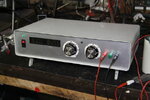
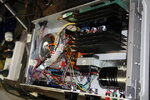
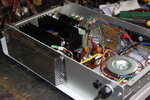
I'm new on this board, just wanted to thank you all for the excellent contributions on this topic. I wanted a bench power supply and came across your contribution. The amount of development is amazing. I made a PCB using Printmaster's single-sided template using the old photocopy and iron-on trick and built it during the Easter weekend. At first, my aim was just to try it out, but, surprised at how well it worked, I ended up using on old RS box and added a couple of LCD displays and making it into a project. OK, so its not like the beautiful "beast" that Liquibyte is building, it doesn't have the buzz of 50Volts like Redwire's and it probably won't meet Audioguru's approval, because it uses TIP3055's instead of the 2Ns. To be quite honest, the whole thing was built using junkbox components. It worked, basically, "out of the box". It deliver's the full 90 Watts and I just love the linear voltage and current limit scales. Ive attached a couple of pics. It needs tidying up, but for a weekend job, I'm very happy. Thanks again.

IMG_1238.JPG

IMG_1239.JPG

IMG_1244.JPG

 
Status
Not open for further replies.
Top