
Nordic nRF71 Series Combines Wi-Fi 6, BLE and Edge AI in Ultra-Low-Power SoCs
Featuring dual-band nRF7120 and tri-band nRF7120E SoCs, the nRF71 Series integrates Wi-Fi 6, multiprotocol wireless connectivity and edge AI with up to 20× lower standby power.
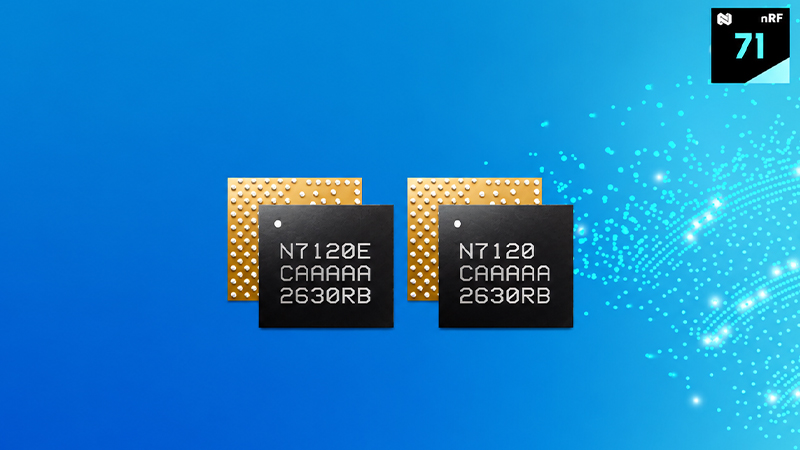
Nordic nRF71 Series
Nordic Semiconductor has unveiled a new family of all-in-one wireless microcontrollers, the nRF71 Series of ultra-low-power SoCs with ultra-low-power Wi-Fi 6, that promises to provide edge compute, Wi-Fi, Bluetooth Low Energy (BLE), Thread, Zigbee and Matter connectivity, and an Axon NPU for edge AI workloads in a single chip. The company says the new chips, beginning with the dual-band nRF7120 and tri-band nRF7120E, have up to 20x lower power consumption in standby mode than nRF70 Series Wi-Fi products of the current generation. This should enable nRF71 devices to run on battery for a long period of time, whether they use BLE, Thread or Wi-Fi for Smart Home, wearables and industrial IoT applications.
Both chips nRF7120 and the nRF7120E are based around a core Arm Cortex-M33 processor. They offer 1MB of accessible static random access memory (SRAM). They also offer 4MB of flash memory, up to 65 general purpose I/O (GPIO) pins and offer a maximum clock speed of 256MHz. Nordic have stated that they both offer a low power sleep mode of between 1.44-4.68µA, depending on their 3.6V supply. When connected to Wi-Fi they will draw 14µA in standby, if using a 2.4GHz network, and 8µA if using a 5GHz/6GHz network. The multi-protocol 2.4 GHz radio offers Bluetooth Low Energy (BLE), Thread, Zigbee and Matter connectivity, along with proprietary protocols. They also offer Near Field Communication (NFC). The radios are separate and can work alongside one another.
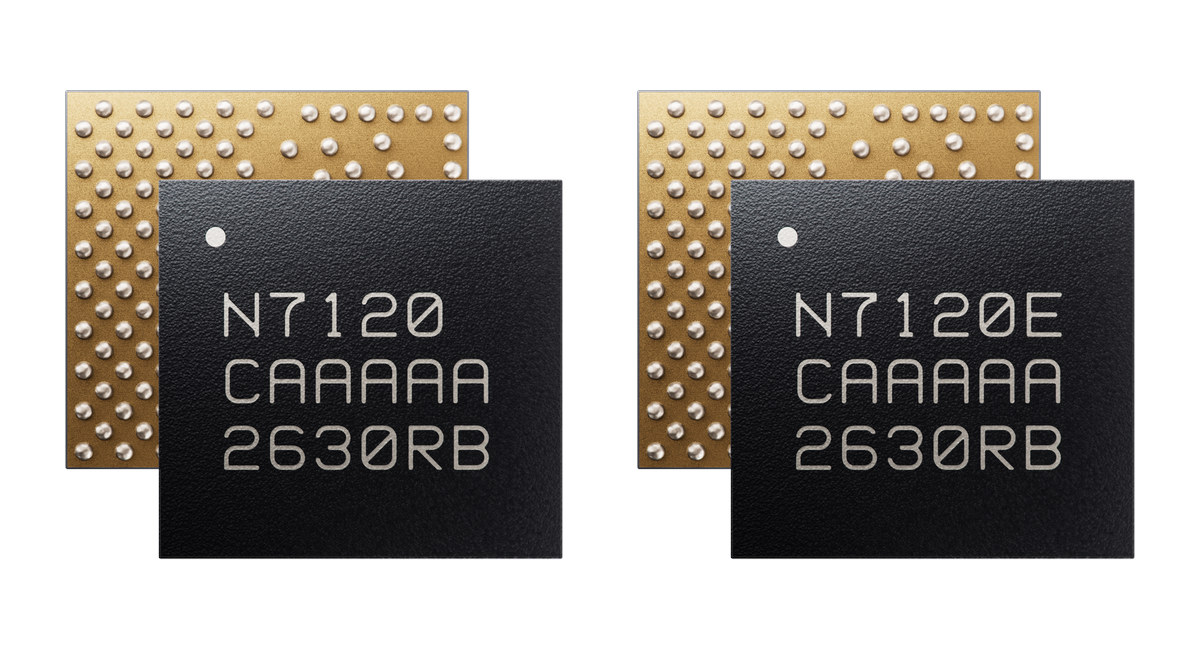
Nordic nRF7120 and nRF7120E
Nordic Semiconductor nRF7120 and nRF7120E Specifications:
- Processor and Memory:
- Main CPU: Arm Cortex-M33 processor operating at up to 256 MHz.
- RISC-V Coprocessor: Up to 256 MHz, with SoftPeripherals support for CAN 2.0B and SDIO.
- RAM: 1 MB of user-accessible, low-leakage on-chip RAM.
- Non-Volatile Memory: 4 MB of integrated NVM.
- AI Acceleration: Integrated Axon NPU (nRF7120E only).
- Wireless Connectivity:
- Wi-Fi:
- Wi-Fi 6 (IEEE 802.11ax) with backward compatibility for 802.11a/b/g/n/ac.
- nRF7120: Dual-band operation at 2.4 GHz and 5 GHz.
- nRF7120E: Tri-band Wi-Fi 6E connectivity at 2.4 GHz, 5 GHz, and 6 GHz.
- Supported operating modes: Station (STA) and Software Access Point (SoftAP).
- Power-saving features include Target Wake Time (TWT) and a low-power receiver.
- Maximum Wi-Fi transmit power: +22 dBm.
- Wi-Fi:
- Bluetooth and Multiprotocol Radio:
-
- Integrated multiprotocol radio supporting Bluetooth Low Energy (BLE) and Thread.
- BLE transmit power: +10 dBm.
- BLE receiver sensitivity: −99 dBm.
- Integrated NFC tag functionality.
-
- USB and Peripheral Interfaces:
- High-speed USB interface with an integrated PHY.
- Up to 65 configurable GPIOs.
- 2× high-speed MSPI interfaces operating at up to 64 MHz.
- 2× high-speed SPI interfaces operating at up to 64 MHz.
- High-speed UART supporting data rates up to 4 Mbps.
- 6× configurable SPI/TWI/UART interfaces operating at up to 8 MHz.
- Additional interfaces and peripherals:
- ADC (Analog-to-Digital Converter)
- TDM (Time-Division Multiplexing)
- PDM (Pulse-Density Modulation)
- PWM (Pulse-Width Modulation)
- QDEC (Quadrature Decoder)
- Security Features:
- Arm TrustZone-based hardware isolation.
- Integrated tamper detection.
- CRACEN hardware cryptographic accelerator.
- Designed to meet PSA Certified Level 3 requirements.
- Electrical and Environmental Specifications:
- Operating Voltage: 2.8–5.5 V.
- Average Connected Current (DTIM 10):
- 14 µA at 2.4 GHz.
- 8 µA at 5 GHz.
- Package: Wafer-Level Chip-Scale Package (WLCSP), measuring 4.9 × 4.6 mm
- Operating Temperature: −40°C to +85°C
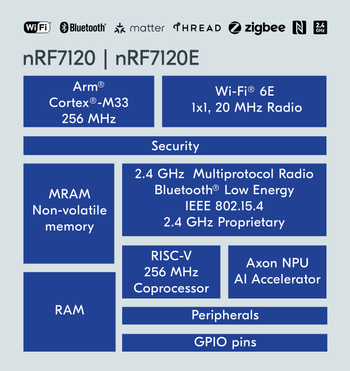
nRF7120 and nRF7120E simplified block diagram
Both the nRF7120 and nRF7120E are fully supported by the nRF Connect SDK. The Axon Neural Processing Unit (NPU) in the nRF7120E allows a 10-17x boost in performance when running machine learning models when compared to the 256 MHz Arm Cortex-M33 alone. A 14 x 10 module version of the nRF7120 is currently under development. There is also a nRF7120 Development Kit (nRF7120-DK). Some information can be found on the Nordic site to help get started with development.
Further information about the nRF7120, nRF7120E and module can be found on their individual product pages. These parts are currently being sampled to selected customers. No information has been given regarding pricing or general availability. For more information please see the product page and press release.
Images used courtesy of Nordic Semiconductor.


