
Single Pair Ethernet: One Twisted Pair, Full Ethernet Performance
Conventional Ethernet cabling contains four twisted pairs, but not every standard uses all four. 10BASE-T and 100BASE-TX use only two pairs: one for transmit and one for receive.
Conventional Ethernet cabling contains four twisted pairs, but not every standard uses all four. 10BASE-T and 100BASE-TX use only two pairs: one for transmit and one for receive. 1000BASE-T is the exception: it uses all four pairs, with each pair carrying traffic in both directions simultaneously.
What Single Pair Ethernet Actually Changes
Single Pair Ethernet (SPE) works differently. Several IEEE 802.3 amendments standardize SPE, including 802.3bw (100BASE-T1), 802.3bp (1000BASE-T1), and 802.3cg (10BASE-T1L and 10BASE-T1S). SPE replaces the four-pair bundle with a single differential pair. That single pair carries full-duplex traffic in both directions simultaneously.
This is possible because SPE transceivers use echo cancellation and hybrid circuits. These circuits separate the transmitted signal from the received signal on the same wire pair. The technique comes from full-duplex DSL and automotive networking.
The result is a much thinner, lighter, and cheaper cable harness. A single small-diameter pair can replace a four-pair cable bundle. This matters greatly in weight-sensitive applications, such as aircraft and electric vehicles. It also matters in space-constrained applications, such as factory sensor networks.
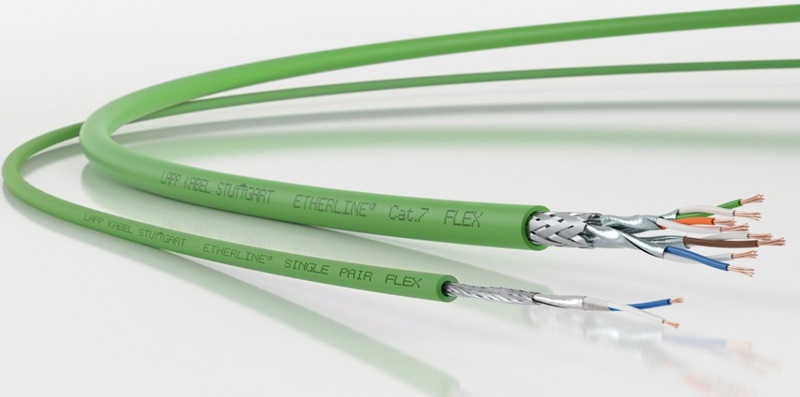
Figure 1. A single-pair SPE cable replaces the four-pair bundle of conventional Ethernet, trimming diameter and weight. Image used courtesy of LAPP
Key Variants and Their Reach
SPE is not a single specification. It is a family of specifications. Each variant balances reach and speed differently.
10BASE-T1L (802.3cg) delivers 10 Mbps over distances up to 1,000 meters. This makes it well suited for process industry field instrumentation, where sensors often sit far from a control cabinet.
10BASE-T1S (802.3cg) targets a different use case: short, multidrop links. It supports links up to 25 meters, shared among multiple nodes without a switch, using Physical Layer Collision Avoidance (PLCA). PLCA lets many devices share one pair deterministically. This is similar in spirit to older multidrop fieldbuses, but it runs native Ethernet frames.
100BASE-T1 (802.3bw) and 1000BASE-T1 (802.3bp) target higher speeds: 100 Mbps and 1 Gbps, respectively. Their reach is shorter, typically 15 meters for a 1000BASE-T1 point-to-point link. These two variants are the most widely adopted in automotive in-vehicle networks. They connect cameras, radar, and infotainment backbones.
Table 1. Comparison of the four IEEE 802.3 Single Pair Ethernet variants by data rate, maximum reach, topology, and typical application.
| Variant | IEEE Standard | Data Rate | Max Reach | Topology | Typical Application |
| 10BASE-T1L | 802.3cg | 10 Mbps | 1,000 m | Point-to-point | Process industry field instrumentation |
| 10BASE-T1S | 802.3cg | 10 Mbps | 25 m | Multidrop (PLCA) | Short-reach sensor and actuator networks |
| 100BASE-T1 | 802.3bw | 100 Mbps | 15 m | Point-to-point | Automotive in-vehicle networks |
| 1000BASE-T1 | 802.3bp | 1 Gbps | 15 m | Point-to-point | Automotive cameras, radar, infotainment backbones |
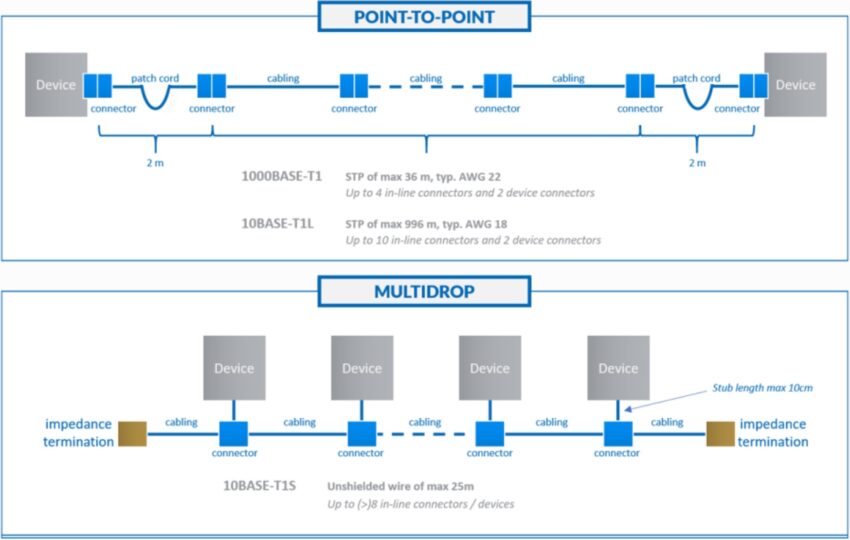
Figure 2. A simple topology diagram showing a 10BASE-T1S multidrop bus next to a 1000BASE-T1 point-to-point link. Image used courtesy of SPE Industrial Partner Network
Power and Connectors: Making It a Complete System
SPE matters for more than signaling. It pairs naturally with Power over Data Line (PoDL), defined in IEEE 802.3bu. PoDL delivers DC power over the same pair that carries the Ethernet signal.
This means a remote sensor, actuator, or camera can receive both data and power through a single thin cable. It eliminates the need for separate power wiring or a local battery. PoDL defines several power classes. These classes set voltage and power tiers up to around 50 W, depending on cable length and conductor gauge. Designers can size the link for applications ranging from a small proximity sensor to a PTZ camera.
Connectors have also been standardized specifically for SPE, rather than reusing RJ45. IEC 63171-6 defines a compact, keyed connector family for industrial SPE deployments. Automotive applications typically use sealed, vibration-rated connectors instead, suited to under-hood or chassis environments. Both connector types are deliberately smaller than RJ45, supporting the density and space savings that motivate SPE in the first place.
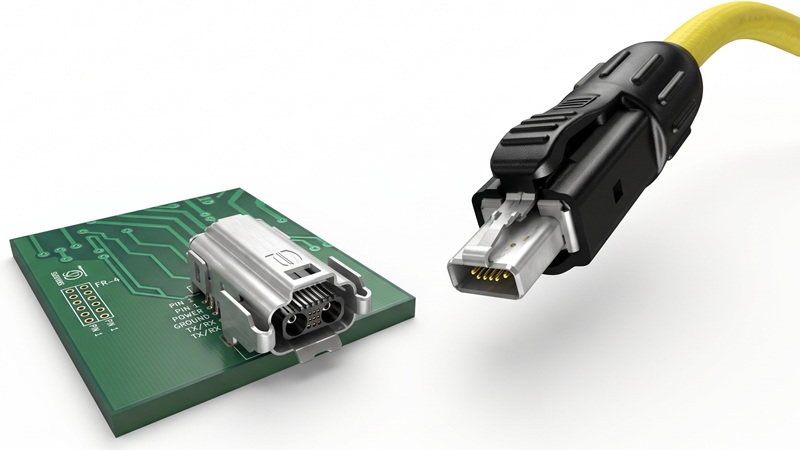
Figure 3. A HARTING T1 Industrial connector—one of the compact, keyed designs standardized under IEC 63171-6 for SPE deployments. Image used courtesy of Mouser
Where This Matters for New Designs
For an engineer encountering SPE for the first time, the key takeaway is simple. SPE extends Ethernet down to the sensor and actuator level. That includes the same IP stack and the same diagnostic tools used elsewhere on the network. Fieldbuses and proprietary point-to-point links have traditionally dominated at this level.
This convergence is the real driver behind SPE’s growth. It is growing in automotive zonal architectures and in Industry 4.0 sensor networks. In both cases, a single Ethernet-based infrastructure is replacing a patchwork of legacy protocols. That infrastructure carries both control data and diagnostic telemetry back to a central system.


