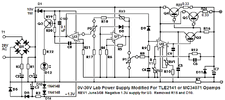
It is a very simple circuit. Tell us which version you made and the problem you have with it and we will tell you the voltages that should be measured and what might cause your problem.Hey umm does anyone that has a working supply did a voltage table for the nodes on the circuit? It would be of great help. Thanks in advance
Check that the -5.6V supply is actually -5.6V.I made the version that is in the page http://www.electronics-lab.com/projects/power/003/. My problem is that the LED is always 'on', and the output voltage steadily declines. The only component taht gets a bit hot is the transistor 2n2219 (Q2) after having it connected 1 minute. The circuit doesn't respond to any of the potentiometers or the trimmer. The rectified/filtered voltage is 36V DC.
Sorry that's my fault I missed those 2 values I can see that they should be 2K2 and 82R, Thanks for pointing that out, I will recheck the rest of the values,PicMaster, How come R1 and R2 in your sketch have signifcantly different values than the revised parts list?
Thanks for that I did spot that one, This has now been corrected, Aslo ZD3 has been reomved has it is not needed,PicMaster, You have other mistakes on your board. R12 and R11 form a voltage divider. Your board seems to have errors in this area.

D7 is a 5.6V zener diode. Its voltage should be -5.6V so maybe you installed it backwards and maybe D5 and D6 are installed backwards.Hey. Ive been trying to fix the circuit. The problem now is that the output voltage is steady at -0.5V!!! The good news is that the current limitng LED is now off... Voltage of D7 is -0.7V
U2 will not work properly without a -5.6V supply. The output from U2 should go from about +1V to about +32V in your circuit.voltage of U2(out) is zero
It is low because your 24VAC transformer voltage is too low.u3 is 32V
The output of U1 should be +11.2V (the 5.6V from D8 times a gain of two). R4 should be changed to 1k.u1 is 8.3, D8 is at -5.6V.
Then throw them away and use good diodes that are very inexpensive.So Im not sure of their code.
The original is 0R47 5W. Your's (fixed 3A version) is also 0R47, but 10W.The original circuit with 0.47 ohms had a max current of about 4.1A which is too much for most of the parts.
With 0.54 ohms the max current before calibrating will be about 3.5A before calibrating.
The original circuit had many parts overloaded. For example its current was not calibrated so when set to max it was typically 4.1A (it could be higher if you have parts on the wrong side of their tolerance). So the poor little 0.47 ohm/5W resistor was dissipating 7.9W and was almost incandescent. If the current was calibrated for 3A max then the 5W resistor dissipated 4.23W and was still extremely hot.The original is 0R47 5W. Your's (fixed 3A version) is also 0R47, but 10W.
Do you think two 0R27 10W in series is still too little and risky?