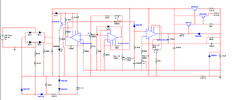
0-30V Stabilized Power Supply

Status
Not open for further replies.

audioguru2

Apr 6, 2004
12,026
Joined
Apr 6, 2004
Messages
12,026
Question said:
Just tried a 12V motor, which was used in a rechargeable mini vacuum cleaner as a load. That is strange, it uses about 0,5V, no matter if voltage potentiometer is on MIN or MAX, but the speed is changed, when the higher current is set with P2. At the half value of P2 the current rises to 5A and higher (I do not set current pot to the maximum). Just do not know, what is the best to use as a load...
The project can regulate the voltage if the current pot is set to a higher current than the current that is used, or it can regulate the current (by reducing the voltage). It cannot regulate voltage and current at the same time.
Its MAXIMUM output current is supposed to be only 3.0A, and when the current pot is at half then the MAXIMUM current is supposed to be 1.50A, not 5A.
 

audioguru2

Apr 6, 2004
12,026
Joined
Apr 6, 2004
Messages
12,026
Question said:
In what range RV3 should change the current?
Maybe from 1.0A to 5.0A. Adjust it for 3.0A maximum when the current pot is at maximum and there is a heavy load or a shorted output.

You mentioned, that the maximum capable output currrent is 3A. By what (components, or maybe a part of circuit) and how it is limited to this value?
When the output voltage is low or shorted and the output current is 3.0A then the driver and output transistors get extremely hot. R7 (0.47 ohms) senses the output current and feeds it to one input of U3. The other input of U3 is the current pot voltage. Then U3 is a comparator and it reduces the output voltage through D9 until the output current is what is set on the current pot.

WILL the circuit will be damaged, if I try to get more than 3A from it?
Yes.
The driver and output transistors might be destroyed.
 

audioguru2

Apr 6, 2004
12,026
Joined
Apr 6, 2004
Messages
12,026
Question said:
1) How do you measure maximum current? Just connect ampermeter to output? During that the voltage out be set to maximum?
An ammeter has resistance so when it is connected in series with a load then it reduces the voltage to the load a little.
Then the current in the load is reduced a little.
Connect an accurate low value power resistor to the output then measure the voltage across it and use Ohm's Law to caculate the max current and adjust the current calibration trimpot for 3.0A.

2) When the output is shorted and the current is 3A, in all cases (output voltage is lowest; highest) the driver transistor stays cool, is does not even warm. Furthermore, output transistors does not get extremely hot, only warm. Hotter gets only R7 (0,47Ohm 10W), R1 (2,2kOhm 2W), R2 (82 Ohm 2W).
Heating of a transistor or resistor is caused by the current in it times the voltage across it. The driver and output transistors are emitter-followers so their heating is the most when the voltage across them is the most (at 3A output) which is when the output voltage is very low or is shorted.
When the output current is 3A and the output is shorted then the output transistors have about 36V across them and their total heating is 36V x 3A= 108W (54W each). The driver transistor has a maximum current of 64mA and a voltage of about 35V across it then its heating is 35V x 64mA= 2.3W. That is why 2 output transistors are used and a REAL BD139 power transistor is used for the driver.
 
Last edited by a moderator:
N

Nadir

Jan 1, 1970
0
Sorry to be that guy.  I have tried reading back through most of the thread, is this the latest and greatest design for the legendary 0-30V power supply?

http://www.electronics-lab.com/forum/index.php?topic=19066.msg1010703#msg1010703

I just want to be absolutely sure before starting a build.  Given the popularity of this project and it's placement in the google search results, would it be possible to post it as a sticky/mod announcement at the top of the forum?  Or you know, give it its own project page on the main site?  (or is it already there?) Would probably cut down on dolts like me asking about where to find the schematic.

Thank-you everyone who has contributed so far.


audioguru2

Apr 6, 2004
12,026
Joined
Apr 6, 2004
Messages
12,026
Yes that is my latest schematic and parts list.
I designed the fixes and would have posted it as a project but I have never made it because I do not need it.
Somebody who has made it and tested it should post it as a project.


audioguru2

Apr 6, 2004
12,026
Joined
Apr 6, 2004
Messages
12,026
Question said:
Hello, I still don't get how and when to set up MIN, MAX voltage value and MAX current value  :(
For example, I have a water heater as a load, which have a rating of 220V, 700W and I measured resistance of it, it is 71 Ohm. What should be the readings of voltmeter and ammeter, when this load is connected to the power supply output and voltage and current pots are set to maximum? They should show 30V and 3A ?
Ohm's Law says that  the current in 71 ohms when it has 30V across it is (30V/71 ohms=) 0.4225A.
For a current of 3A then the 71 ohms needs (3A x 71 ohms=) 213V across it.

If you want 30V and 3A then the load must be (30V/3A=) 10 ohms.

Ohm's Law uses simple arithmatic.
 

audioguru2

Apr 6, 2004
12,026
Joined
Apr 6, 2004
Messages
12,026
Question said:
Hi, C7 capacitor should be changed to film capacitor with a resistor in parallel. What would be the best values for them?
Use 10uF for a film capacitor for C7 with a 4.7k/0.5W resistor in parallel.
 
N

nida

Jan 1, 1970
0
Hello. I tried making this power supply circuit on Multisim 12. When I simulate it, the C2 capacitor with value 47uF/50V gets burned.
Also I am getting only 12V at the output and the voltage is not varying when I connect the pin4 of U1(op-amp) with 2 1N4148 series diodes.
But when I give -1.3V at the pin4 then I dont get any output and simulation error arises. 
I am posting my schematic as well.
Please help. Thank You.

0-30V.png


audioguru2

Apr 6, 2004
12,026
Joined
Apr 6, 2004
Messages
12,026
nida said:
Hello. I tried making this power supply circuit on Multisim 12. When I simulate it, the C2 capacitor with value 47uF/50V gets burned.
Also I am getting only 12V at the output and the voltage is not varying when I connect the pin4 of U1(op-amp) with 2 1N4148 series diodes.
But when I give -1.3V at the pin4 then I dont get any output and simulation error arises. 
I am posting my schematic as well.
I think Multisim did not learn about electronic circuits properly. It does not know about the extremely simple negative supply source so you had to add a 1.3V battery in series with it.
It does not have a model of the modern TLE2141 opamps.

A little capacitor (C2) cannot burn and it will not even get warm with 50Hz half-wave at a low current.

Your schematic has one wire of the AC input shorted to the output 0V (the ground). The 28VAC secondary winding of the transformer MUST NOT be connected to ground! Maybe that is why the circuit does not work properly.
 
N

nida

Jan 1, 1970
0
Hello,I have checked the circuit with and without ground the 28VAC power source but it  gives the same results so ground does not makes any difference.

External Negative 1.3V supply is necessary for U3? If it is necessary so  Why it is?

What is the modern model of TLE2141?

Which software is better for the simulation of this circuit?


audioguru2

Apr 6, 2004
12,026
Joined
Apr 6, 2004
Messages
12,026
nida said:
Hello,I have checked the circuit with and without ground the 28VAC power source but it  gives the same results so ground does not makes any difference.
It makes a HUGE difference.
Without the ground at the 28VAC then the full-wave rectifier works properly and the negative supply works properly.
With the ground then the rectifier is half-wave and the negative supply does not work.

External Negative 1.3V supply is necessary for U3? If it is necessary so  Why it is?
Yes it is necessary for the U3 current regulator to cause the output voltage to go to zero volts when the current is high and the output is shorted. For the output to be zero volts then the output of U3 must go a diode drop (D9) negative.
Without the negative supply, when the output is shorted then there is nothing to limit the current and many parts will burn.

Remove the ground at the 28VAC and remove the 1.3V battery.

What is the modern model of TLE2141?
Texas Instruments make the TLE2141. Get the simulation model of it from them.

Which software is better for the simulation of this circuit?
I haver never simulated this project. If I did then I would use the LTspiceIV program that is free from Linear Technology and Yahoo has a user group that provides help and models.
 
Last edited by a moderator:

sobol

Dec 7, 2012
8
Joined
Dec 7, 2012
Messages
8
So, I have built that power supply, but after test run i've found what follows:

P1 (voltage control pot) - without a load on the output i've got 7mV to 5V, and at maximum pot position current limiting turns on (while P2 is on the maximum, while less, current limiting is constantly turned on and output voltage is about -200mV).
U1 gets too hot in my opinion - after 10 minutes of test run it was about 80-90 celsius degrees.

Any ideas what could be wrong?


audioguru2

Apr 6, 2004
12,026
Joined
Apr 6, 2004
Messages
12,026
sobol said:
So, I have built that power supply
Which version? The original, a modified one or the latest modification?
Which transformer? 24VAC, 28VAC or 30VAC?
Which opamps? TL081, MC34071 or TLE2141?

P1 (voltage control pot) - without a load on the output i've got 7mV to 5V
The output should be able to go from calibrated 0V to calibrated 30.0V.
Measure the output voltage of U1. It should be about 11.2V. The output amplifier has a calibrated gain of 2.68 times to make the output 30.0V max.

at maximum voltage pot position, current limiting turns on (while P2 is on the maximum, while less, current limiting is constantly turned on and output voltage is about -200mV).
Your current regulator U3 is not working correctly. Its output should be high (so that D9 cannot reduce the output voltage and does not turn on the LED) until the load current in R7 causes as voltage drop that is more than the amount of voltage set by P2. 

U1 gets too hot in my opinion - after 10 minutes of test run it was about 80-90 celsius degrees.
If you used DIP 14 pins case opamps then their maximum allowed dissipation is 1000mW when the anbient is 25 degrees C.
The MC34071 will dissipate a maximum of 302mW and the TLE2141 will dissipate a max of 470mW. Not too hot.
 

sobol

Dec 7, 2012
8
Joined
Dec 7, 2012
Messages
8
audioguru said:
Which version? The original, a modified one or the latest modification?
Which transformer? 24VAC, 28VAC or 30VAC?
Which opamps? TL081, MC34071 or TLE2141?
Version from the first post (latest i believe), 28VAC transformer, TLE2141 opamps.

The output should be able to go from calibrated 0V to calibrated 30.0V.
Measure the output voltage of U1. It should be about 11.2V. The output amplifier has a calibrated gain of 2.68 times to make the output 30.0V max.
I'll check it tomorrow and i'll post measurements.

Your current regulator U3 is not working correctly. Its output should be high (so that D9 cannot reduce the output voltage and does not turn on the LED) until the load current in R7 causes as voltage drop that is more than the amount of voltage set by P2. 
I'll focus on the U3 neighbourhood, maybe I will find a mistake.

If you used DIP 14 pins case opamps then their maximum allowed dissipation is 1000mW when the anbient is 25 degrees C.
The MC34071 will dissipate a maximum of 302mW and the TLE2141 will dissipate a max of 470mW. Not too hot.
If its ok, i'm ok too. : D
 

audioguru2

Apr 6, 2004
12,026
Joined
Apr 6, 2004
Messages
12,026
If you made the circuit on a solderless breadboard then the opamps are probably oscillating which makes them maqlfunction and get hot.


sobol

Dec 7, 2012
8
Joined
Dec 7, 2012
Messages
8
Power supply is soldered on normal PCB.
OK, I've made some measurements, look at the result:

U1 pin 6 (output) - 11.2V.
U3 pin 3 - varies from 0 to 1.3V, depends on P2 position.
10V zener diode works properly, there is 29V on emitter of Q3 while current limiter works, and 29V on pin 7 of U3.
U3 pin 6 - 29V while current limiting off, -1V while current limiting on.

And still power supply does not work properly. Any ideas? Can't see any bad soldering or something like that.


audioguru2

Apr 6, 2004
12,026
Joined
Apr 6, 2004
Messages
12,026
R7 is 0.47 0hms and is in series with the load. Load current causes a voltage drop across R7. 3A x 0.47 ohms= 1.41V. With a low load current then the voltage across R7 is very low.
The voltage across R7 is fed to pin 2 input of U3.

U3 is used as a comparator. Normally its output is high so the LED is turned off and D9 does not reduce the output voltage.
When the voltage across R7 exceeds the voltage of P2 then the output of U3 goes low enough to reduce the output voltage so that the load current is reduced to the setting of P2.

Your U3 is not detecting the voltage across R7, it acts like an on-off switch. Maybe R7 is the wrong value or is connected wrong.

What is the part number of your opamps?


sobol

Dec 7, 2012
8
Joined
Dec 7, 2012
Messages
8
audioguru said:
R7 is 0.47 0hms and is in series with the load. Load current causes a voltage drop across R7. 3A x 0.47 ohms= 1.41V. With a low load current then the voltage across R7 is very low.
The voltage across R7 is fed to pin 2 input of U3.

U3 is used as a comparator. Normally its output is high so the LED is turned off and D9 does not reduce the output voltage.
When the voltage across R7 exceeds the voltage of P2 then the output of U3 goes low enough to reduce the output voltage so that the load current is reduced to the setting of P2.

Your U3 is not detecting the voltage across R7, it acts like an on-off switch. Maybe R7 is the wrong value or is connected wrong.

What is the part number of your opamps?
TLE2141IP opamps.

So...
R7 looks good to me, its 0,47ohm, 10W resistor, connected from the GND "cross" on the pcb to the output GND pad.
I've checked this U3 and it works in weird way. As i wrote before, voltage on the 3rd pin of U3 changes from 0 to 1,3V depending on P2 position. BUT on the 2nd pin of U3 is 20mV to 30mV (depends on P1 position), and at 30mV current limiting turns on(while P2 sets 1,3V on pin 3). That 2nd pin voltage was measured between "Cross" ground and 2nd pin. It should work as comparator, but it's not, and I don't have any idea why.
 
Status
Not open for further replies.
Top