
Nordic’s nRF71 Series Puts Wi-Fi and Edge AI on One Chip
Sampling now: the first two parts pair dual- or tri-band Wi-Fi 6 with Bluetooth LE and Thread, and cut standby draw by up to 20 times compared with the nRF70 family.
Nordic Semiconductor has unveiled the nRF71 Series, a family of systems-on-chip (SoCs) that folds Wi-Fi, Bluetooth LE, Thread, and edge AI into a single package built for battery-powered products. The company says standby power falls by up to 20 times compared with its current nRF70 Series Wi-Fi devices. That matters, because Wi-Fi has long been the radio that battery-bound designers loved to avoid. The first two members, the nRF7120 and nRF7120E, are now sampling with selected customers.
Two Radios Working in Parallel
Rather than time-slicing one radio between protocols, the nRF71 Series carries two independent radios, each with its own RF and processing blocks. One is a Wi-Fi radio; the other is the 2.4 GHz multiprotocol radio borrowed from Nordic’s latest nRF54 Series SoCs. Both can receive at the same moment, so a device can hold its Wi-Fi link to the cloud while still listening for Bluetooth LE or Thread traffic, and neither protocol waits on the other.
The nRF7120 offers dual-band Wi-Fi 6 at 2.4 and 5 GHz, while the nRF7120E extends that to tri-band Wi-Fi 6E. Both share a 256 MHz Arm Cortex-M33 application processor, a RISC-V coprocessor, 4 MB of non-volatile memory, and 1 MB of RAM, which leaves room for the Wi-Fi stack, Matter, and the application itself without external memory or a separate host MCU. Nordic quotes Wi-Fi connected-standby currents of 14 µA at 2.4 GHz and 8 µA at 5 GHz (DTIM10, 3.6 V), with sleep modes running from 1.44 µA to 4.68 µA. Target Wake Time support helps keep that connection cheap. Security also gets attention: TrustZone isolation, tamper detection, and a cryptographic engine designed for PSA Certified Level 3. Everything arrives in a 4.9 × 4.6 mm WLCSP with up to 65 GPIOs, and the two parts are pin-to-pin compatible.
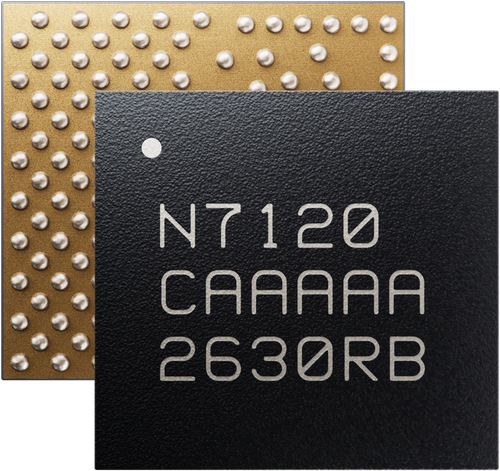
Top and bottom views of the nRF7120 WLCSP, which packs up to 65 GPIOs into a footprint under 5 mm per side. Image used courtesy of Nordic Semiconductor
Inference Without an Added Processor
The nRF7120E is where the edge AI story lives. It adds the Axon Neural Processing Unit (NPU), which runs machine learning models 10 to 17 times faster than the Cortex-M33 can manage alone. Keyword spotting, anomaly detection, and image classification all become practical on a battery budget, with no external AI processor and fewer components on the board. Developers who prefer to skip the NPU can use Nordic’s Neuton software to build ultra-small models from their own data and run them on the processor. Model updates can then travel over the air through nRF Cloud.
Software and Availability
Development stays within the nRF Connect SDK, the same toolchain used for the nRF54 and nRF70 Series, so teams already fluent in Nordic’s ecosystem don’t need to relearn their workflow. Interested developers can contact a local Nordic sales representative about availability, and the company will show the series, including a Nordic-branded module, at Electronica in Hall C6, booth 159.
All told, the nRF71 Series looks like a tidy answer to an old trade-off: connectivity, intelligence, and endurance—no longer pick two. Battery-powered smart home hubs, Matter bridges, and Thread border routers could run all three wireless protocols from one part, as could smart locks, security panels, wearables, and industrial sensors. Add on-device inference, and those products can decide locally, speak to any network, and still sip power for years.


