
Littelfuse Debuts Ultra-Compact Surface-Mount Half-Pitch DIP Switches
The new TDB series offers a 1.27 mm half-pitch, surface-mount DIP switch solution with gold-plated contacts and a washable sealing, optimized for high-density PCB designs.
The evolution of industrial and consumer electronics continues toward miniaturization, placing increased pressure on the available space within PCB layouts. When design engineers require manual configuration or hardware addressing, the physical footprint of the interface components can become a limiting factor. The recently introduced Littelfuse/C&K TDB series addresses these constraints by providing an ultra-miniature, half-pitch surface-mount DIP switch family designed for high-density applications.
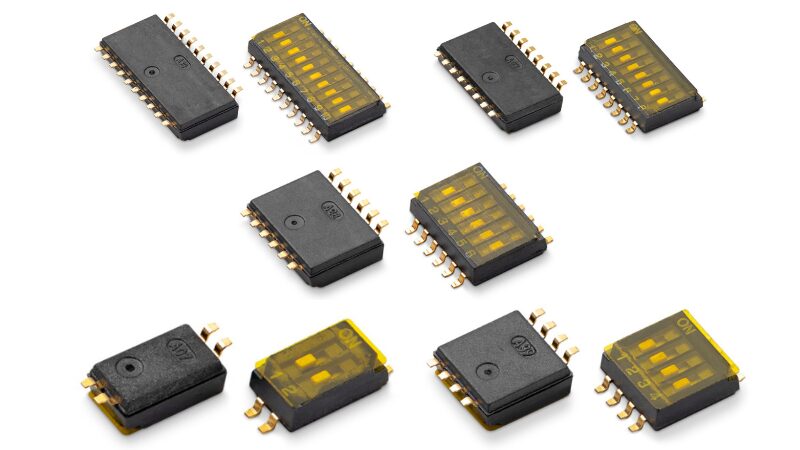
Littelfuse/C&K’s TDB series ultra-miniature half-pitch surface-mount DIP switches. Image used courtesy of Littelfuse
Ultra-Miniature Surface Mount Half-Pitch DIP Switches
The TDB series transitions from the traditional 2.54 mm pitch to a 1.27 mm (0.050 inch) half-pitch design. This reduction in lead spacing reduces the overall board footprint, enabling more compact placement of configuration switches alongside other high-density surface-mount components. The series is available in several configurations, ranging from two to ten positions. For example, the two-position variant measures approximately 3.67 mm, while the ten-position version extends to 13.83 mm. This range of sizes enables engineers to select the specific number of poles required for a given logic or addressing task without over-allocating board area.
Electrical Integrity and Contact Material
Reliability in the TDB series switches is ensured by gold-plated bifurcated contacts. This contact geometry is chosen to ensure stable, low-resistance signal integrity throughout the component’s life. Electrically, the switches are rated for a steady-state current of 100 mA at 50 V DC, while the switching rating is specified at 25 mA at 24 V DC.
The mechanical and electrical life of the series is rated at 1,000 cycles, providing sufficient durability for configuration settings that are adjusted during initial setup or periodic maintenance. The contact resistance is kept low, with a maximum initial value of 100 mΩ. Furthermore, the insulation resistance is rated at 100 MΩ minimum at 500 V DC, ensuring proper isolation between adjacent circuits. The switches operate across a wide temperature range from -40°C to 85°C, making them suitable for environments with varying thermal demands.
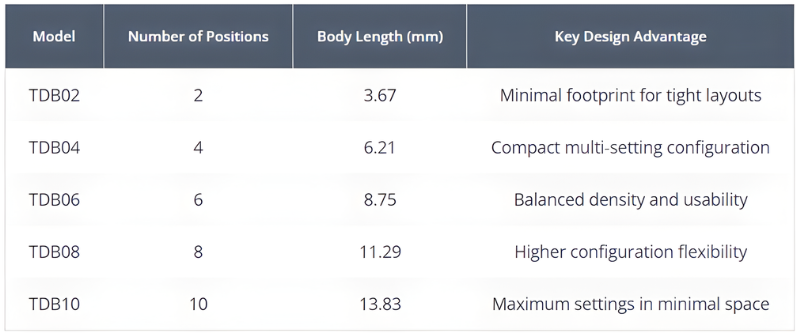
TDB series model options, available in 2, 4, 6, 8, and 10-position variants. Image used courtesy of Littelfuse
Manufacturing and Process Compatibility
To support high-volume automated assembly, Littelfuse has engineered the TDB series to be compatible with standard surface-mount soldering processes. The base and cover are constructed from high-temperature thermoplastic (PPS), which withstands the thermal profiles associated with reflow soldering. The components are provided in either tube or tape-and-reel packaging, facilitating integration into pick-and-place machinery.
A key feature for manufacturing yield is the top-tape sealed construction. This seal protects the internal contact mechanisms during the soldering process and facilitates post-reflow aqueous cleaning. By allowing the switches to be washed along with the rest of the assembly, the design eliminates the need for manual cleaning or secondary assembly steps that could introduce contaminants into the contact area. This “washable” designation is a critical requirement for maintaining the long-term reliability of gold-plated contacts in industrial environments.
High Density, Space-Constrained Designs
The TDB series provides a solution for designers who must balance the need for manual configuration with the realities of shrinking board space. By leveraging a half-pitch footprint and gold-plated contacts, the series maintains electrical performance while optimizing PCB density. These switches are well-suited for industrial control equipment, power supplies, inverter systems, and security or fire alarm modules. Additionally, the switches are effective in building automation, smoke detection systems, and consumer IoT applications where compact, reliable, and process-compatible switches are necessary for hardware addressing and system setup.


