
From Hearing to Understanding: MEMS Microphones as a Foundation of Robotic Perception
Explore how high-SNR MEMS arrays and beamforming enable human-like spatial perception in complex acoustic environments.
As robotics and AI continue to converge, the ability of robots to accurately perceive and interpret their acoustic environment becomes increasingly critical. High-performance MEMS (Micro-Electro-Mechanical Systems) microphones serve as the auditory foundation for advanced human-robot interaction, enabling machines to not just hear, but truly understand their surroundings.
Humanoid robots and robotic systems continue to become more integrated into our daily lives. From service robots in healthcare to collaborative robots in manufacturing, their ability to accurately capture and process sound directly impacts their functionality and user experience. On top of spatial audio perception, hearing is increasingly seen as a safety-critical feature.
However, as robots leave structured environments, acoustic conditions become more complex: reverberation, overlapping conversations, machinery noise, and unpredictable background sounds. High-performance microphones and microphone arrays are the foundation for enabling robots to operate reliably in these real-world acoustic landscapes.

With improved microphone arrays, robots will be able to identify individual speakers and focus on a single conversation
As we’ll discuss, MEMS microphones with high SNR, wide bandwidth, and low distortion can play a key role in enabling natural human-machine interactions (HMI). These microphones can serve as the auditory foundation for advanced human-robot interaction, enabling machines not just to hear but to truly understand their surroundings.
Why Robotics Needs High Quality Audio
The integration of AI into robotic platforms has elevated audio capture from a peripheral function to a core system requirement. The shift from keyword-based command recognition to context-aware conversational AI places stringent new demands on MEMS microphone performance: accurately reproducing not only speech content, but the fine acoustic detail that encodes meaning, emotion, intent, and biometric identity.
With AI becoming increasingly integrated into robotic systems, the quality of audio input provided by MEMS microphones has never been more important. The evolution from simple voice command recognition to conversational AI requires microphones that can capture not just words, but the subtle acoustic details that convey meaning, emotion, and intent.
AI relies on the audio data it receives to understand and interact with humans. The clearer the audio, the better AI can understand us and our environment. This is particularly critical as humanoid robots are expected to interact naturally with humans in complex, real-world situations where acoustic conditions are far from ideal.
Our human auditory system enables us to localize sounds in a 360° environment, identify speakers, and focus on a single conversation in the presence of surrounding noise. To equip humanoids and other robotic systems with similar capabilities in terms of audio perception, high-performance microphones are needed.
One of the most critical specifications for MEMS microphones is the Signal-to-Noise Ratio (SNR). SNR measures a microphone’s ability to distinguish desired sounds—such as human speech, and more subtle audio cues—from its self-noise.
In robotic systems, high SNR microphones are essential for:
- Advanced speech recognition: Enabling robots to understand commands even in the far field.
- Natural human-robot interaction: Capturing the nuances of human communication.
- Speaker differentiation: Allowing AI to more easily tell the difference between different speakers, reducing misunderstandings, and improving the quality of interactions.
- Speaker identification and authorization: Ensuring the AI performs sensitive commands only for authorized speakers (e.g., shopping, payments, security controls).
Although current MEMS microphones have not yet matched the signal-to-noise ratio of the human ear, they are a vital technology that enables AI-driven human-machine interaction. Better audio input is essential for making HMI suitable for everyday use. High SNR audio improves voice biometrics and anti-spoofing capabilities, minimizing false acceptances and rejections in noisy real-world settings, at a distance, and in challenging acoustic environments.
Multi-Microphone Arrays: Enabling Human-Like Acoustic Orientation
To provide humanoids with the same level of acoustic understanding as humans, single-microphone solutions are insufficient. Just as humans use two ears to localize sound sources and focus on specific speakers in noisy environments, humanoid robots require multi-microphone arrays to achieve comparable environmental understanding. This spatial awareness underpins safe navigation, natural interaction, and situational understanding.
Value of Beamforming in Robotics Applications
Multi-microphone arrays allow robotic systems to apply beamforming algorithms that spatially filter audio, enhancing target sounds while suppressing noise and interference. Following initial keyword detection via omnidirectional capture, adaptive beamforming enables:
- Precise speaker and sound source localization: Pinpointing the origin of speech or acoustic events in three-dimensional space.
- Focused listening: Steering directional listening beams toward the target speaker while attenuating competing sound sources.
- Enhanced situational awareness: Building a real-time spatial map of the acoustic environment—critical for safe, context-aware human-robot interaction.
A Platform for Evaluating MEMS Microphone Arrays
Platforms such as Infineon’s XENSIV™ Audio Shield simplify the evaluation of array geometries and enable developers to prototype beamforming and localization algorithms early in the design cycle.
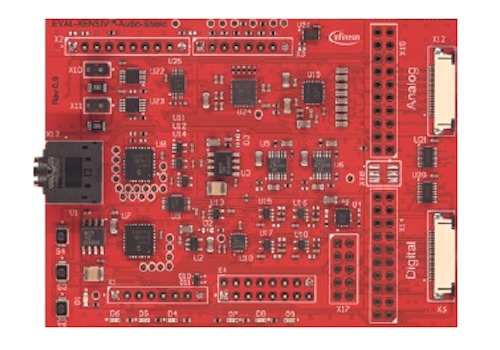
Top view of the XENISVTM audio shield
The XENSIV Audio Shield enables comprehensive evaluation of all available XENSIV MEMS microphones in combination with PSoC™ 6 or ARDUINOTM platforms. It is compatible with all existing XENSIV MEMS microphone flex kits and supports direct connection of up to 4 microphones on flex. It also has the option to interface up to 4 analog or 8 digital microphones in custom array designs.
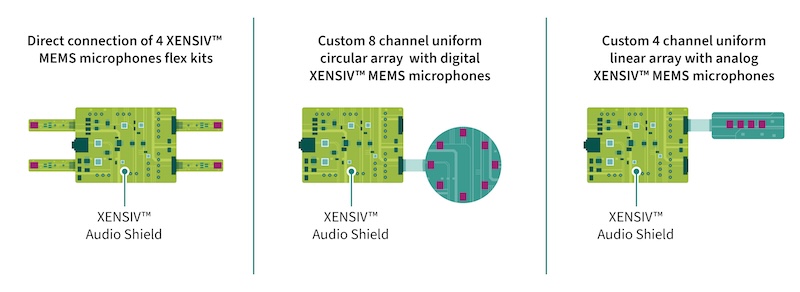
Example array configurations using XENSIV Audio Shield
The bottom side of the PCB has 4 flex connectors for XENSIV MEMS microphone flex evaluation kits. They can be used for both analog and digital microphones.
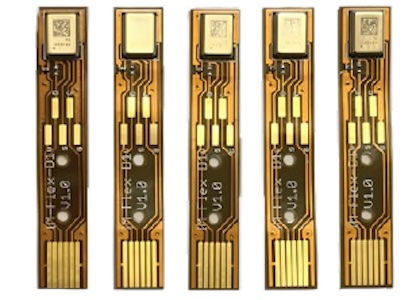
XENSIV MEMS microphone flex kit
The XENSIV Audio Shield includes an Arduino interface, a high-performance audio codec, and a headphone jack, expanding its flexibility for various audio development setups. It is also designed to work seamlessly with selected PSoC 6 Pioneer Kits, including the PSOC 62S2 Evaluation Kit (CY8CEVAL-062S2) and the PSOC 62S2 Wi-Fi Bluetooth® Pioneer Kit (CY8CKIT-062S2-43012). It is fully compatible with ModusToolbox™ and comes with entry-level code examples.
This new shield enables fast evaluation of microphone performance and supports development of advanced multi-microphone applications such as beamforming, machine learning, and audio algorithm design for robotic applications and beyond.
In combination with Infineon´s high-performance XENSIV MEMS microphones like the IM72D128V01, this solution is the perfect development platform for spatial audio and robotic HMI applications.
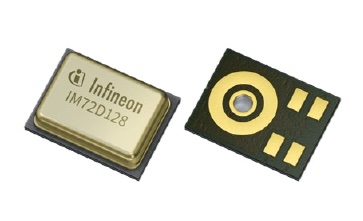
IM72D128 XENSIV MEMS microphone
Enabling Intelligent Human-Robot Communication
High-performance MEMS microphones are more than just components. They are fundamental enablers of intelligent human-robot communication. Their compact form factor, combined with high SNR audio performance and scalability into multi-microphone arrays, makes them a critical building block for the next generation of humanoid and collaborative robotic platforms.
The ability to precisely localize speakers, isolate speech in multi-talker environments, and extract spatial audio information brings humanoid robots measurably closer to human-level acoustic perception. As robotic systems take on increasingly complex roles alongside humans, investment in superior MEMS microphone performance and advanced array architectures will be decisive. It will define which robots can truly hear, understand, and seamlessly interact with the world around them.


